A stainless steel box that packs flat into its bag
The JONES Jr. is the smaller of the two folding grills in Burnhard’s JONES series, a gas grill with one burner for a screw-on cartridge. Burnhard (Burnhard GmbH, Düsseldorf) lists it under item number 946369. The same number appears in the Amazon catalogue as the part number. The manufacturer’s own page does not link to an Amazon listing, so the match between the two shops rests on this number alone.
On Amazon the grill costs approx. €127 (Amazon page on 20.10.2026: €126.75), in the Burnhard shop approx. €159. In our gas grill category it scores 8.2 out of 10 and sits at the extreme mobile end: no wheels, no cabinet, no side tables.
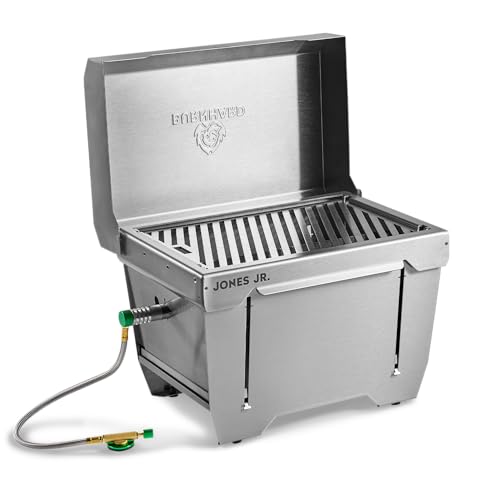
The product image shows a rectangular box of bare stainless steel. The lid is hinged at the back and opens upwards, and underneath sits a grate with closely spaced longitudinal bars. A metal hose with a connector for the cartridge leads out of the left side wall. According to the manual, the cartridge stands next to the grill and not underneath it. The side walls carry vertical fold lines. That is where the housing folds in when packed.
The series comprises three offers: the Jr. on its own, the Jr. in a set with gas bottle adapter (item no. 946831) and the two-burner JONES (item no. 945835). The category page lists the Jr. in exactly one version, with no colour variants and no Black Edition.
Dimensions, weight and what is in the box
Packed, the JONES Jr. measures 8.5 × 33 × 23 cm with lid and 7 × 32 × 22.5 cm without, according to the product page. Set up, it grows to a height of 27.5 cm with the lid closed and 40.5 cm with the lid open; width and depth stay at 33 and 23 cm. The instruction manual gives slightly different figures of 33.2 × 27.4 × 23.6 cm (width, height, depth).
On weight, the sources agree, only the precision differs: 4.4 kg with lid on the product page, approx. 4.42 kg in the manual. For luggage, the second manual figure matters more, 5.5 kg including the bag.
Burnhard gives the cooking area as 28 × 19 cm, which is 532 cm². This matters because you would otherwise estimate it from the outer dimensions: between the 33 cm width and the 28 cm grate lie wall thickness, fold and rim.
According to the manual, one piece of each of these parts is in the box:
- Grease tray
- Grill frame
- Lid
- Grill grate
- Flame tamer
- Stainless steel burner with gas hose and nozzle
- Multitool
- Grill mat
- (Bicycle) carry bag
The bag has carry handles, a shoulder strap and a hook for the luggage rack. According to the product page, the multitool lifts the lid, cleans and lifts the grill grate and opens bottles. Sold separately, it costs €29.90 in the manufacturer’s shop. The grill mat is heat-resistant and, according to the manual, goes under the grill if you have no other heat-resistant surface.
On construction, Burnhard writes: “Grill housing, burner and grate are made of robust stainless steel.” The FAQ on the product page and the Amazon text say V2A.
Burner, gas and ignition
Under the grate sits a single stainless steel rod burner with 3.2 kW, infinitely adjustable. The manual adds a gas nozzle of 0.3 mm and a connection rating of 233 g/h for butane and 229 g/h for propane. The flame tamer sits between burner and grate, and both parts can be removed.
A flame bridge connects the two sides of the rod burner. You light only one side, and according to Burnhard the other catches by itself. There is no piezo ignition. The manual describes lighting with a long lighter or long matches through the ignition and flame-check hole, keeping 30 cm between your face and body and the hole. The lid must be open while you do this.
Burnhard gives a heat-up time of approx. 5 minutes and up to 500 °C, explicitly “with lid” for that temperature. According to the product page, the lid also saves “a lot of energy”.
Gas is not included. According to Burnhard you can get an EN417 screw-on cartridge in most DIY stores, among other places; exactly which one fits is in the FAQ below.
One point in the manual does not add up. The technical data list the gas category as “direct pressure”, while the safety chapter says the grill may only be operated with a pressure regulator and speaks of the “enclosed pressure regulator”. The accessory list also includes a “hose incl. pressure regulator and gas nozzle”. Burnhard nowhere gives a pressure in mbar for cartridge operation.
What the manufacturer does not state
These details are missing from the product page and the manual: a temperature without the lid, a lid thermometer, a number of people for the cooking area, cooking times for food, the stainless steel grade number beyond the abbreviation V2A, the material of grease tray, flame tamer, gas hose, bag and grill mat, the country of manufacture, a minimum clearance above and to the front, a numerical value for the distance to the ground that the manual mentions, and a statement on balconies. We have not evaluated the declaration of conformity with approved countries.
In detail: 3.2 kW on 532 square centimetres
A kW figure alone says little unless you know over how much area it is spread. Divide 3.2 kW by 532 cm² and you get roughly 6 W/cm². The large JONES has two such burners under an area twice as large and so lands at exactly the same value. In this calculation the Jr. is a halved JONES.
What the number does not show: a single rod burner forms one zone. You turn the whole area up or down together. Indirect grilling needs a side without a flame directly beneath it, so that a thicker piece can cook next to the heat. That is not possible here, and Burnhard itself points to the two-burner JONES for this.
The lid is the second lever. According to the manufacturer, the grill reaches 500 °C only when closed, because the heat then builds up under the lid instead of escaping sideways. If you grill with it open, expect less. How much less is not stated anywhere.
Then there is the cartridge. As a general rule for liquefied gas, the pressure in the cartridge depends on temperature, and it cools itself as it evaporates. Butane evaporates less well in the cold than propane, and Burnhard specifies a propane-butane mix for the Jr. If the grill stands by a cool lakeside, the cartridge is therefore more likely to limit output than the burner.
How long does a cartridge last?
According to Burnhard, about 3 hours and 20 minutes at full power. In its words: “easily 10 grill sessions of 20 minutes each at high performance (= full throttle) with 1 full cartridge”.
Checked against the figures in the manual, this does not quite add up. 200 minutes at 233 g/h gives roughly 777 g of butane. The manual, however, allows only cartridges with a fill of at most 550 g, and at the rated value these last on paper for just under 2 hours and 22 minutes, so a good seven sessions of 20 minutes. Both statements can only be right if the burner runs below its connection rating. We would plan with the manual figure and pack one cartridge more for a weekend.
We did not collect what a cartridge costs for this comparison, and Burnhard does not sell them on the product page. If you already own a gas bottle, you can connect the Jr. to bottles via the gas bottle adapter. How cartridge and bottle differ in everyday use is explained in our guide Gas bottle for the grill.
Three alternatives worth a look
| Model | The difference | Price | Our rating | Choose this if |
|---|---|---|---|---|
| BURNHARD JONES Jr. folding grill (this one) | 1 burner with 3.2 kW, 28 × 19 cm, one cartridge | approx. €127 | 8.2 | you want to carry the grill in a rucksack or on a bicycle |
| BURNHARD Jones folding grill | 2 burners with a combined 6.4 kW, 38 × 28 cm | approx. €187 | 8.3 | you grill for more than two people or want to use one side indirectly |
| CADAC Safari Chef 30 HP Deluxe | round, 2 kW, grate, griddle and lid that doubles as a pot | approx. €155 | 8.3 | you also want to fry or cook in a pot on the go |
| Broil King Regal 590 | stationary grill cart with 5 burners on the 11 kg bottle | approx. €1,649 | 9.4 | you want a fixed garden grill for large groups |
The prices come from our price box and change; the rating is an editorial assessment from the data comparison and not a measured value. Our price box lists the two-burner Jones via Amazon, and in the Burnhard shop it is higher (details in the FAQ).
We included the Broil King as a counterpoint. If you are torn between a cartridge grill and a grill cart, you have not really decided yet where you will be grilling.
When the JONES Jr. fits and when another grill does
Number of people. 532 cm² is roughly one A4 sheet (DIN format, as used in Germany and the EU), which has 624 cm². Our assessment: for two people that is enough if you eat in turns. If you grill for four, you will stand at the grate for a long time. In that case we would reach for the two-burner BURNHARD Jones folding grill, which costs approx. €187 in our price box, against approx. €127 for the Jr.
Style of grilling. Sausages, vegetables, flat steaks, anything that cooks directly over the flame suits one burner. A whole chicken or a thick roast that should cook slowly with indirect heat does not.
Cooking instead of grilling. The Jr. has only a grate. If you also want to put a pan or pot on the flame on the go, look at the CADAC Safari Chef 30 HP Deluxe. It has a griddle, a pot stand and a lid that doubles as a pot, at 2 kW instead of 3.2 kW.
Where to set it up. According to the manual, the grill needs a level, stable and fireproof surface, sheltered from wind, with 50 cm clearance to the back and both sides. The cartridge stands next to it and needs its own space. A plastic camping table is therefore not a good base, whereas the supplied grill mat is. Burnhard mentions balconies neither as permitted nor as forbidden. Here your tenancy agreement and house rules decide; our guide Grilling on a balcony explains the legal position.
Transport. At 5.5 kg including the bag, with a hook for the luggage rack, the Jr. is the only model in the table that we would take along on a bicycle. The large Jones weighs almost three kilos more.
If you are still torn between gas, charcoal and electric for travel, the Camping grill buying guide has the criteria, or you can let the Grill finder point you in a direction.
Safety, cleaning and care according to the manual
With gas the wording counts, so here is what Burnhard writes. On where to use it: “Never operate the grill in a building, garage or other enclosed area.” The grill stands outdoors, sheltered from wind, on level, stable and fireproof ground, away from moisture, splashing water and flammable materials. Because it radiates heat, you never place it directly against glass fronts, walls or plants.
Before every use you check the hose and pressure regulator for cracks and damage, the gas connections for breaks, cracks and wear, and the burner for dirt. When connecting, the gas valve is fully closed. You fit the cartridge straight and tighten it only hand-tight, because too much force can damage the cartridge valve and gas line, and the sealing ring must be intact and seated correctly.
Next comes the leak test, repeated after every cartridge change. You spray all sealing points with leak detection spray or brush them with soapy water (1 part soap to 3 parts water) and open the valve. If bubbles rise, the point is leaking: tighten and repeat. If it does not stop then, you close the gas valve and call customer service. According to the manual, you never look for leaks with a flame.
During use the rules are: no aluminium foil in the cooking chamber, never cover the ventilation openings, do not move the grill, and do not leave it unattended either during operation or while it cools. According to Burnhard, you wear protective gloves once the hot components exceed the ambient temperature by 50 °C. For emergencies you keep a bucket of sand or a fire extinguisher suitable for grease fires ready. If grease burns, you switch off the burner and either close the lid until the fire is smothered or let the grill burn out without moving it. Water on a grease fire is forbidden.
If you smell gas, you shut off the gas supply, put out all open flames including cigarettes and open the lid. If the smell remains, you keep your distance, warn bystanders and take the device to a well-ventilated place outdoors with no open fire. You replace the pressure regulator and hose after 10 years at the latest, even without visible damage, and a new hose may be no longer than 1.5 m.
Cleaning is done after every grilling session. First you burn the grill off with the lid closed for 15 to 30 minutes on “HI” and then brush the grate. Once it has cooled completely and the cartridge is removed, you empty and clean the grease tray. According to the manual, grease tray, grill grate, flame tamer and lid may go in the dishwasher, and for intensive cleaning all individual parts except the burner tube and gas hose. The product page adds that you remove the burners beforehand. You brush the burner tube with a copper brush and wipe the bag damp with mild washing-up liquid. More on the procedure for gas grills is in the guide Cleaning a gas grill.
Before storing, everything must be dry, and Burnhard additionally recommends a stainless steel care product. You store the cartridge upright, below 50 °C, in shade and well ventilated, never in the house and never below ground level such as in a cellar or underground car park, because liquefied gas is heavier than air. According to the manual this also applies to empty cartridges, as they still contain residual gas.
Who is it for?
For people who travel on foot or by bike to the lake, the park or the campsite and grill there for themselves and one other person. According to the manual, setup is tool-free: you turn the grill over with both hands and a little swing, the walls of the grill chamber fold down, then you turn the burner tube by 180° anticlockwise until it clicks into place. Burnhard states less than a minute for this.
Taking it down is not so hurried. The manual requires the grill to cool down completely before folding, the gas supply to be closed and the cartridge to be disconnected. If you want to move on straight after eating, you have to allow for this waiting time.
The Jr. is the wrong choice for anyone who wants to cook under a roof when it rains. The manual rules out buildings, garages and other enclosed areas. We would treat an awning as such an enclosed area. The same goes for a snack bar or market stall: according to Burnhard, the grill is not approved for commercial use.