A FRED with six gas controls
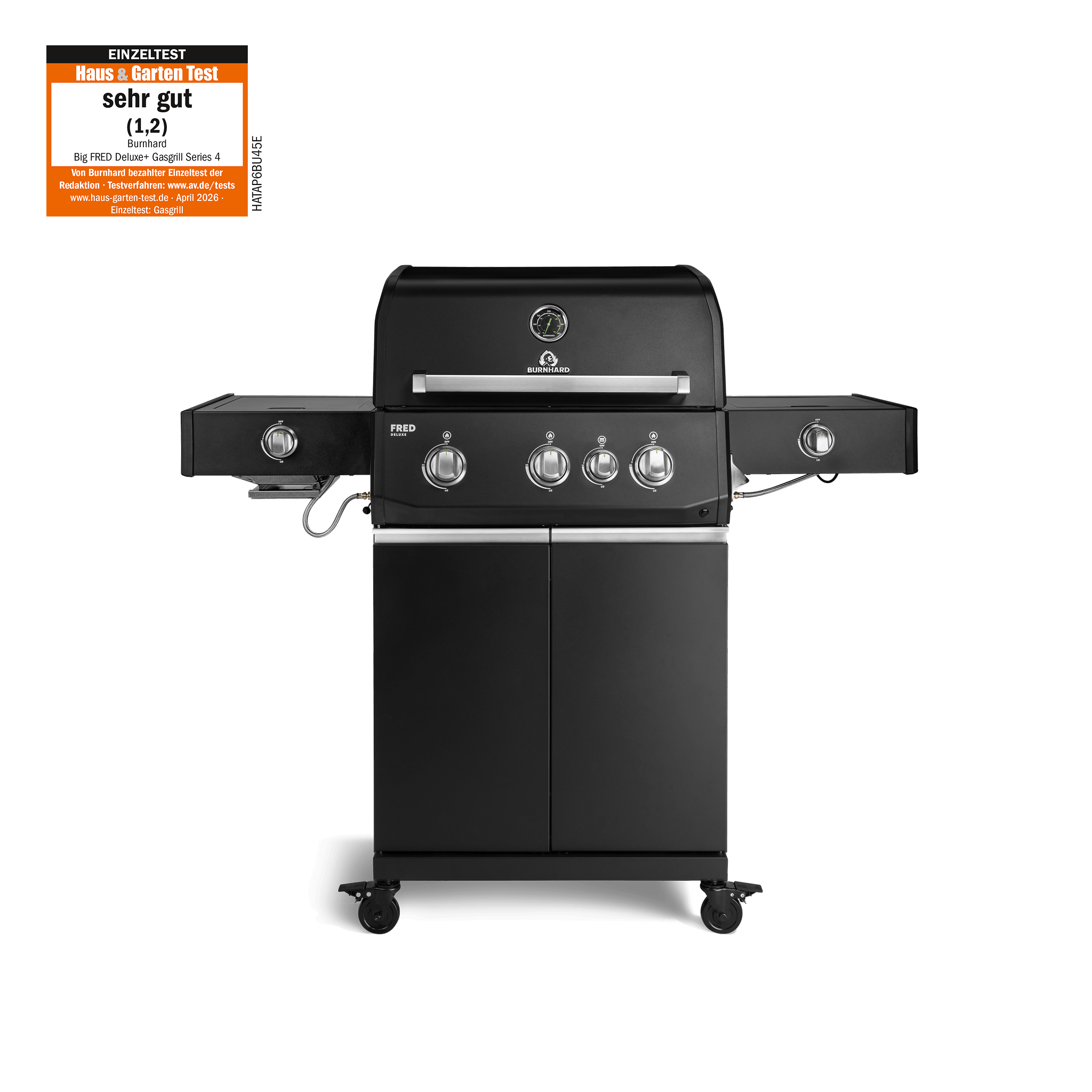
Burnhard builds its FRED Series 4 gas grills in three trim levels: Base, Deluxe and Deluxe+. The Deluxe+ is the fullest of them. In the cooking chamber there are three main burners and an infrared ceramic rear burner, and each of the two side tables holds another gas module: a hob on one side, a second infrared ceramic burner on the other. In the product photo there are four control knobs in the control panel and one at the front of each side table.
In the Burnhard shop the base version costs approx. €929 (on 21.10.2026: €929.00).
There are four variants. The Black Edition has a base cabinet and lid made of cold-rolled steel with a matt powder coating and weighs 49 kg, while the stainless steel version has a stainless steel body and weighs 47.6 kg. Both are available with enamelled cast iron grates or, according to the manufacturer’s page, with stainless steel grates for a €70 surcharge; the item numbers run from 947132 to 947135. According to Burnhard, the cooking chamber itself is made of stainless steel on all Series 4 models, including the Black Edition.
The manufacturer is Burnhard GmbH from Düsseldorf. According to the product page, the grill is designed for up to 10 people. The other gas grills in our catalogue are in the Gas grills category.
What is built into the cooking chamber and the sides
The main cooking surface measures 59.0 × 41.5 cm, which works out at just under 2,450 cm². Above it hangs a fold-down stainless steel warming rack measuring 54.6 × 13.5 cm. Three flame covers, which Burnhard calls W-Shape Flavor Bars, sit above the main burners, and below them a grease tray and a removable stainless steel drip pan catch the dripping fat. There is a thermometer in the lid.
The side panels of the cooking chamber and lid are die-cast aluminium, which Burnhard describes as heat-retaining. Compared with the Series 3, the manufacturer names further changes: sturdier side tables, a hinge band on the lid and a rear burner set flush in the back wall. This rear burner is permanently fitted and cannot be retrofitted to a Base or Deluxe.
On the type of main burners, Burnhard’s own documents contradict each other. The scope-of-delivery list on the product page names both three stainless steel tube burners and three Longlife Premium cast burners. The FAQ on the same page speaks of cast burners in the cooking chamber for the Deluxe+, the data table of “stainless steel tube burners or stainless steel cast iron burners”, and the Series 4 manual lists stainless steel tube burners. We would ask customer service before buying which burner is actually supplied.
The side tables fold down, each carry up to 20 kg and are swapped via quick-release adapters. Unfolded, the grill is 130.4 cm wide, and with the tables folded down 87.4 cm. The depth is 58.4 cm with the lid closed and 64.5 cm with it open, and the height 119 and 148.5 cm. It moves on four rubberised casters with locking brakes.
The delivery also includes two hook rails on the side tables, a magnetic bottle opener, a kitchen roll holder, the smoker box, a weatherproof cover and a pre-assembled gas hose with pressure regulator. Each burner is lit by piezo ignition. The rear burner has its own ignition switch on the side of the control panel, and the matching battery compartment is included. For the side table modules, you turn the control knob on, wait 3 seconds according to the instructions and then keep turning until the piezo ignition triggers.
What Burnhard does not state in any of the three sources, gathered in one place: a maximum temperature for the main burners, cooking chamber or rear burner, a total cooking area in square centimetres, the thickness of the grates, the material of the Flavor Bars, the working height and the country of production. Two details in the manual also do not add up: the dimensions are printed there as 624 × 600 × 1190 “cm”, obviously a unit error, and the rated heat input of the three main burners is given as 11.5 kW, whereas three times 3.75 kW makes only 11.25 kW. And the side table manual lists item numbers 946715 to 946718 as compatible grills, not the numbers of the Deluxe+.
In detail: 20.95 kW that never burn at the same time
The total output is a sum of four items. The three main burners deliver 3.75 kW each, 11.25 kW together. The rear burner has 3.2 kW, the infrared module in the side table 3.5 kW, the hob 3 kW. Added up, that gives the 20.95 kW Burnhard advertises.
For the cooking chamber, less of that counts than the figure suggests. The manual says: “We recommend not operating the rear burner at the same time as the main burners. Otherwise there is a risk of overheating and damage.” The product page warns in the same way that the material could otherwise warp or discolour. In the chamber, then, either the 11.25 kW of the main burners or the 3.2 kW of the rear burner run. The two side table modules work outside the lid and do not heat the grate. That leaves around 4.6 watts per square centimetre for the main grate, calculated from burner output and grate area.
The output figures appear in the manual as rated heat input with the abbreviation Hs. That is the gross calorific value, meaning the energy in the gas including the heat contained in the water vapour of the exhaust gases. A grill cannot use this share in principle, as it leaves with the steam. A kW figure is therefore only useful as a comparison between grills if both manufacturers calculate on the same basis and count the same burners.
A rear burner sits on the back wall and radiates horizontally onto the food turning on the spit in front of it. This is the usual design for a rotisserie. Burnhard ties its operation to two prohibitions: no use in strong wind, and none while greasy food is on the warming rack. According to the product page, you do not need to clean the ceramic stone.
Burnhard states up to 900 °C for the infrared ceramic burner. For the rear burner, the documents give no temperature. In principle, a perforated ceramic plate glows in such a burner and gives off its heat mainly as radiation, which is why it suits hot searing. Burnhard writes that the grates above the ceramic burner do not need a long preheating time. Before first use it should burn in for 20 minutes, and only unmarinated, unoiled food goes on it.
For the lid thermometer, the manual gives a grilling range of 250 to 370 °C. It points out that the display shows the temperature in the cooking chamber and the grate temperature is usually higher. The grill should heat up for approx. 15 minutes with the lid closed, while the side table instructions speak of only 10 to 15 minutes except for first use. You burn in the cast iron grates for 45 minutes on HI with the lid closed before first grilling.
How long does an 11 kg gas bottle last?
With all three main burners on full, roughly 13 hours on paper. That is our calculation from the consumption of 273 g per hour per main burner that the manual gives. With the burners turned down, the bottle lasts longer, with the side table modules shorter.
Together, the three main burners draw 819 g per hour. An 8 kg bottle lasts just under 10 hours under this load, a 5 kg bottle a good 6 hours. The rear burner alone needs 233 g per hour, and with it an 11 kg bottle would last around 47 hours on paper. The hob is at 218 g, the infrared module at 255 g per hour. If the main burners and both side tables run at full at the same time, that is 1,292 g per hour, and the 11 kg bottle is empty after around 8.5 hours. All six burners at once would come to 1,525 g, and so above the 1.5 kg per hour the pressure regulator is designed for. According to Burnhard’s own rule on the rear burner, however, this combination does not occur at all.
Three bottle sizes fit in the base cabinet, and the manual gives them with dimensions: 5 kg with 420 mm height and 230 mm diameter, 8 kg with 505 mm and 11 kg with 600 mm height, both with 300 mm diameter. The bottle should stand centrally on the struts so it does not tip, and before you move the grill, you take it out. You lay the hose so that it does not touch the cooking chamber and does not run under the drip pan.
One restriction is not on the product page. There it says you store your bottle “directly in the grill”. For the time when it is not in use, the manual says something different: “When the appliance is not in operation, the gas bottle must be disconnected.” And: “The gas bottle must be stored outside the grill base cabinet.” The cabinet is therefore a place for the connected bottle during grilling, not a storage space.
The grill runs on butane (G30) or propane (G31); natural gas is ruled out, and you buy the bottle separately. The supplied pressure regulator is fixed at 50 mbar and complies with DIN EN 16129 and DIN EN 16436-1 (standards that apply in Germany and the EU); the hose is at most 1.5 m long. The appliance class is I3B/P(50). What to watch out for when buying a bottle is covered in our guide Gas bottle for the grill.
Accessories and running costs
The cover and smoker box are included, a rotisserie spit is not. For the rear burner you therefore have to buy it separately before the burner serves its actual purpose. According to Burnhard, you fill the smoker box with pellets or smoking chips and place it directly on a W-Shape Flavor Bar.
The cover is made of UV-resistant polyester, flame-retardant and with a water-repellent coating. You only put it on once the grill has cooled down completely.
According to their instructions, the two side table modules are intended only for the FRED Series 4 and are connected to the main grill exclusively via the Quick Connect. You may only mount them with the gas bottle closed, and fit or remove them only with the grill switched off. According to Burnhard, the Base and Deluxe can be upgraded later with an upgrade set or individual accessories, with the exception of the rear burner.
There are few verifiable running costs. The surcharge for stainless steel grates is stated above. Gas prices per bottle vary by retailer and region, so we leave out a euro calculation. To keep the nozzles clear, Burnhard includes three cleaning needles of 0.7, 0.8 and 0.9 mm.
Setting up, connecting, cleaning: what the instructions require
The manual sets out precise requirements for the location. The grill may only be used outdoors, never in a building, garage or other enclosed area. It should stand sheltered from wind on a level, stable and fireproof surface, away from moisture, splashing water and electrical cables. A minimum distance of 1.5 m applies to all combustible materials, and 7.5 m to flammable liquids. Burnhard requires 100 cm to objects of any kind at the back, 100 cm to the side and 200 cm above, and the grill never belongs directly against glass fronts, walls or plants, because it radiates heat. Before each use you secure it with the locking brakes, and you protect the gas bottle from strong sun. For the side table modules, their instructions repeat the same distances.
Burnhard makes no explicit statement about balconies. You can work it out, though: with the side tables unfolded and 100 cm on each side, the grill needs a clear width of a good 3.3 m. You cannot fold the tables down during operation, as the instructions forbid it while a burner is running. On a typical rented balcony, in our assessment, this will not work out, and your tenancy agreement and house rules apply on top. More on this in the guide Grilling on a balcony.
Before each use, you check the hose and pressure regulator for cracks and damage and the burners for dirt. According to the manual, the leak test works like this: spray all sealing points with standard leak detection spray or brush them with soapy water in the ratio of 1 part soap to 3 parts water, then open the bottle valve. Small bubbles indicate a leak. You then retighten the nuts on both connection sides by hand and repeat the test; if bubbles keep rising, you close the valve and go to a specialist retailer. This is repeated after every bottle change, and for the side tables additionally between the quick coupling and the connection on the grill.
The lid must be open when lighting, and this applies equally to the side table modules. You never lean over the open grill while doing so. Charcoal, briquettes and lava stones have no place in a gas grill, and neither do aluminium foil or an aluminium tray on the grease tray or drip pan. According to the manual, you wear protective gloves as soon as hot components exceed the ambient temperature by 50 °C. A running grill is never left unattended, and after grilling you close the bottle valve.
The cleaning rules appear in the manual in this order: clean the gas grill after every use, without flammable cleaning agents and only after removing the gas bottle. Wait until it has cooled down, pull out the drip pan and dispose of the fat in an environmentally friendly way. You wipe stainless steel surfaces and stainless steel grates with a damp cloth or rinse them hot; according to Burnhard, stainless steel grates may also go in the dishwasher. To burn off residues, you set the main burners to HI and let them run for 15 to 30 minutes with the lid closed until no more smoke rises. Common grill cleaners are only conditionally suitable for the aluminium parts, and a microfibre cloth can scratch stainless steel.
Two parts need their own rules. You must “under no circumstances” treat the ceramic stone of the infrared module in the side table “with water and/or cleaning agents”. The cover of the rear burner can be removed and cleaned in the dishwasher. Every three to four months and after long periods of standing, Burnhard provides for a thorough clean, in which you check the venturi tube at the end of the main burners, which has an insect and spider guard.
These three alternatives are worth a look
| Model | The difference | Price | Our rating | Choose this one if |
|---|---|---|---|---|
| BURNHARD FRED Deluxe+ (this one) | 3 main burners and rear burner, infrared module and hob in the side tables | approx. €929 | 8.5 | you want to use the rotisserie, hob and infrared zone all together |
| BURNHARD FRED Deluxe | Infrared burner in the cooking chamber instead of the side table, without cover and smoker box | approx. €719 | 8.3 | you want the rear burner and hob but do not need the cover and smoker box |
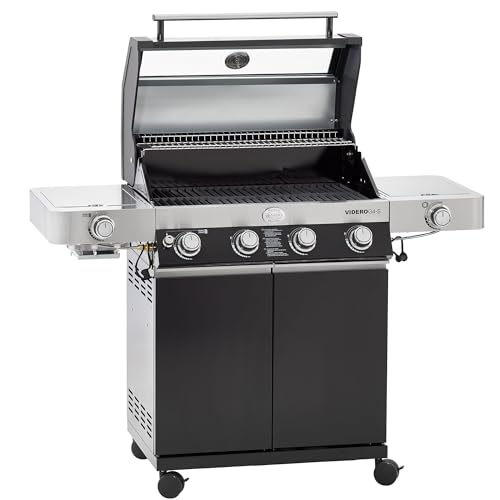
| Rösle Videro G4-S Vario+ | 4 main burners on 70 × 45 cm, no rear burner | approx. €849 | 9.2 | you mostly grill directly for many people and do not use a rotisserie |
| Broil King Regal 590 | 5 main burners, rotisserie spit with motor included | approx. €1,649 | 9.4 | your budget stretches beyond €1,600 and the spit should come with it |
The price of the Deluxe+ comes from the Burnhard shop (21.10.2026); the others are guide values from our price boxes, as of September 2026, and for the FRED Deluxe the Amazon price. The rating is our editorial assessment from the data comparison; we have not measured anything.
When the Deluxe+ fits and when another grill does
The first question is the rotisserie. If you never want to roast on a spit, you pay for a rear burner on the Deluxe+ that you do not need. If you might want to at some point, you should decide now, because the rear burner cannot be retrofitted to a FRED Base. We have the Base itself in our price box at approx. €519; our review of it is at FRED Base.
Second, the layout. On the FRED Deluxe the infrared ceramic burner sits in the cooking chamber, on the Deluxe+ in a side table, and the chamber keeps three main burners. Both models have the hob and rear burner. The Deluxe+ also adds a cover, smoker box and kitchen roll holder, while the Deluxe instead has a cutting board with GN container. The FRED Deluxe is at approx. €719 in our price box, the Deluxe+ at approx. €929. If fewer main burners and individually bought accessories are enough for you, we would go for the Deluxe; if you want three full main burners and a separate infrared zone, the Deluxe+ belongs on your list.
Third, the area. The Rösle Videro G4-S Vario+ stands at approx. €849 in the price box (the Deluxe+ at approx. €929) and, according to our research, has a main area of 70 × 45 cm, which works out at 3,150 cm² against just under 2,450 cm² for the Deluxe+. For someone who mainly grills directly for a large group, we consider it the better choice. The Rösle has no rear burner.
Fourth, the space. The required clear width from the section on setting up practically rules out small balconies. Anyone who often has to move the grill will also find it hard: before every change of position, the manual requires you to switch the grill off, close the bottle valve and unscrew the bottle from the hose, and nothing is moved during operation.
Fifth, the budget. According to the price box, the Broil King Regal 590 is at approx. €1,649 and already brings the rotisserie spit with motor. With the Deluxe+ (approx. €929), €109 for the spit comes on top.
The Deluxe+ is the wrong choice, in our assessment, for two groups: for anyone who only grills sausages and steaks on the main grate and touches neither the spit nor a pot nor the infrared module, and for caterers or clubs, since Burnhard does not provide for commercial use.