The Smokey Joe Premium is Weber’s small kettle grill for charcoal, 37 cm in diameter, built for the table, the pitch or as a second grill next to a large one. This page covers the black version with Weber item number 1121004. The same number carries the ASIN B002S2S9PQ in the Amazon catalogue, and that field is the only way to check the match, because Weber’s product page never links to Amazon. The Slate Blue colour is technically identical, and we list it separately as the Weber Smokey Joe Slate Blue. In our overview of charcoal grills it sits among the small, portable units.
We have not grilled anything on it, and we have not handled it either. What is written here comes from Weber’s product page (retrieved on 21.10.2026), from assembly instructions 54233, from Weber’s general instruction manual for charcoal grills (document 71150, without a model name, called the general instructions below), from an English Smokey Joe booklet for Australia and New Zealand, from the warranty page and from the Amazon catalogue. Calculations and ratings of our own are marked.
What is in the box and what it is made of
Weber lists five things: a solid steel charcoal grate, bowl and lid in porcelain enamel, a heat-protected lid handle, a measuring cup for briquettes and the Tuck-N-Carry lid lock. The cooking grate is missing from this list, even though the product page describes it elsewhere, as a grate made of coated steel. In the parts list of the assembly instructions it is included anyway.
Porcelain enamel is a layer of glass fused onto the metal at high temperature. Steel lies underneath; that is stated in the general instructions for every Weber charcoal grill, while the Smokey Joe page itself leaves the base material open. Weber promises that the coating protects against rust-through, cracking and flaking and withstands high grilling temperatures. On top of that comes the manufacturer’s claim that bowl and lid store heat for a steady temperature. For the handles, Weber names glass-fibre-reinforced nylon, one piece.
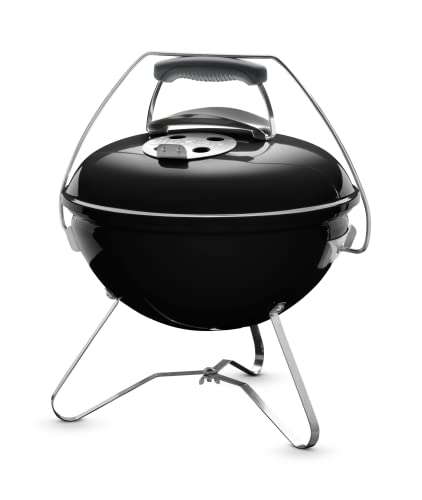
The product photo shows a round bowl with a domed lid on thin, silver wire legs. On top of the lid sits a round vent plate with three openings and a small slider. A wire bracket with a grey grip stretches over the lid and attaches to the side of the bowl: that is Tuck-N-Carry. According to Weber’s description, the lid locks in place with it, so you can carry the grill by the handle. If you lower the bracket, it becomes a lid holder, and the lid does not lie on the ground while you grill.
With the lid closed, the grill measures 43.2 cm in height, 36.1 cm in width and 42 cm in depth according to Weber, at 5.48 kg. The Amazon catalogue arrives at the same dimensions after converting from inches. Its weight field, on the other hand, is evidently broken: converted, around 4.5 grams.
Assembly instructions 54233 are a pure sequence of pictures in seven steps, showing a screwdriver as the tool. Three steps concern the legs, which are attached with a screw, toothed washer and wing nut; according to these instructions they are therefore not foldable, as the old version of this page claimed. After that you hook the lid lock onto the bowl, insert the ash catcher tray, charcoal grate and cooking grate, screw on the lid handle and let the lid lock in place. Here too the old version was wrong: there is an ash catcher, and the parts list calls it the ash catcher tray. The document is dated August 2012 and gives the model as “Smokey Joe Premium EURO”.
In detail: two vent positions, three different numbers
A kettle grill regulates its heat through air. Oxygen flows to the embers at the bottom, and hot air draws off at the top. If you narrow the openings, the charcoal burns more slowly; if you close them completely, it is smothered. Weber describes it for the Smokey Joe like this: you regulate the heat with the lid vent without lifting the lid, and when it is fully closed, the oxygen supply is cut off and the charcoal goes out.
How many vents there are depends on where you read it up. Weber’s detail table lists 3 rustproof aluminium vents, without splitting them between lid and bowl. The Amazon catalogue speaks of 2 vent sliders. The assembly instructions list a lid vent and a vent on the bowl as separate components. What is certain, then: there is an air opening at the bottom of the bowl. The earlier statement that the Smokey Joe lacks a bottom vent is wrong according to Weber’s own documents. In the photo you only see the lid plate, because the camera shows the bowl from diagonally above.
The Australian booklet requires the upper and lower vents to be fully open before the lid goes on, otherwise the fire goes out. The lower ones must not be clogged with ash or briquettes. The Smokey Joe is designed for grilling with the lid closed, and you should lift it only to turn the food, because a lot of heat escapes then. The general instructions add a move that is often overlooked: take the lid off to the side rather than straight up, so that the suction does not pull ash onto the food. Aluminium foil in the bowl blocks the air supply; for dripping meat juices, use a drip pan when grilling indirectly.
A temperature display is not part of the features, at least none is in Weber’s list, and none can be seen on the lid in the photo either. So you steer by vent position, amount of charcoal and the clock.
How much fits on 948 cm²?
According to Weber, six burger patties from the Weber hamburger press. Weber gives no number of people. Our assessment: for two, the area is comfortable, for three it is tight, and from four people you grill in rounds.
The 37 cm is the diameter of the unit, not of the cooking area. By our calculation, a circular area of 948 cm² corresponds to a diameter of around 34.7 cm. The old version of this page calculated with the full circle of 37 cm and arrived at about 1,075 cm²; that is a good 13 percent above Weber’s figure and does not come from the manufacturer.
If you count two burgers per head, one full grate is enough for three people in one go, not counting buns and vegetables.
The cooking time decides which method suits. Directly over the embers, according to the general instructions, you grill small, tender pieces that need less than 20 minutes: hamburger patties, steaks, chops, skewers, fish fillets, sliced vegetables. Larger pieces belong to the indirect method, in which the charcoal lies on one or on both sides and the food over the area without charcoal. For the Smokey Joe, Weber makes no statement of its own on this. We are sceptical: on just under 35 cm of diameter, there is little grate left beside a pile of charcoal for a zone without embers, and we would not plan a whole chicken on it. How the two zones work in principle is explained in our guide to direct and indirect heat.
From lighting to the first food
According to the general instructions, the simplest and most thorough way to light is with a Rapidfire chimney starter or with firelighter cubes, both to be bought separately. Methylated spirits, petrol, alcohol and other volatile substances are prohibited, Weber advises against lighter fluid, and other firelighters must comply with EN 1860-3 (a standard that applies in the EU). If liquid has run through the bowl ventilation, you remove it before lighting. No lighter fluid goes onto hot or warm charcoal.
The charcoal always lies on the charcoal grate, never directly on the bottom of the bowl. You measure how much with the measuring cup from the box. The Australian booklet gives about 20 Weber briquettes as a guideline for most dishes; more fuel gives more heat, less correspondingly less.
The charcoal is ready when a white layer of ash covers it. Firelighter cubes must have burned away completely by then. With Weber briquettes, according to the booklet, that takes up to 25 to 30 minutes, after which the grate and lid go on and the grill preheats for 5 to 10 minutes. The general instructions set 10 to 15 minutes for preheating and then send the stainless steel bristle brush over the grate. Added together, we arrive at 30 to 45 minutes between the match and the first sausage; we would plan with the longer value.
Before the very first use, you let the fuel glow red with the lid closed for at least 30 minutes. The 260 °C under the lid that the general instructions give for fully glowing charcoal applies to all Weber charcoal grills and is not a value for this model. Whether briquettes or lump charcoal suit your evening better is covered in the guide charcoal or briquettes.
Care, transport and safety according to Weber
These warnings appear on the product page, in full:
- Use outdoors only.
- Read the manual before use.
- Exposed parts can get very hot.
- Keep children away.
- Do not use methylated spirits or petrol to light or relight.
- Risk of carbon monoxide poisoning.
- Do not operate the grill indoors, only outdoors.
In the section before lighting, the general instructions require a well-ventilated place outdoors, no garage, no building and no other enclosed area, a safe, level surface and at least 1.5 m clearance from any combustible material. Weber expressly counts wood and treated wooden decking, patios and verandas as combustible. Elsewhere in the same instructions further prohibitions are added: do not place it on glass or combustible surfaces, do not grill under a combustible structure, not in strong wind, never without the ash catcher and only once all parts are fully assembled. The complete list is in document 71150 and is longer than this paragraph.
On carrying: Weber writes that the grill gets very hot and must not be moved during operation, and the Australian booklet says the same for the hot grill. You should only stow it once ash and charcoal have gone out completely. Our reasoning: the carry bracket is meant for the cold grill, and it only goes into the boot once nothing is still glowing. To put it out, according to the general instructions, you close the bowl ventilation and the air flap on the lid and leave the lid on the bowl. You never tip out hot charcoal where people walk or where something could catch fire.
You clear the ash out of the bottom of the bowl and the ash catcher tray before every grilling session, but only once the charcoal has gone out completely and the grill has cooled; ash left behind slows the air supply. According to Weber, varnish-like marks inside the lid are fat that has turned into carbon, and they come off with the stainless steel brush. With the grill still warm, not hot, you can wipe the inside of the lid with kitchen paper. Where acid rain, chemicals or salt water promote surface rust, you wipe the outside with warm soapy water, rinse and dry thoroughly. Sharp objects and abrasives have no place on the surfaces.
Price, accessories and warranty
On Amazon the price on 21.10.2026 was approx. €112 (Amazon page on 21.10.2026: €112.35). That is the cheapest new price from a marketplace seller, because Amazon itself did not offer the grill that day. In the Weber shop the price may differ; shipping there was free from an order value of €49 on 14.10.2026.
As accessories, Weber shows on the product page the Small Rapidfire Chimney Starter (item 7447) for €19.99, the Premium Barbecue Tools Compact (6645), reduced from €47.99 to €40.79, and two firelighters without a price, Lighter Cubes (7417) and 12 pc Rapidfire Fire Starters (7480). The page also shows the Weber Connect Smart Grilling Hub (3201) for €149.99; it does not say whether it is of any use with this grill. You need briquettes and gloves anyway.
Weber graduates the warranty by component. Bowl and lid have 10 years against rust-through or burn-through, plastic parts 5 years, with fading and discolouration excluded, and all other parts 2 years. In our reading, the cooking grate and ash tray fall under the other parts. The same table has a line on the One-Touch cleaning system, which comes to nothing for this grill, because according to the parts list it has only an ash catcher tray. The warranty does not cover ordinary wear; Weber names surface rust, dents and scratches as examples. A scratch in the enamel where rust forms is therefore not a warranty case, but a rusted-through bowl is. The two-year statutory warranty in the EU remains unaffected.
What Weber leaves open
On these points, we found no figure or statement that applies specifically to the Smokey Joe Premium, either on Weber’s German pages or in the instructions or the Amazon catalogue:
- Output, maximum temperature and heat-up time of this model
- Burn time of a charcoal load; the quantity tables in the German instructions only start at a grill diameter of 47 cm
- How the 3 vents are split between lid and bowl
- Material of the legs, lid lock and ash catcher tray
- Diameter of the cooking grate and charcoal grate, bar spacing
- What the dimensions refer to, because a width of 36.1 cm is below the 37 cm diameter
- Suitability for smoking or two-zone grilling on this area
- A statement on balconies, rented flats or house rules
- Country of manufacture and market launch of the black version
- A German instruction manual of its own for the Smokey Joe alone; only the assembly instructions are linked
What else comes into question?
| Model | The difference | Price | Our rating | Choose this if |
|---|---|---|---|---|
| Weber Smokey Joe Premium (this one) | round bowl, 948 cm² according to Weber, lid locks in place for carrying | approx. €112 | 8.1 | you mostly grill for two and take the grill along cold in the car |
| Weber Go-Anywhere Charcoal | rectangular bowl, 1,035 cm² according to Weber, legs hold the lid shut during transport | approx. €95 | 8.3 | a flat box fits the boot or shelf better than a kettle |
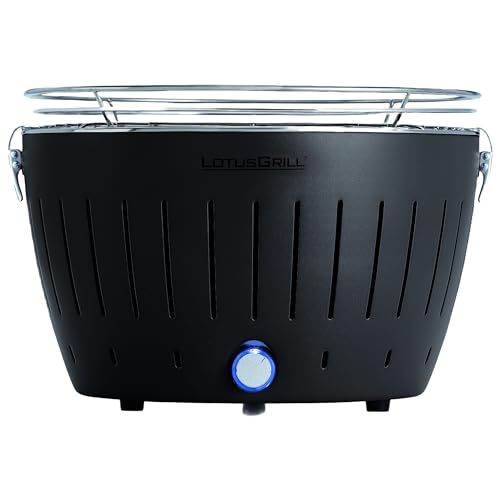
| LotusGrill G340 | fan on batteries or USB, ready for use after approx. 3 to 4 minutes according to the instructions | approx. €179 | 8.8 | a quick start at the table matters more to you than a grill without electricity |
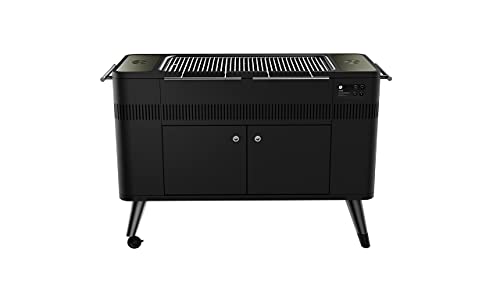
| Everdure HUB II | grill cart with electric charcoal ignition (1450 W), 3,270 cm², rotisserie up to 40 kg | approx. €2,503 | 9.4 | you want a permanent main grill with a socket in the garden |
The prices are guide values from our price boxes, not daily prices, and the rating is our editorial assessment based on manufacturer data. The sources differ: the Smokey Joe Premium is in the table with the marketplace price of 21.10.2026, the other units with the value from our price box.
Who it suits and when another grill is better
The Smokey Joe costs time above all. Three quarters of an hour from lighting to grilling suits a Saturday at the lake, not a quick dinner after work. If you want that, you are better served by gas or electric, or by the LotusGrill from the table, whose fan brings the charcoal up to heat in a few minutes; in our price box it is approx. €179 and needs batteries or a USB power supply.
Second question: how do you carry it? The kettle with its bracket cannot be laid flat. The Go-Anywhere has 87 cm² more area and at 6.78 kg weighs 1.3 kg more (both according to Weber, difference calculated by us), but stacks better as a flat box between bags. Neither of the two is built for hikers with a rucksack. For the campsite, it is worth first looking at our guide buying a camping grill.
On the balcony, you first check the tenancy agreement and house rules, because charcoal smokes and Weber itself makes no statement on it. On top of that comes the 1.5 m clearance from combustibles from the safety section, which on many balconies already fails because of wooden decking or privacy screens. What applies legally is summarised in the guide grilling on a balcony.
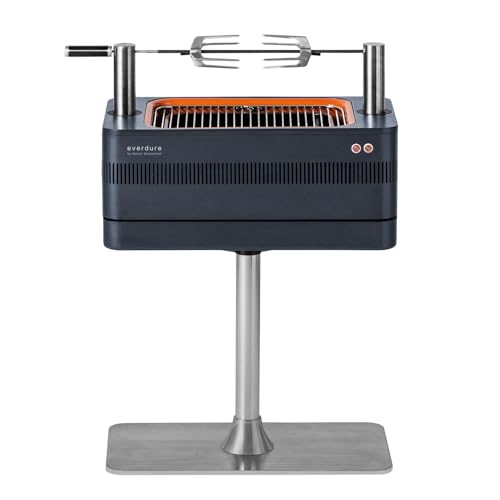
In our assessment, the Smokey Joe Premium is wrong for anyone who regularly grills for four or more people, who wants to cook low and slow or smoke, or who expects a temperature display on the lid. If you want a grill for the whole season in the garden, you are better off with a kettle grill of 47 cm or more. We would only consider a grill cart like the Everdure from the table if there is a socket at the grilling spot and the budget runs to four figures. If you are unsure which type suits you, the Grill Finder sorts by fuel and size.
For two people who occasionally grill with charcoal at the weekend and pack the grill into the car for it, we would buy it, in whichever colour is cheapest at the moment; technically the versions do not differ according to Weber.