A gas grill without a stand: what the Platinum Compact is
The TAINO Platinum Compact is a gas grill with no legs and no trolley. You put it on a table and connect it to a gas bottle. In the manufacturer’s shop it carries the article number 93512, and in the manual and on the rating plate it is called COMPACT 2.0 S. The Amazon listing has the same part number, so it is the silver version from the manufacturer’s shop.
The company responsible is Clic-Trade GmbH in Cologne. By its own account, the TAINO brand went online in 2015 and is still sold only on the internet; according to the rating plate, it is manufactured in China. The product page lists terrace, balcony, park and campsite as places of use.
In our price box the grill is listed at Amazon at approx. €150. In the manufacturer’s shop, the standalone unit cost €149.99 on offer on 21 October 2026, regularly €179.99. Among the gas grills on topgrillreviews it counts as a tabletop unit, and with 7.9 points it sits just behind the three alternatives in the table further down in our rating.
Box, lid, two knobs: the construction
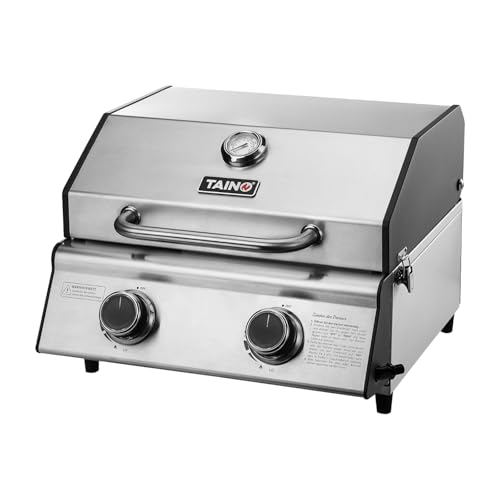
In the product photo, the Platinum Compact is a rectangular box. The lid takes up the whole top, with the thermometer in the middle and a transversely mounted handle bar below it. The two knobs are at the front, a latch is visible on the right-hand side, and small feet are underneath. Side tables are missing, and neither the product page nor the parts list mentions shelves or a side burner.
According to the manufacturer, the body and grill grate are stainless steel. Add-on parts and trim strips are made of plastic, steel and heat-resistant powder-coated steel. The lid is double-walled, and the thermometer shows Celsius and Fahrenheit. With two latches you can secure the lid, and then you carry the whole grill by the handle. This comes with a warning from the manual: the dark area of the handle gets hot during operation and must not be touched then.
TAINO gives the overall dimensions as approx. 45.5 × 45.5 × 34.5 cm (length, width, height) and the weight as approx. 10 kg. The Amazon catalogue arrives at the same values when converted. The grilling surface measures approx. 39 × 33 cm, which works out at around 1,287 cm².
There is not much to assemble. According to the parts list, the grill consists of a lid with thermometer and two lid screws, handle, grill grate, rear wall with attachment, grease tray, front panel, gas pipe, two gas valves with knobs and control panels, two stainless steel burners with clamping springs and burner covers, and four rubber feet. You screw on the feet, slide in the grease tray and place the burner covers and grate on top. The screws are only meant to be fully tightened at the end, and because some edges are sharp, TAINO advises wearing work gloves. If a burner has to come out later, you squeeze the clamping spring at the back next to the burner end, push the burner to the side and pull it out.
What remains open after the product page, manual and Amazon catalogue is collected here:
- the maximum temperature in grilling mode (only a target temperature for burning in is given) and the heat-up time
- the gas consumption per burner, only the total figure is documented
- the material of the lid, grease tray and burner covers in detail, and the grade of stainless steel
- the dimensions with the lid open
- the number of grates: the parts list counts one grill grate, while the accessories page speaks of stainless steel grates in the plural
- spare parts for burners, valves and thermometer; in the shop we found only the cover and cast iron grate as accessories
- a number of people or portions for the surface
- the year of market launch (the declaration of conformity is dated 29 March 2019, which says little about the market launch)
In detail: 4.4 kW, 321 grams per hour and the lid
The product page lists two stainless steel main burners at 2.2 kW each. The rating plate in the manual clarifies: 4.4 kW nominal heat input, based on the gross calorific value Hs, at a gas flow of 321 g per hour. The two figures fit together. Butane has a gross calorific value of around 13.7 kWh per kilogram, and 0.321 kg times 13.7 gives 4.4 kW.
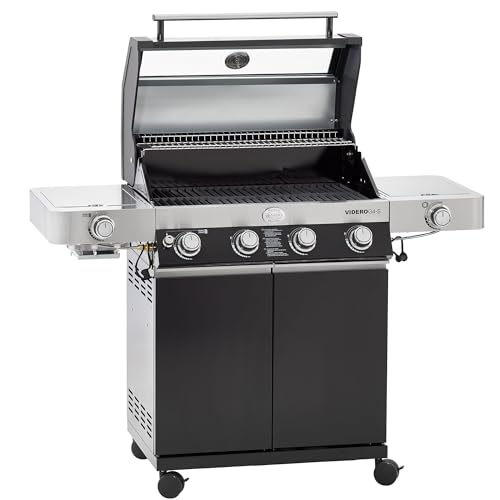
Why the Hs suffix matters: if a manufacturer calculates with the net calorific value Hi, the same amount of gas comes out around 8 per cent weaker on paper. Kilowatt figures from different brands can therefore only be compared if it is clear what they refer to. Grams per hour are less ambiguous. According to its instructions, the tepro Chicago uses a maximum of 437 g per hour on approx. 47.5 × 35 cm of grate. Per square centimetre, that is around 0.26 g per hour for the tepro and around 0.25 g for the Platinum Compact. In terms of gas per area, the two are almost level; the tepro simply has more area and correspondingly more burner output.
The rating plate has gas category I3B/P(50) ticked, valid for Germany, Austria, Switzerland, the Czech Republic and Slovakia. The nozzle table specifies main burner nozzles with a diameter of 0.65 mm for 50 mbar, 0.68 mm for 37 mbar and 0.72 mm for 30 mbar. A grill of this category therefore belongs on a 50 mbar regulator.
Ignition is by piezo ignition in the knob, separately for each burner: open the lid fully, push the knob in and turn it anticlockwise to HI. The knobs are labelled OFF, HI and LO and are infinitely adjustable, and according to the manual the burners run in any combination. Switching off is in reverse order: first close the valve on the gas bottle, then turn the knobs clockwise to OFF.
This also allows indirect grilling, which TAINO expressly mentions on the product page: one burner on, the food over the switched-off one. A restriction from the manual comes with it. At maximum output, the lid may stay closed for no more than 10 minutes. For anything that cooks longer under the lid, that means in our reading: one burner, and not turned up fully. On a grate of this size, the indirect zone is also right next to the flame, and we would not plan a larger roast on this grill.
Does the Platinum Compact also run on a gas cartridge?
According to TAINO’s documents, no. The product page and manual describe only operation on a gas bottle, connected via a flexible hose with a screw connection and a suitable low-pressure regulator. A cartridge adapter does not appear in the manufacturer’s accessories.
According to the manual, the bottle may be at most 600 mm tall and must stay under 300 mm in diameter. Examples given there are 5 kg (505 mm tall, 225 mm diameter), 8 kg (460 mm, 298 mm) and 11 kg (600 mm, 330 mm). At 330 mm, the 11 kg bottle is over the manual’s own limit. The manual does not clarify which of the two values applies, and before buying an 11 kg bottle we would ask TAINO service. The bottle is to be positioned at least 60 cm from the grill.
Regulator and hose are not included with the standalone unit; the scope of delivery is only the grill and the assembly instructions. According to the manual, the regulator must comply with EN 16129 in its current version and with national regulations. You must never connect an unregulated liquefied gas container. What to bear in mind in general about bottle and regulator is covered in our guide to the gas bottle for the grill.
The manual describes the connection step by step, and because of the risk of explosion, only outdoors and on a cooled-down unit. With the bottle valve closed and the protective caps off, place the hose’s union nut on the screw fitting on the grill and carefully tighten it with a spanner. On the pressure regulator, likewise with a spanner. The regulator itself, by contrast, you screw onto the bottle without tools so the seal stays intact. One step in between talks about a trolley or base cabinet for the bottle, which this tabletop grill does not have at all.
Before first use, TAINO recommends a leak test. For this, the grill must be fully assembled and the bottle full, and smoking and naked flames are off limits. You mix a soap solution of one third soap and two thirds water (the illustration next to it shows half and half), set the knobs to OFF, connect the bottle and open its valve. Then you apply the solution with a brush or cloth to all connections and hoses. If bubbles form, there is a leak there: close the valve, tighten, and repeat until no more bubbles appear, and close the valve again at the end. The grill must not be run with a leak, and you shut off the gas supply immediately. According to the instructions, you check the regulator and hoses before every use and replace them if they are excessively worn, and while the grill is burning, you do not undo any gas connections.
For running costs, a lower limit of burn time can be calculated from the flow rate. With both burners at full output, a 5 kg bottle lasts around 15.5 hours on paper, an 8 kg bottle around 25 hours. On a lower setting it lasts longer, and by how much depends on how you use it.
Where it may stand: balcony, surface, clearances
TAINO expressly names the balcony as a place of use. What the manual requires for the location limits this. The grill is intended exclusively for outdoor use and may only be used in well-ventilated places, and you check local regulations beforehand. It does not belong under combustible surfaces or roofs, and the area above must be clear. In enclosed or habitable spaces, with houses, tents, caravans, motorhomes and boats given as examples in the manual, it is prohibited because of carbon monoxide, and likewise in the garage.
It needs a stable, heat-resistant surface on which it can neither wobble nor tip over, and it must not stand on wooden decks. You do not store flammable items near it, and children and animals should not be able to get close. The unit must be protected from weather and moisture.
On clearances, the manual contradicts itself. Page 6 gives at least 95 cm from combustible materials, the same page has a graphic with approx. 60 cm to the rear, approx. 50 cm to the side and approx. 100 cm upwards, and page 17 then has a recommendation of 0.5 to 1.0 metres. We would plan with the strictest values, meaning almost one metre from anything that burns and one metre clear above. On a balcony with an awning or wooden floor, that practically rules out the Platinum Compact. What tenancy law and house rules say about gas on a balcony is covered in our guide to grilling on a balcony.
While it is running, you never move it and never touch it with bare hands, because the housing and add-on parts get very hot. For grilling, TAINO requires grill or oven gloves and suitable clothing, specifically closed shoes, long sleeves and trouser legs, and no loose clothing, sleeves or scarves. When opening the lid, you keep your hands, face and body at a distance, because hot steam can escape.
Burning in, burning off, maintenance: what the instructions require
From the factory, the surface is pre-treated with vegetable oil as protection from dirt in transit. Before the first grilling, you clean it with a soft cloth and soapy water. Then comes a step that the manual says is mandatory: burning in. You light the burners one after another on the lowest setting, after approx. 10 minutes turn them all to the highest, and let the grill run at approx. 220 to 250 °C for around 20 to 25 minutes. Afterwards you turn it down for approx. 15 minutes. All together this takes 40 to 45 minutes. Because production residues burn off in the process, you should avoid standing in the smoke if possible. During burning in, you may rub the grate with heat-resistant oil, with rapeseed or sunflower oil recommended.
After every use, all grease residues must be removed, which the manual justifies with fire risk. You take excess grease out of the grease collection tray after cooling, and you do not line the bottom of the grill tray with aluminium foil, sand or grease-absorbing substances.
For burning off, the manual gives two versions. In one, you let each burner run for approx. 15 to 20 minutes without food after grilling. In the other, the grill burns on the highest setting with the lid closed for 10 to 20 minutes until no more smoke rises, and never unattended. The second version clashes with the 10-minute limit for a closed lid at full load. We would open the lid after ten minutes at the latest when burning off. You then brush the cooled grate with a long-handled stainless steel brush.
For cleaning, one basic rule applies: only on a cooled-down grill with the bottle closed, no sharp objects and no aggressive, abrasive or flammable cleaning agents. Component by component the manual gets more specific and allows exceptions in two places:
- Grate and interior: loosen residues with a brush, scraper or cleaning pad, wipe clean with mild soapy water, wipe off with clear water and dry. For stubborn stains, a wire brush, steel wool or scouring sponge is allowed.
- Grill grate and grease collector: mild soapy water solution, soak if needed, rinse, dry.
- Exterior surfaces: mild detergent or baking powder with hot water, a slightly abrasive agent for stubborn stains.
- Inside of the lid: flaking grease deposits with strong, hot soapy water, never with oven cleaner.
- All other components: only gentle soapy water and a sponge.
The manual also states that the stainless steel surface can discolour from the high temperatures.
The grill is meant to be serviced every 90 days, but at least once a year. In the additional notes, TAINO recommends leaving the annual service to a competent technician at the local gas retailer, and own work on gas taps, injectors and valves is prohibited. When cleaning the burners, the burner and nozzle openings must not become larger. You clear blocked connections with a pipe cleaner or stiff wire, and if a burner has cracks or holes, a new one goes in. General care of gas grills is collected in our guide to cleaning a gas grill.
Three alternatives for similar money or a little more
| Model | The difference | Price | Our rating | Choose this one if |
|---|---|---|---|---|
| TAINO Platinum Compact (this one) | 2 × 2.2 kW on approx. 39 × 33 cm, stainless steel body, no regulator | approx. €150 | 7.9 | you want a lockable grill that can be carried by the handle and already have a regulator and bottle |
| tepro Chicago | 2 × approx. 3.0 kW on approx. 47.5 × 35 cm, hose and regulator included | approx. €121 | 8.0 | more grate area and an included regulator matter to you |
| Enders Explorer II | 2 × 2.2 kW on 49 × 32 cm, 80 cm hose with regulator included | approx. €122 | 8.0 | you want to buy the complete gas connection with it |
| Weber Q 1200N | 1 burner, cartridge to DIN EN 417 (applies in Germany), two side tables | approx. €249 | 8.3 | you want to manage without a gas bottle and have shelves on the grill |
The prices are guide values from our price boxes and they move. The rating is our editorial assessment based on the manufacturers’ data; we have not taken measurements on any of the four grills ourselves.
When the Platinum Compact fits and when another one does
First, the surface. At around 1,287 cm², the Platinum Compact is almost level with the Weber Q 1200N, for which Weber gives 1,290 cm². The Enders Explorer II reaches 1,568 cm² with 49 × 32 cm, and the tepro Chicago around 1,662 cm². That is around 280 and around 375 cm² more than on the TAINO. If you regularly grill for more people than fit on one grate load, in our assessment you are better off with one of those two.
Then the gas connection, and for us this is the biggest difference. With the tepro, according to the manufacturer, gas hose and regulator are included, and with the Enders an 80 cm hose with a gas pressure regulator. In our price boxes, the tepro is at approx. €121, the Enders at approx. €122 and the Platinum Compact at approx. €150, and with the TAINO you still have to buy the regulator and hose. Without an existing 50 mbar regulator, the sums speak rather against it.
If you do not want to haul a bottle at all, it is ruled out. The Weber Q 1200N runs on disposable cartridges to DIN EN 417 (which applies in Germany) with 430 to 460 g and has two side tables, but in our price box it costs approx. €249, the TAINO approx. €150. On the other hand, it has only one burner, and two separately adjustable zones as on the TAINO are missing there.
On weight, the four are barely separated: approx. 10 kg for the TAINO, and according to the respective manufacturers approx. 8.5 kg for the tepro, 9 kg for the Enders and 11.0 kg for the Weber. In the Platinum Compact’s favour for transport is rather its shape: the lid can be latched and the whole thing carried by the handle.
And finally the material. On material the TAINO is level with the tepro Chicago, where the manufacturer also names the fire pan and lid as stainless steel. According to Enders, the Enders has a powder-coated cast aluminium body and a steel hood.
Who is it suitable for?
Our assessment: The Platinum Compact suits you if you have a fixed outdoor spot with clearance above, already own a 50 mbar regulator and a suitable bottle, and value a stainless steel body that can be carried closed.
It is the wrong choice for anyone who wants to use it commercially or for a club event. The manual declares it for private use only and intends it solely for heating, grilling and browning food outdoors. If you like toasting bread on the grate, you will even read the opposite there: dry foods such as bread rolls or bread should not go on this grill.
According to the manual, children must not operate it, and every person at the grill must be instructed beforehand. If several people take turns at it in your household, it is worth going through the pages on gas connection and grease fires together once.