A sauce from Lubbock, now at McCormick
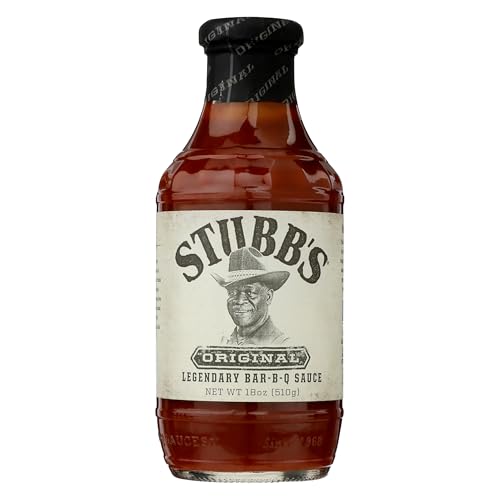
The label reads “Original Legendary Bar-B-Q Sauce”, with the logo above it and the addition “Since 1968”. That is the year C.B. “Stubb” Stubblefield opened his first restaurant in Lubbock, Texas. Behind the building stood a hickory pit, in which, according to the company history, he prepared his barbecue.
The chronicle on the manufacturer’s site is brief but precisely dated. Stubblefield was born on 7 March 1931 in Navasota, Texas. In 1986 he reopened his restaurant, this time in Austin. From 1992 he sold his sauces in grocery retail, and in 1993 he was still filling them himself in Austin: into old whiskey bottles and jam jars, each container sealed with a jalapeño. He died in May 1995.
Today the brand belongs to McCormick. The old address stubbsbbq.com permanently redirects to mccormick.com, and the Amazon catalogue also lists McCormick as the manufacturer. According to Amazon the sauce is made in the USA; we found no more precise location.
In our catalogue the bottle sits in the category Rubs & Sauces. On Amazon it is listed at approx. €10.
Ingredients in label order
Important first: the following list comes from the US label, which McCormick shows as an image on the product page. We read it off there and translated it.
First comes tomato puree, which itself consists of water and tomato paste. Then follow distilled vinegar, sugar, molasses, salt, spices (only black pepper is named explicitly), corn starch and brown sugar. Below 0.5 percent, according to the label, are onion, garlic, guar gum and xanthan, both marked as thickeners, as well as “natural flavor”, with the addition “including hickory smoke”.
In the US, ingredients must be listed in descending order by weight, which applies in general and not just to this bottle. For Stubb’s that means: there is more vinegar in the sauce than sugar, and more sugar than molasses. If you add up sugar, molasses and brown sugar as sweeteners, you get three sources, but none of them comes before the vinegar.
What is missing is just as revealing. A separate smoke flavouring does not appear as an ingredient on the label; the hickory smoke is part of the natural flavour below the 0.5 percent threshold. High fructose corn syrup does not appear either. McCormick highlights this on the product page with its own symbol.
In detail: what vinegar and sugar mean on the grate
McCormick describes the taste as “tangy” and names tomato, vinegar, molasses and black pepper. “Tangy” means sharp and savoury. We have not tasted the sauce ourselves, so this remains the manufacturer’s description and what can be read from the ingredients and nutrition values.
McCormick calls the style Texas-style. What exactly defines this style, McCormick does not explain. In our guide to homemade sauce we describe Kansas City as tomato-based, thick and sweet from molasses and brown sugar, and Carolina as thinner and more sour, either with plenty of apple cider vinegar or with yellow mustard as the base. Stubb’s takes a little from both: molasses and brown sugar like a Kansas City sauce, but with the vinegar in second place, even before the sugar.
The nutrition values make this concrete. A serving of 2 tablespoons weighs 33 g according to the nutrition table and contains 5 g sugar, of which 4 g added. The one gram of difference comes from the ingredients themselves, presumably mainly the tomato. Converted to 100 g, that is around 15 g sugar. The conversion is ours; we found no EU nutrition table per 100 g for this bottle. For sodium the label shows 250 mg per serving; by the formula customary in the EU (sodium times 2.5) that corresponds to around 1.9 g salt per 100 g.
Why the sugar content matters at the grill: sugar browns quickly over direct heat and turns bitter if it sits on the embers too long. That is general kitchen physics and not a measurement on this sauce. A sauce with little sugar is more forgiving when brushing, while a very sweet one belongs more in the last minutes or on the indirect zone.
For ribs McCormick gives its own instruction: apply the sauce during cooking and once more before serving. With around 15 g sugar per 100 g we consider that plausible, especially in comparison with sauces whose label shows a multiple of that (see the table further down). If you cook spare ribs by the 3-2-1 method, you glaze only in the last hour anyway, in two to three thin layers.
How much is in it: 510 ml or 510 g?
According to the label 510 g net weight, printed on the bottle as “NET WT 18oz (510g)”. That is the manufacturer’s only statement of quantity.
Amazon does not make it easier. The catalogue title says 510 ml, a bullet point below it 511 ml. Both are evidently converted values; McCormick gives no fill volume in millilitres anywhere. Because a tomato sauce with sugar is usually denser than water, 510 g would be somewhat less than 510 ml. How much less cannot be said without a density figure, so we do not calculate a volume.
The catalogue dimensions are not usable either. Amazon lists the bottle at 3.937 inches in height, length and width, so around 10 x 10 x 10 cm. The product photo shows a slim, round bottle with a black cap, clearly taller than wide. The three identical values look like a placeholder. The weight of 1.13 pounds (approx. 513 g) is almost exactly the net weight of the contents; whether the bottle is included remains open.
The serving information matches the label: approx. 15 servings of 33 g each make around 495 g. Per 100 g, at approx. €10 per bottle, the sauce costs around €2.06.
What McCormick intends the sauce for
The product page lists six uses: chicken, wings, short ribs, beef, pork and baked beans. In addition there are recipe tips that get a little more specific.
Chicken is to be brushed before grilling, then sliced and served with rice or leaf salad. For ribs the instruction from the section above applies. Away from the grill, McCormick suggests drizzling the sauce over homemade macaroni and cheese or stirring it into baked beans.
For pulled pork the product page has nothing specific; the keyword is only “pork”. We would mix the sauce in only after pulling, or serve it at the table, so that the crust from the rub does not soften. That is our assessment and not manufacturer advice. How the shoulder cooks until then is covered in our pulled pork guide.
On marinating for hours McCormick says nothing. If you want to try it, you will find the basic rules on acid, salt and contact time in our guide Marinating meat.
What the manufacturer does not state
A few points that interest buyers cannot be backed up by any source, and we collect them here instead of scattering them through the text: the German or EU label of the imported bottle with ingredient list, allergen labelling, importer and best-before date; the fill volume in millilitres; the bottle material; a shelf life in days, unopened and opened; a heat level; the consistency; nutrition values per 100 g in EU format; any statement on sweetness compared with other US sauces; the production site more precisely than “USA”; a vegan label.
Two consequences of this come up again further down. The nutrition values per 100 g in this text are converted by us. And anyone who has to watch for allergens cannot avoid checking the bottle itself.
These three alternatives are worth a look
| Product | Type and quantity | Price | Our rating | Choose this one if |
|---|---|---|---|---|
| Stubb’s Original Bar-B-Q Sauce (this one) | Tomato and vinegar sauce, 510 g according to the label, around 15 g sugar per 100 g (converted) | approx. €10 | 8.7 | you want a sauce with vinegar before sugar and want to brush the ribs while they cook |
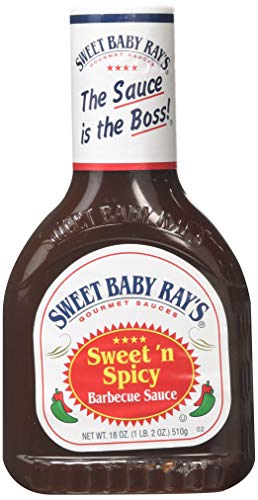
| Sweet Baby Ray’s Barbecue Sauce | Sauce with corn syrup as first ingredient (US recipe), around 47 g sugar per 100 g (converted) | approx. €7 | 8.7 | you want a distinctly sweet glaze and apply it shortly before the end |
| Bull’s-Eye Original BBQ Sauce | Sauce with German label, 300 ml, 28 g sugar per 100 g, contains mustard seed | approx. €7 | 8.4 | a German ingredient list matters to you and you need only a little sauce |
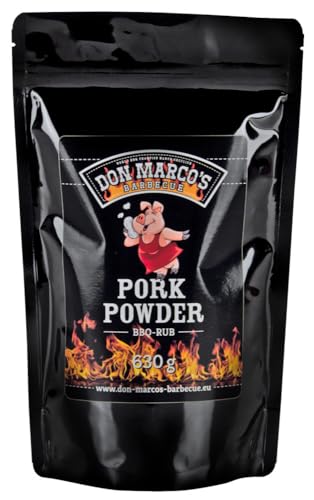
| Don Marco’s Pork Powder Rub | Dry rub, 630 g pouch, approx. 30 g per kg of meat | approx. €27.90 | 9.4 | you want to get the flavour into the meat before cooking rather than after |
The prices are the guide values of our reviews and vary in the shops. The rating is our editorial assessment. The sugar values come from the manufacturer information for each sauce; for Stubb’s and Sweet Baby Ray’s they are converted by us from US servings.
When Stubb’s, when one of the others
The biggest difference between the three sauces lies in the sugar. According to the manufacturer information, Sweet Baby Ray’s contains a good three times as much as Stubb’s, and Bull’s-Eye almost twice as much. So if you choose sauces by how early they may go onto the food, Stubb’s gives you the most room.
On price, Stubb’s is at approx. €10 for 510 g, Sweet Baby Ray’s at approx. €7 for the same 510 g, and Bull’s-Eye at approx. €7 for 300 ml.
A third point is the label. For Bull’s-Eye a German ingredient list from the manufacturer is available; for Stubb’s and Sweet Baby Ray’s we only have the US version. If you need the declaration under EU law before buying, that speaks for Bull’s-Eye.
Don Marco’s Pork Powder is not a substitute for a sauce but the step before it. The rub is in the price box at approx. €27.90, Stubb’s at approx. €10, and according to the manufacturer it goes onto the meat dry, at approx. 30 g per kg. In our comparison it is ahead with 9.4. If you only want to buy one thing and mainly cook pork in the smoker, we would rather reach for the rub.
If you would rather set the direction yourself, take a look at our guide Making BBQ sauce yourself. There you control vinegar and sugar yourself.
Who is it suitable for?
For anyone looking for a tomato sauce with vinegar as the second ingredient who wants to brush it onto ribs or chicken early, as McCormick suggests. If you are looking for a pronounced smoky sauce, you are in the wrong place by our reading of the label: the flavour with the hickory smoke stays below 0.5 percent. Bull’s-Eye, by contrast, lists smoke and smoke flavouring as separate ingredients.
The bottle is wrong for people with a mustard or celery allergy unless they have seen the declaration themselves. The US label lists no mustard, only “spices (including black pepper)”. What other spices hide behind that, McCormick does not say. In the EU, mustard and celery are among the allergens that must be labelled, and it is precisely this label of the imported bottle that we are missing.