Magic Dust is a ready-made seasoning blend from Ankerkraut that is rubbed dry onto meat before it goes on the grate. Among grillers, something like this is called a rub. The product designation on the manufacturer’s page sounds more sober: “Mischung würzender Zutaten für Fleisch” (blend of seasoning ingredients for meat). In its promotional text, Ankerkraut calls the rub its “all-purpose miracle weapon for meat”.
The same page says the blend follows an American original recipe. Whose recipe that is, only the Amazon text tells: Mike Mills is said to be the inventor, the origin lies in the USA, and Ankerkraut aligned its own blend with his original recipe.
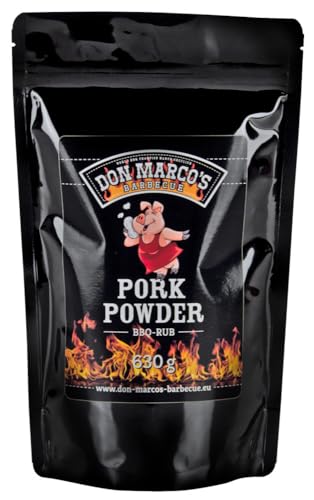
In our category Rubs & Sauces, Magic Dust sits next to blends that carry a specific meat in their name, such as the Pork Powder from Don Marco’s. Nobody here has tasted it, and nothing was grilled with it either. We therefore give the flavour in Ankerkraut’s own words. What sugar and salt do on the grate, we explain ourselves; the nutrition table and a little food chemistry are enough for that.
Which Magic Dust is behind our link
Ankerkraut sells Magic Dust in six pack sizes, from a sample bag to a large refill bag. Our Amazon link leads to the 230 g shaker. This can be pinned down by a number: in the Amazon catalogue, the ASIN B00NEG6SX0 carries the model number 4260347894649, and under exactly this barcode the Ankerkraut shop lists the variant “230g im Streuer” (230 g in a shaker) in its product data. On Amazon this shaker cost approx. €7.99 on 2 October 2026, in the manufacturer’s shop €9.99.
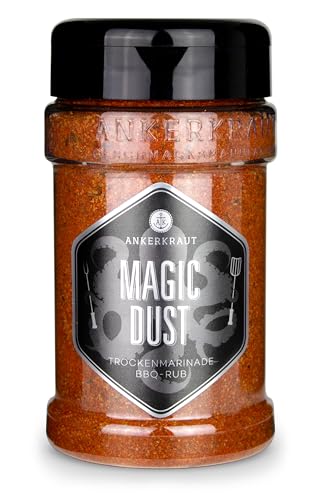
The product photo shows a round shaker with a black lid. The hexagonal label carries the line “Trockenmarinade BBQ-Rub” (dry marinade BBQ rub) under the name, and the brand name appears once more on the shoulder of the container. In its questions and answers, Ankerkraut gives its shakers a volume of 300 ml, a height of 12.5 cm including the lid and a diameter of 6.5 cm. In the Amazon catalogue, somewhat larger values are listed for this item, around 12.8 cm in height and 7.0 cm each in length and width. The weight in the catalogue, around 230 g, matches the fill quantity.
According to the Amazon text, the shaker is UV-light-protected and aroma-tight. The spices are said to be filled into this shaker and shipped after a very short storage time.
Ten ingredients, paprika first
The product page lists the ingredients in this order: sweet paprika, sea salt, raw cane sugar, mustard flour, garlic, black pepper, cumin, smoked jalapeño (chilli, smoke), smoked paprika (paprika, smoke), cayenne pepper.
The order follows a rule. Under the EU Food Information Regulation, ingredients are listed in descending order of weight. There are only a few exceptions, such as ingredients under 2 percent, which may be listed in any order at the end, or spice blends with the note “in variable proportions by weight”. The Magic Dust list does not carry this note. So paprika is the largest component, and salt and sugar follow in places two and three. The two chillies in places eight and ten may belong to the trace amounts under 2 percent. Smoke flavouring does not appear in the list; the smokiness comes from two smoked ingredients, the jalapeño and part of the paprika.
Per 100 g, Ankerkraut publishes these nutrition values: 1085 kJ (259 kcal), 2.6 g fat, of which 0.4 g saturated fatty acids, 43 g carbohydrates, of which 38 g sugars, 9.0 g protein and 26.0 g salt. Sugar and salt together make 64 g, just under two thirds of the blend. The sugar value includes all the sugar in the shaker, including what the paprika brings naturally.
According to the product page, Ankerkraut adds no anti-caking agents to this product. The same applies to flavour enhancers and palm oil, and the Amazon text adds the absence of artificial colourings. The manufacturer rules out preservatives on its sustainability page, though in one sentence covering all spices and blends of the brand.
In detail: what the sugar does over the embers
Raw cane sugar is predominantly sucrose, chemically the same substance as white household sugar, only with a remainder of molasses. Sucrose begins to caramelise from about 160 to 170 °C. If the surface of the food gets even hotter, the sugar decomposes further and the crust turns black and bitter. Paprika powder is similarly heat-sensitive and darkens quickly under strong heat.
In a basics article in its magazine, Ankerkraut states a rule on this: “Grill the meat at a low temperature so that the sugar in the rub does not burn.” That article deals with sugary rubs in general; Magic Dust is not mentioned specifically in it.
What follows from this, we derive from physics. As long as the meat surface is moist, water evaporates there and the surface stays below 100 °C, even if the air in the cooking chamber is at 120 °C. In the indirect zone of a kettle or gas grill and in a smoker, it dries slowly, and the sugar browns gradually. Directly over full embers it dries much faster, and afterwards its temperature quickly rises past the caramelisation threshold. Chicken thighs that lie directly over strong embers for half an hour risk a black crust with this rub. We would cook them indirectly first and only put them over the embers for a few minutes at the end.
What Ankerkraut intends the rub for
In the Amazon description, the manufacturer lists: pork, for example for pulled pork, plus beef, poultry, veal and game, also vegetables such as peppers, courgette and aubergine, cheese such as feta and halloumi, and tofu. The product page sums this up more briefly as meat, tofu or vegetables. Fish appears in neither list. The schedule and core temperature for the explicitly mentioned pulled pork are in our pulled pork guide.
Ankerkraut describes the flavour differently in four places. On the product page the rub gives “a savoury, smoky note with paprika, garlic and cumin”, while on Amazon it has a savoury paprika taste with a slightly piquant note. On the page for a small grill spice set it is called “nicely savoury and a little smoky”. Sweetness appears only in the description of the Dust Trio Box, as a “slightly sweet BBQ seasoning”. Yet raw cane sugar is the third ingredient.
For application, the product page suggests brushing the food with a few drops of olive oil or mustard and then rubbing it generously with Magic Dust. According to the Amazon text, the dry marinade forms a crust during cooking, and stirred with oil it becomes a liquid grill marinade. For direct heat we would reach for a refined oil rather than cold-pressed olive oil, whose smoke point is lower; the figures are in our guide Marinating meat for the grill.
The recommended serving is approx. 1 to 2 tablespoons for 250 g of meat, which works out at 4 to 8 tablespoons per kilo. The range is wide, and a tablespoon of powder weighs differently depending on the spoon and how full it is. So weigh one spoonful once, filled the way you actually use it. With the salt share from the nutrition table you can then calculate how much salt ends up on your kilo of meat.
Is the refill bag worth it instead of the shaker?
Yes, if you use up the amount before the best before date. Even the 250 g bag costs one euro less from the manufacturer than the shaker and contains 20 g more. The 750 g bag is cheapest per 100 g.
Ankerkraut’s shop prices on 1 October 2026, sorted by fill quantity:
- 15 g in a sample bag: €1.29, by calculation €8.60 per 100 g
- 100 g in a cork jar: €5.99, according to the shop €59.90 per kilo
- 230 g in a shaker: €9.99, by calculation €4.34 per 100 g
- 250 g in a bag: €8.99, by calculation €3.60 per 100 g
- 700 g in an XXL shaker: €19.99, by calculation €2.86 per 100 g
- 750 g in a bag: €19.99, by calculation €2.67 per 100 g
At the end of the list are two pack sizes at the same price, and the large bag holds 50 g more than the XXL shaker. You pay for the shaker in every size. Conversely, the sample bag is the most expensive form per 100 g, but the cheapest way to get to know the blend before 750 g sit in the cupboard.
Mustard, celery and the word “gluten-free”
Mustard flour is in fourth place on the ingredient list. Mustard is one of the 14 main allergens that must be highlighted in the ingredient list of packaged food in the EU. If you react allergically to it, leave Magic Dust out, even as a thin layer. In addition there is a trace warning, worded on the product page as: “May contain traces of celery.” Celery is on the same EU list.
With gluten, it pays to read closely. According to Ankerkraut’s general questions and answers, the company uses no raw materials containing gluten. It still does not want to declare its products gluten-free, because contamination of the delivered raw materials cannot be ruled out and the blends are not regularly tested for gluten.
As its legal basis, Ankerkraut cites Regulation (EC) No 41/2009. It was replaced in July 2016 by Implementing Regulation (EU) No 828/2014, and the limit stayed the same: a food may only be called gluten-free if it contains at most 20 mg of gluten per kilogram. Until this revision, this page said Magic Dust was gluten-free and suitable for coeliac disease. That was wrong. With coeliac disease we would avoid a blend without that assurance.
Three alternatives from our catalogue
| Product | Type and quantity | Price | Our score | Choose this if |
|---|---|---|---|---|
| Ankerkraut Magic Dust (this one) | All-purpose rub, 230 g in a shaker | approx. €9.99 | 9.0 | you want to season meat, grilled vegetables and halloumi with a single blend |
| Don Marco’s Pork Powder Rub | Rub for pork, 630 g in a bag, according to the manufacturer 25.3 g sugar per 100 g | approx. €27.90 | 9.4 | you mainly season pork and want to avoid mustard as an ingredient |
| Klaus grillt Magic Dust | All-purpose rub of the same name from a different manufacturer | approx. €9 | 8.7 | you are looking for an all-purpose rub and are not committed to Ankerkraut |
| Ankerkraut BBQ Rub sampler pack | Assortment pack with several Ankerkraut rubs | approx. €24 | 8.9 | you want to try several Ankerkraut rubs side by side |
The prices are guide values from our data sheets, for Magic Dust the Amazon price from September 2026, and they change. The score is our editorial assessment based on manufacturer information and price; no tasting is behind it. Calculated per 100 g, the Pork Powder bag costs around €4.43 and the Magic Dust shaker around €4.34, so Pork Powder is around 9 cents higher; the large numbers in the price column are explained by the fill quantity. The sampler pack with 18 varieties that our individual page describes was not listed in the Ankerkraut shop on 1 October 2026. The manufacturer sells several varieties together there in sets such as the Dust Trio Box.
What the manufacturer leaves open
On these points we found no information on the product page, in Ankerkraut’s questions and answers or in the Amazon catalogue:
- a heat level as a number or on a scale
- the shares of the individual ingredients in percent
- the weight of a tablespoon of Magic Dust and thus how much meat one shaker lasts for
- grind and grain size
- the material of the shaker and lid and whether both can be recycled
- the hole pattern in the shaker lid; the product photo does not show the top of the lid either
- a shelf life in months, from production or after opening; Ankerkraut refers to the best before date on the pack
- the origin of individual raw materials such as paprika, jalapeño, mustard and sugar
- since when Magic Dust has existed; the date June 2018 in the Amazon catalogue belongs to the data record and does not prove a market launch
What we miss most are the quantity shares. With them, one could read off how much of the sugar comes from the raw cane sugar and how much from the paprika.
Who Magic Dust suits, and who it does not
The line is drawn by the temperature at the food. If the air in the cooking chamber stays permanently below about 160 °C, as with low and slow in a smoker or in the indirect zone, the surface of the food cannot get noticeably hotter either, and it stays below the range in which sugar turns black. In our assessment, the sugar content of Magic Dust is then no reason to reach for another blend. Over open embers, on the other hand, the lid thermometer says little, because it measures the air under the lid and not the radiant heat hitting the food from below.
If you mostly grill directly over the embers, skewers for example that lie there from start to finish, the sugar is the catch. Zero Dust could be considered here, according to the manufacturer the variant of Magic Dust without added sugar (230 g shaker from the manufacturer €8.99, as of 1 October 2026). It still contains sugar: Ankerkraut states 19 g per 100 g, plus 32.9 g salt, so more salt than in Magic Dust.
Don Marco’s Pork Powder Rub manages without mustard in the ingredient list; according to the manufacturer it contains no allergenic ingredients. Whether traces of mustard are possible is not stated on its product page, however, and it is geared towards pork. It contains more salt than Magic Dust, at 28.7 g per 100 g.
If you have to save salt on medical advice, you cannot solve that with Magic Dust through quantity: the salt is built firmly into the blend, and if you use less rub, you also get less paprika and garlic on the meat. We consider a self-mixed rub without salt the better solution here. A basic formula and five recipes to mix yourself are in our guide Making BBQ rub yourself; you leave the salt out and add it separately, weighed.