Bull’s-Eye Original BBQ is a ready-made tomato-based barbecue sauce, and in Germany Kraft Heinz sells it in a single size. The manufacturer describes it as an “original American BBQ sauce with an intense smoky flavour”. It says nothing more about the taste, and we cannot add more: nobody here has tasted the sauce.
What you read here comes from the German product page on kraftheinz.com, from the brand page including its “Our story” section, and from the Amazon catalogue. We explain ourselves how sugar, vinegar and starch behave in a sauce at the grill, because that is food chemistry and applies to every bottle of this kind. You will find the other sauces and rubs we compare it with in our category Rubs & Sauces.
Which bottle is behind our Amazon link
There is a discrepancy here that you should know about before buying. Kraft Heinz lists the German edition under the GTIN 8715700208602 and gives 300 ml as the available size. The Amazon catalogue entry for ASIN B07V6BG3B2, on the other hand, has the title “Bull’s Eye -Original Barbecue-Sauce - 355 G”, 355 g as contents and 76013419 as the part number.
We cannot prove whether both statements refer to the same bottle. The Amazon record contains no GTIN, and the manufacturer page has no buy button through which the match could be traced. Grams and millilitres are also different quantities. A sauce made from tomato purée, sugar and starch is denser than water, so 300 ml weighs more than 300 g. How much more, none of our sources says, and without a density figure we do not extrapolate it.
The rest of the catalogue entry does not fit together well either. It lists converted item dimensions of around 17.7 cm height, 8.2 cm width and 4.4 cm length, and a weight of 0.47 pounds, so approx. 213 g. That is less than the stated contents, and that is before the bottle itself has even been weighed. At least one of these figures is wrong.
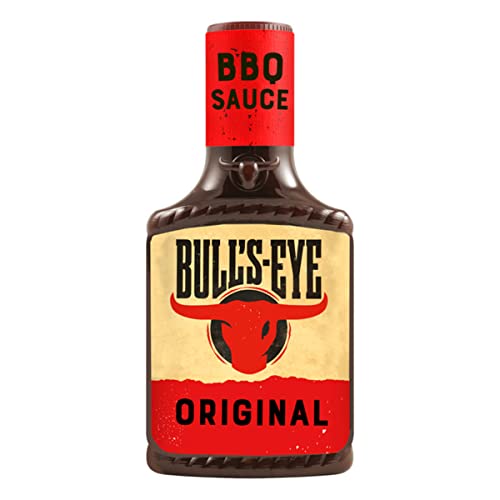
The product image shows a bottle with a red top that says “BBQ Sauce”, with the label below showing a bull’s head and the lettering “Original”. A fill quantity cannot be read in the image.
Our advice: check on the Amazon page which size is currently stated there, and calculate the unit price with that figure. With the manufacturer’s 300 ml and the price of approx. €7 (Amazon page on 21.10.2026: €7.36) you arrive at around €24.53 per litre.
Fourteen ingredients, sorted by weight
The German ingredients list on kraftheinz.com reads: tomato purée, sugar, spirit vinegar, molasses, water, modified starch, salt, ground mustard seed, maltodextrin, smoke, smoke flavouring, spices, onions, garlic.
The order follows a rule. Under the EU Food Information Regulation (LMIV in Germany), ingredients are listed in descending order of their weight share at the time of manufacture. Tomato purée is therefore the largest ingredient, sugar the second largest, and the last six items from maltodextrin to garlic are added in smaller amounts. No ingredient has a percentage figure.
Spirit vinegar is vinegar made from fermented agricultural alcohol, often sold as distilled vinegar in shops. It provides acidity without a fruit note of its own, unlike apple or wine vinegar. Molasses is the dark, thick syrup left over from sugar production. In the nutrition table it counts as sugar and contributes to the dark colour.
The sauce is thickened with two ingredients. Modified starch is starch treated physically, enzymatically or chemically that stays more stable when heated and in an acidic environment than untreated starch. Maltodextrin is made from starch and adds body. So this sauce gets thick through thickeners and less through reducing.
Smoke and smoke flavouring appear as separate items in the list. The EU Flavourings Regulation (EC) No 1334/2008 lists smoke flavouring as its own category: a product obtained from condensed smoke. What Kraft Heinz means by “smoke” as the second item is not explained on the product page. All that is certain is that the smoky note the manufacturer advertises is already in the bottle and does not first develop on the grill.
Kraft Heinz writes the mustard seed in capital letters, with “Contains: MUSTARD SEED” below it. The German list contains no preservative.
In detail: 28 grams of sugar and the heat at the grate
Per 100 g, Kraft Heinz gives 135 kcal, 0 g fat, of which 0 g saturates, 32 g carbohydrates, of which 28 g sugars, and 1.1 g protein. The reference is the gram, although the bottle is labelled in millilitres.
The energy comes almost entirely from the carbohydrates. Carbohydrates provide around 4 kcal per gram, so 32 g gives about 128 kcal, and the protein contributes a good 4 kcal. A good quarter of the sauce is sugar. In this value, the LMIV counts all monosaccharides and disaccharides, including those that tomatoes bring naturally. How much of it is added cannot be read from the table.
At the grill this has a consequence that has little to do with this brand and a lot to do with sugar chemistry. Household sugar begins to caramelise from about 160 to 170 °C, and at clearly higher temperatures it burns and turns bitter. The surface of meat lying directly over the embers or over fully turned-up burners reaches such temperatures quickly. A sauce with this much sugar therefore belongs at the end: brushed on in the last minutes, ideally in the indirect zone, or simply as a dip at the table. Kraft Heinz gives no usage instructions of its own; this is the general rule for sweet sauces.
With the 3-2-1 method for spare ribs, this is the last phase, in which the ribs lie in the grill uncovered again and are glazed. Temperatures and times for it are in our guide Spare ribs using the 3-2-1 method.
A finished bottle fixes the ratio of sugar, acidity and smoke. If you want to adjust that, you will find a basic recipe and five regional styles under Making BBQ sauce yourself.
Is the German bottle the same sauce as in the USA?
No. According to Kraft Heinz, the German Bull’s-Eye Original has tomato purée as its first ingredient and is sweetened with sugar and molasses. The US original, which Kraft Heinz describes on its American site, begins with high fructose corn syrup.
In the EU, this syrup is called glucose-fructose syrup or fructose-glucose syrup, depending on the fructose share. Neither term appears in the German ingredients list. If you read at a retailer or in an older text that Bull’s-Eye Original contains glucose-fructose syrup, either the US recipe is meant or the statement is wrong.
The US list differs in three more places. It has apple cider vinegar instead of spirit vinegar, plus honey and potassium sorbate as a preservative. Honey and preservative are missing in the German version. For anyone who avoids honey, that is the difference that matters.
In practice, this means: nutritional values, recipes and user reports from US sources refer to a different sauce. If a bottle has an English label, read the ingredients list before you equate it with the German one.
What Kraft Heinz intends the sauce for
On the brand page, Kraft Heinz lists pork steak, chicken wings, spare ribs and beef fillet. In the brand story it is chicken wings, brisket and ribs (“Bruststück” in the German text). From the context, “Bruststück” means beef brisket, in American barbecue simply brisket; that is at least how we read it.
Burgers, sausages, vegetables, fish and grilling cheese appear on neither of the two lists. Pulled pork does not either, although spare ribs and pork steak are included.
What stands out to us on the list is the beef fillet. Fillet is lean and usually grilled briefly and hot, so exactly under the conditions in which a sugary glaze is most likely to burn. We would therefore put the sauce next to the fillet as a dip rather than brush it on. For spare ribs, brisket and chicken wings, which cook indirectly for longer, glazing in the last minutes suits the cooking method better. And if you like chicken wings with crispy skin, it is best to brush on only at the very end and only thinly, because a wet layer softens the skin again.
Three alternatives from our catalogue
| Product | Type and quantity | Price | Our rating | Choose this one if |
|---|---|---|---|---|
| Bull’s-Eye Original BBQ (this one) | smoky tomato-based BBQ sauce, 300 ml according to the manufacturer | approx. €7 | 8.4 | you want a ready-made sauce with tomato purée as the main ingredient for glazing and dipping |
| Sweet Baby Ray’s Barbecue Sauce | barbecue sauce, 510 g | approx. €7 | 8.7 | you want a clearly sweeter glaze and more contents for the money |
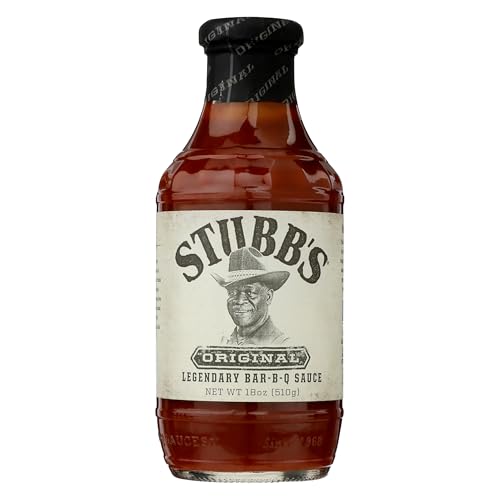
| Stubb’s Original Bar-B-Q Sauce | Bar-B-Q sauce, 510 g | approx. €10 | 8.7 | you want little sugar or gluten-free labelling |
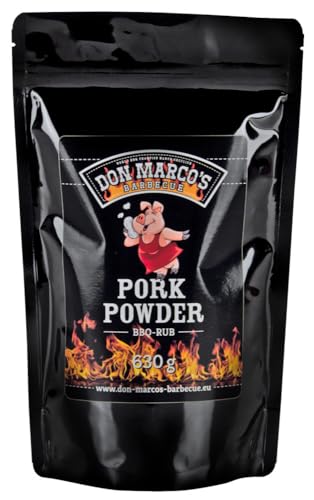
| Don Marco’s Pork Powder Rub | dry rub, 630 g in a pouch | approx. €27.90 | 9.4 | you want to season pork before cooking instead of glazing it at the end |
The prices are guide values from our data sheets and change without notice. The rating is our editorial assessment based on manufacturer information and price; we have not tasted any of the four products.
What Kraft Heinz does not state
The research for this text found nothing on the following points on the German Kraft Heinz pages:
- the salt content per 100 g, the field of the nutrition table is empty
- the share of added sugar
- consistency and heat level
- a shelf life after opening and a storage instruction
- bottle material and type of closure
- gluten-free or vegan labelling
- the country of manufacture of the German edition
- usage instructions, for example on marinating or glazing
- larger pack sizes, the German brand page lists only the one bottle
- information on which supermarkets or discounters stock the sauce
We miss the salt content most. Anyone counting salt because of blood pressure cannot work out a portion without it and has to pick up the bottle first.
When Bull’s-Eye fits and when another bottle
On sugar, Bull’s-Eye sits in the middle of our catalogue. Sweet Baby Ray’s gives 17 g sugar per 36 g serving on the US manufacturer page, converted around 47 g per 100 g, and corn syrup is in first place there. Stubb’s gives 5 g sugar per 33 g serving on the US label, which is around 15 g per 100 g. Both values apply to the American bottles. If you want the sweet, sticky glaze, choose Sweet Baby Ray’s; if you watch sugar, choose Stubb’s.
On price per quantity, Bull’s-Eye is the most expensive of the three sauces. Sweet Baby Ray’s is at approx. €7 in the price box and has 510 g contents, which is around €13.33 per kilo; Bull’s-Eye has 300 ml at a price of approx. €7. Even if 300 ml of Bull’s-Eye weighs clearly more than 300 g, the bottle stays more expensive per kilo. Stubb’s is at approx. €10 in the price box, for 510 g according to the label. So the cheapest way into a ready-made sauce in our comparison is not Bull’s-Eye.
In favour of Bull’s-Eye, in our assessment, is the recipe, if you want a sauce with tomato purée in first place and without corn syrup that is not as low in sugar as Stubb’s. If you want to stay with the brand and have it sweeter, Kraft Heinz names honey as the sweetener in the Honey and Sweet Whiskey varieties.
If you actually do not need a sauce but a seasoning that goes on the meat before cooking, a rub such as Don Marco’s Pork Powder is the other tool. It is at approx. €27.90 in the price box, Bull’s-Eye at approx. €7, and it does not replace the sauce but comes earlier in time: rub before grilling, sauce in the last minutes or at the table.
The wrong choice is Bull’s-Eye Original for anyone with a mustard allergy. The sauce is then out, and with the alternatives too only the label helps: Sweet Baby Ray’s lists mustard flour in the US ingredients list. Nor does it suit you if you depend on an explicit gluten-free declaration. In our catalogue, Stubb’s has it and, according to the manufacturer’s US data, so does Sweet Baby Ray’s; Bull’s-Eye does not.