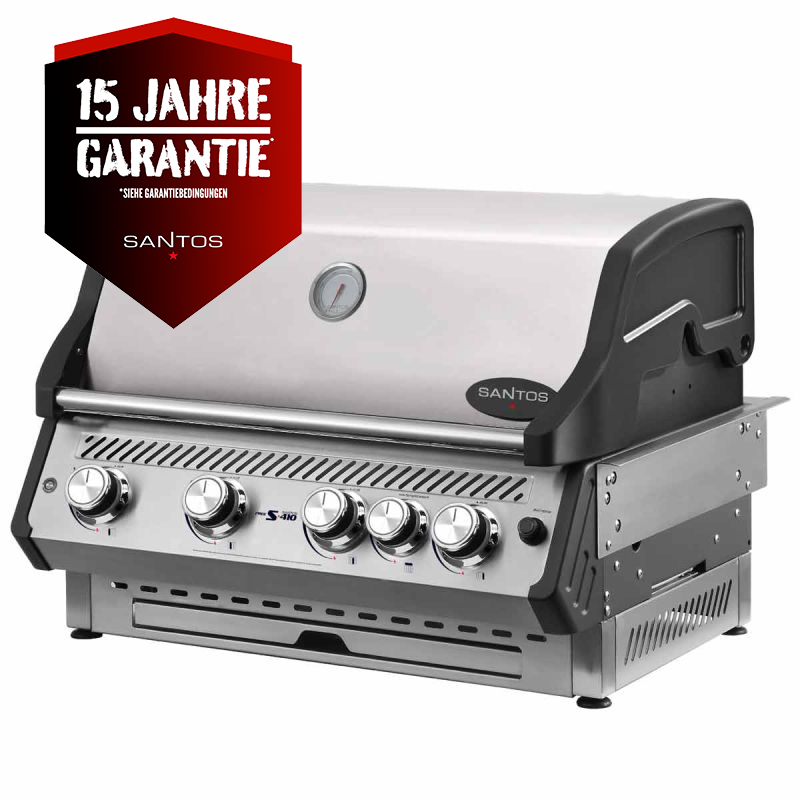
The SANTOS Free S-410 PRO is a gas grill without legs. Santos Grills GmbH from Cologne sells it as a built-in grill: you set the body into an outdoor kitchen, a masonry module or another base that you provide yourself. At Santos Grills the stainless steel version costs approx. €749. In its own range Santos has four built-in grills, the S-410 PRO and the larger S-510 PRO, each in stainless steel and in All Black. According to the operating instructions, the grill is made in China. You can find other gas grills with a frame in our gas grill category.
A grill for the base: cut-out, weight, assembly
For the cut-out, the product page gives an installation dimension of 81.4 x 31 x 54 cm (width, height, depth). The installation drawing on page 13 of the assembly instructions confirms this in millimetres: 814 mm wide, 540 mm deep, 310 mm high. The lid is dimensioned there at 800 mm wide, the body at 804 mm. Around the grill, Santos draws a non-combustible structure.
Four further dimensions on this sheet carry no labels, namely 170 mm, 70 mm, an opening of 120 x 80 mm and 30 mm. What they dimension cannot be read from the drawing. Before anything is built, we would ask Santos about this.
The product page describes two ways of installing it. Either the grill stands on a fireproof surface, or it hangs from its side rails in an opening. The parts list includes three mounting brackets for this.
With the fixing brackets, the S-410 PRO measures 86 x 59.5 x 67 cm according to the product page, in the order width, height, depth. The operating instructions print 81 x 59.5 x 53 cm, but as width, depth, height. So whether the 59.5 cm is the height or the depth remains open between the two documents. For the cut-out, the installation dimension is what counts anyway.
The grill weighs 50 kg. The assembly instructions require at least two people for transport and assembly, and a Phillips or flat-head screwdriver is enough as a tool. When unpacking, you grip the body at the sides; it must not be lifted out of the box by the handle. The box itself measures 63.5 x 82.5 x 64.5 cm.
The distances to combustible materials are tricky. The operating instructions require you to keep the “applicable minimum distances” to combustible objects and structures on all sides. The safety sheet of the Free S series refers to the assembly instructions for these distances, and there you find only the drawing with the non-combustible surroundings; a table in centimetres appears in none of the three documents. If you are planning a wooden frame or wooden cladding, you should have Santos confirm the distances in writing before building.
Burners, grates, lid: what the data sheet says
Under the grate are four stainless steel main burners with 3 kW each, 12 kW in total. At the back sits a stainless steel rear burner with 4 kW, which gives the total output of 16 kW in the data sheet. In the running text of the product page, one passage says “total output of 12 kW”; there it means the four main burners.
You light the main burners by piezo ignition, each one separately. On the rear burner, battery-powered electronics provide the spark, directly at the control. The ignition section of the product page speaks of “side and rear burner”, but this model has no side burner.
Four cast iron cooking grates form the main area of 42.5 x 75.5 cm, 3,208.75 cm² in the data sheet. You can turn them over: one side has V-shaped bars, the other is flat with grooves. Elsewhere the product page speaks of a 76 cm wide cooking area. Above it hangs a three-part stainless steel warming rack, 77 cm wide, which you pull out from 14 cm through 24 cm to 33.5 cm depth. Pushed in, that is 1,063 cm², fully extended 2,579.5 cm².
The burner housing is made of cast aluminium with extended side panels, the grill tray of stainless steel. Over the burners are covers made of solid stainless steel, and the rear burner is protected by a hang-in stainless steel cover that, according to Santos, may stay in place even while the rear burner is running. The lid is tall, double-walled and has a thermometer. You pull the grease tray out towards the front. Santos advertises that improved insulation can reduce gas consumption, but no measured figure is given alongside.
Some things remain open in the product page, operating instructions and assembly instructions, collected here: the maximum temperature under the lid, a heat-up time to a particular temperature (there are only preheating recommendations), the measuring range of the lid thermometer, the grade of stainless steel, whether the cast iron grates are enamelled or raw, whether the main burners are tube or bar burners, the gas consumption on a low flame, requirements for ventilation openings in the base, an explicit statement about balconies and the deadline by which you must register the grill for the warranty.
In detail: rear burner, indirect zone and the 15-minute limit
A rear burner radiates onto the food from behind, typically onto a rotisserie spit turning in front of it. Because the heat does not come from below, fat basically does not drip into a flame. On the S-410 PRO, two fixed rules from the instructions apply here. Before using the rear burner, you always remove the warming rack. And the rear burner must not run together with the main burners. To light it, you hold its control pressed for at least 5 seconds after the click; for the main burners 2 seconds are enough, one after another from left to right. If that does not work, you light it with extra-long matches through the grate.
You buy the spit itself separately. The instructions name a rotisserie spit as an accessory with its own operating instructions.
According to Santos, you grill indirectly like this: the outer burners are on the lowest setting, the others are off, the lid stays closed, and the temperature should not exceed 160 °C. The food then lies in the middle or on the extended warming rack. How the direct and indirect zones work together is explained by our guide to direct and indirect heat.
For the other end of the scale, the instructions set a limit that you should know before buying: the appliance never runs longer than 15 minutes in the highest burner position. Preheating is done with the lid closed, for meat at most 5 minutes on full, for fish and vegetables at most 2 to 3 minutes. If you are used to grilling on full blast for half an hour, you will have to rethink here.
The instructions become precise on pans and plates. The entire cooking area must never be covered with pans. With a steak plate, at least one grate stays in the grill, and the burner under the plate or stainless steel pan runs only on the lowest setting. Plate and pans keep at least 2 cm distance from all side walls. Lava stones and briquettes do not belong in this grill. Our reading of these rules: a closed metal surface traps the heat beneath it, and the instructions themselves do not give a reason for it.
Is the cooking area enough for your group?
This can only be answered through the area, because Santos has not stated a number of people. What counts is the 3,208.75 cm² of main grate. If you often grill for large groups at the same time, the S-510 PRO becomes interesting with 828.75 cm² more main area.
On the larger sibling, more kilowatts do not bring higher heat per area. If you divide the output of the main burners by the main area, the S-410 PRO comes to 12,000 W over 3,208.75 cm², around 3.7 W per square centimetre. According to its product page, the S-510 PRO has five burners with 3 kW each on 4,037.5 cm² and also ends up at around 3.7 W. We left out the rear burner for both because it must not run in parallel with the main burners. The calculation is ours, not Santos’s.
Four individually adjustable burners under four grates mean in practice: one half can grill hot while vegetables cook on a low flame on the other side. Fully extended, the warming rack reaches around 80 percent of the main grate area, which is a lot of space as a resting place for finished food.
What else comes into question?
| Model | The difference | Price | Our rating | Pick this one if |
|---|---|---|---|---|
| SANTOS Free S-410 PRO (this one) | Built-in grill, 4 x 3 kW plus 4 kW rear burner | approx. €749 | 8.3 | you are building an outdoor kitchen and have 81.4 cm of cut-out width there |
| SANTOS Free S-510 PRO | Built-in grill with five main burners, 4,037.5 cm² main grate | approx. €899 | 8.4 | you often grill for many and have almost 20 cm more width free in the base (101 instead of 81.4 cm cut-out) |
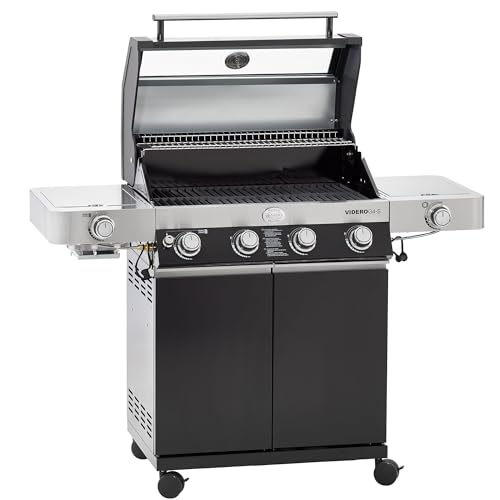
| Rösle Videro G4-S Vario+ | freestanding with base cabinet, infrared prime zone and side burner | approx. €849 | 9.2 | you do not want to build a base and are looking for a zone for hot searing |
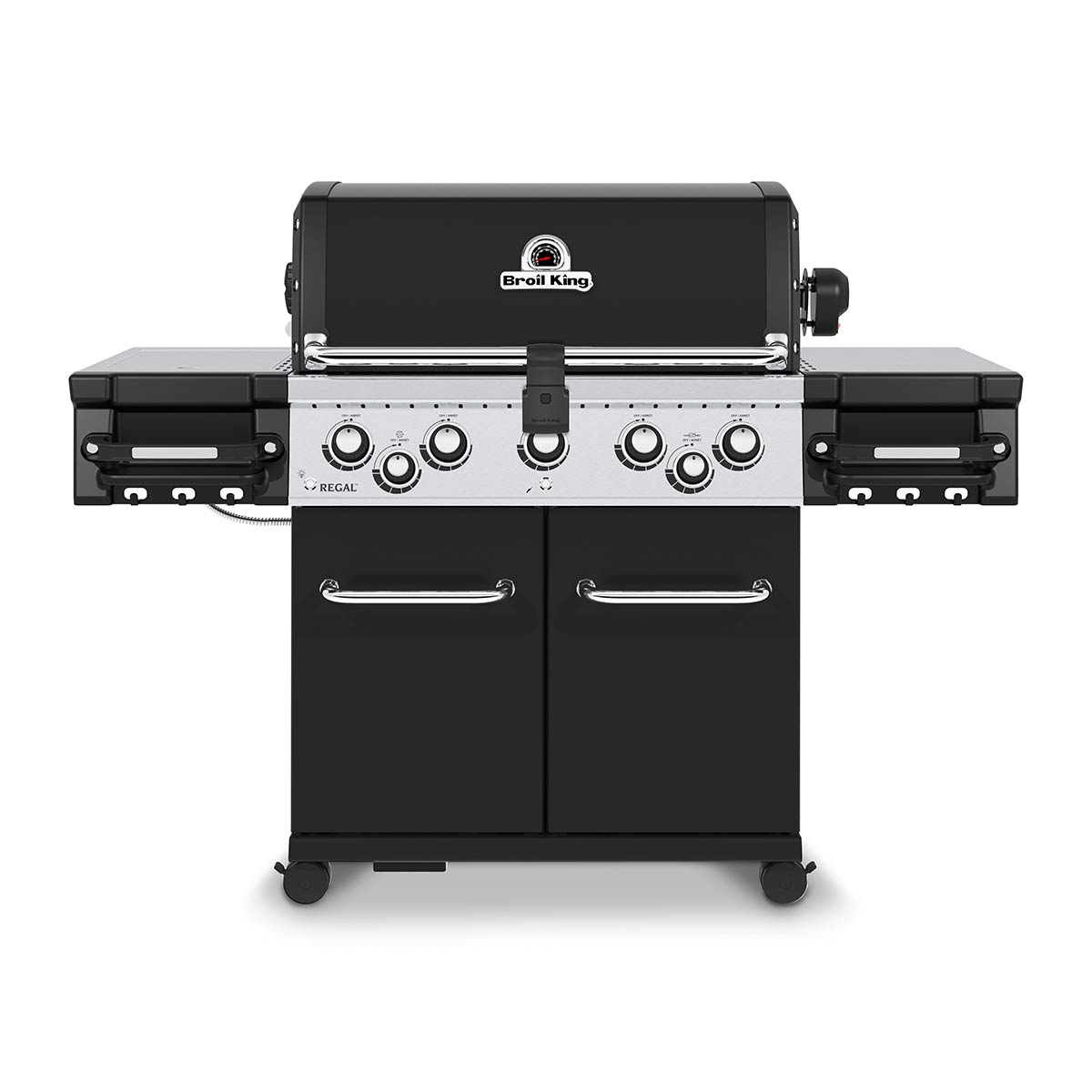
| Broil King Regal 590 | freestanding with five burners, side cooktop and space for the cylinder in the cart | approx. €1,649 | 9.4 | you want a complete grill with a cooking zone and have the budget for it |
The prices come from our price boxes and change; the rating is our editorial assessment from the data comparison and not a measurement result.
According to our price box you get the S-510 PRO for approx. €899, the S-410 PRO for approx. €749. For that you get a fifth burner, 19 instead of 16 kW and a cut-out of 101 instead of 81.4 cm width, at 57 instead of 50 kg. The Rösle Videro G4-S Vario+ is in our price box at approx. €849, but needs no base, and that is exactly what you still have to pay for with the Santos. The Broil King Regal 590 is in our price box at approx. €1,649.
When the S-410 PRO fits and when another grill does
If the outdoor kitchen already stands, or is firmly planned, the concept fits. You buy burners, grates and lid and set them into a piece of furniture that you are building anyway.
Without a base, the sums are different. On top of the grill price come a module or masonry, a place for the gas cylinder and, with a wooden structure, clarifying the distances. What such a base costs depends on your project; we cannot give you a figure. If you simply want to put a grill on the terrace, we would recommend a freestanding model such as the Rösle Videro G4-S Vario+.
If you like cooking side dishes in a pot alongside, the S-410 PRO lacks a cooking zone. The Rösle has a side burner, the Broil King Regal 590 a side cooktop. Built-in grills can be complemented with a separate hob in the outdoor kitchen, but that is then another appliance.
The rear burner is there for the rotisserie spit, just not at the same time as the main burners. Anyone who wants to cook chicken on the spit and sausages on the grate in parallel will not manage with this grill.
For the budget, we would count on these items: approx. €749 for the grill, €74.90 in the manufacturer’s shop for the matching cover, a gas cylinder, possibly a rotisserie spit, and the base.
Gas, connection and safety according to the instructions
The grill is operated on liquefied gas at a connection pressure of 50 mbar. The operating instructions name butane, propane or a mixture of the two as the gas type; the product page says simply “propane, 11 kg”. Fuels other than liquefied gas are excluded. The pressure regulator must be a 50 mbar device; Santos Grills GmbH expressly accepts no liability for damage caused by a wrong pressure regulator.
As a hose, the instructions require a medium-pressure hose line with PS 10 bar according to DVGW or DIN EN respectively. The union nuts have a left-hand thread. At the grill’s gas connection you remove the plug, screw on the hose and tighten the nut with an open-end spanner. On the pressure regulator, by contrast, you tighten the union nut by hand only, expressly without tools. The hose must not touch hot surfaces, must not run along sharp edges, must not be twisted, and hot fat must not drip onto it.
Before every use you check the complete gas system for leaks. For this the grill must be fully assembled and the cylinder full. You mix soapy water from one part washing-up liquid and one part water or use leak detection spray, set all controls to OFF and open the cylinder valve slowly so that no air gets into the hose and pressure regulator. Then you spray all the connections. If bubbles form, you close the valve, tighten the leaking connection and check again until no more bubbles form. If you cannot make a leak tight yourself, you do not use the grill and contact customer service. Smoking is forbidden during the check, and so is an open flame as a test means. You also check the hose and pressure regulator before every use; if the hose shows excessive wear, cracks or cuts, it is replaced before grilling.
On the installation location, chapter 2.2 says: exclusively outdoors in a well-ventilated place, never in enclosed spaces, not in a hollow because escaping gas can collect there, not in rain or strong wind, always on firm and level ground, built in only according to the specifications. According to the instructions, you always keep a suitable fire extinguisher ready.
Before lighting, you open the lid, otherwise, according to Santos, there is a risk of explosion. No combustible or heat-sensitive items may lie in the cabinet under the grill housing; if in doubt, you empty it. Lighters and accelerants are taboo for lighting, and you do not lean over the appliance while doing so. On sunny days the burner flames are hard to see. You never line the bottom of the grill tray with aluminium foil, sand or a fat-absorbing substance.
As intended use, the instructions name four points: the appliance is intended exclusively for grilling and for food that can be grilled, it is intended for private use or household-like use, any other use counts as not intended, and it is not a children’s toy.
Cleaning, warranty and what costs more after purchase
Before first use, you remove the protective film with a soft sponge and hot soapy solution and check that there are no insects or spider webs in the burner openings. The grill is burned off before first use and after every use, 15 minutes with the lid closed. It is also cleaned after every use, because old fat can trigger corrosion through its fatty acids.
Before every cleaning, you let the grill cool down completely, switch it off, close the gas valve and remove the cylinder. Chapter 7 excludes: aggressive cleaning agents, brushes with metal or nylon bristles, sharp or metallic cleaning objects, the dishwasher for the appliance and accessories, the wire brush in the interior, as well as water hose and pressure washer. For the grates, the same instructions allow only brass or silicone brushes, and for stubborn residue a scraper with a fibre or brass brush. Brass is also a metal; the instructions nevertheless expressly name it as an exception for these parts. You clean the burners with a soft brush or with compressed air and a soft cloth, the lid with kitchen paper, and the grease tray particularly thoroughly. Afterwards you dry everything. Before longer storage, parts and appliance should dry open for at least 8 hours. You rub the cast iron grates thinly with sunflower or rapeseed oil, not with acidic oil such as olive oil.
For the stainless steel surfaces, chlorine-containing cleaners are forbidden, as are steel wool and wire brush. According to the same chapter, only ferrite-free scouring sponges and ferrite-free steel wool are permitted. Santos also stipulates cleaning exclusively with SANTOS care and cleaning products, and excludes liability for damage or discolouration caused by other agents. For overwintering, the grill goes to a dry place, rubbed all over with an oil-containing stainless steel care product, and the cylinder and hose are always removed for storage. You check the burner nozzles at least once a year. The gas hose carries a type plate with an expiry date from the factory and is replaced before it expires.
The warranty of the Pro series is tiered and requires registration. According to the warranty page, 15 years apply to the stainless steel hood, 15 years to the porcelain-enamelled hood, 15 years to stainless steel cooking grates, 5 years to stainless steel tube burners, 5 years to stainless steel flame guard inserts and 2 years to all other parts, and only towards the first buyer. Cast iron grates and the cast aluminium housing are not in the table. We read that as meaning they fall under the two years; this reading is not binding.
Running costs arise mainly from gas. The instructions give the total heat input as 16 kW or 1,164 g/h. Because the rear burner must not run in parallel, the highest actually possible consumption is with the four main burners at approx. 218 g/h each, around 872 g/h together. An 11 kg cylinder would then be empty after around 12.6 hours if all four burners ran continuously at full. Since the instructions limit the highest setting to 15 minutes, a cylinder lasts longer in practice; how much longer depends on your control settings. The cover for the Free S-410 costs €74.90 in the manufacturer’s shop, is made of polyester with PU coating (300D), and has ventilation slits and a storage bag.