A griddle plate with a hood for the table
Our comparison includes two almost identical Outsunny tabletop grills with three burners. This one has a lid. In the Aosom shop it is listed under item number 846-128V90BK, and the manual calls it model WN-Q03B. Food is cooked not on a grate but on an enamelled, non-stick-coated plate, similar to a plancha. According to our price box the grill costs approx. €125 (Amazon page on 21.10.2026: €124.99).
Outsunny is a brand of the mail-order retailer Aosom. According to the data sheet, the grill is made by Ningbo Xinwei Metal Products Co., Ltd. in Ningbo in Zhejiang Province, and the identification number 2531DP-0185 appears under the CE mark.
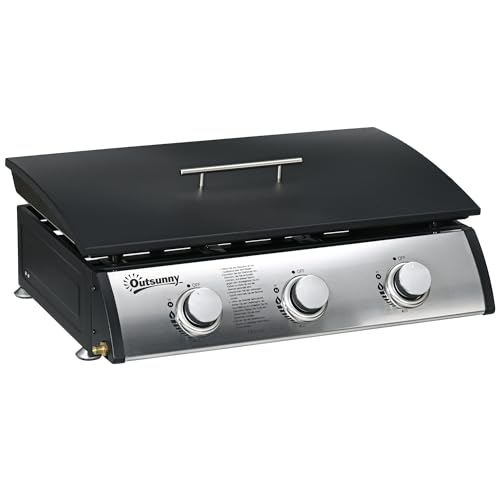
The product photo shows the grill closed. The black lid is gently domed and has a stainless steel bar handle in the middle. Below it is a silver front panel with three round control knobs and the Outsunny lettering, and a brass-coloured connector for the gas hose sits at the bottom of the left side of the housing. There is no frame or wheels; the grill stands on short feet directly on the table. In our overview of gas grills it therefore belongs among the small griddle appliances.
Burners, plate and dimensions according to Aosom
Three main burners, no side burner. According to Aosom each burner delivers 2.5 kW, also given in the shop as 8530 BTU, which matches the conversion exactly. The data sheet in the manual uses this to calculate the nominal heat input: 3 × 2.5 kW gives 7.5 kW.
Ignition is by piezo. Each burner has its own control knob, and after lighting the flame can be turned to any setting between high and low output. Aosom writes that, if needed, just a single burner can be run to save gas.
The sources do not quite agree on the cooking area. Aosom gives it as 63 × 37.5 × 6 cm (length, width, height) and additionally lists a cooking area of 0.22 m² in the product features. The Amazon title mentions 61 × 35.5 cm. Work it out and 63 × 37.5 cm comes to about 2,360 cm², while 61 × 35.5 cm comes to about 2,170 cm², and the second figure is clearly closer to 0.22 m². Our reading: the 63 × 37.5 cm describes the plate including the raised edge, which the height of 6 cm also suggests. This is not confirmed, so we work with the 0.22 m².
Externally the grill measures 63 × 47 × 25 cm and weighs 13 kg. The data sheet lists the material as “stainless steel, metal”, the frame is stainless steel, and the colour is called black+silver. The feet can be adjusted by 2 cm. Under the housing sit a grease tray and a grease cup; the removable tray measures 19 × 5 × 3.8 cm. What the load capacity of 10 kg mentioned in the shop refers to remains unclear, whether lid, plate or housing.
According to Aosom the box contains the grill, the lid, a regulator, a hose and the manual. A cover is not included.
What the manufacturer leaves open
These points are missing from the product page and the German manual:
- Thickness of the griddle plate and the metal underneath the enamel
- Material of the burners and lid in detail
- Maximum temperature and heat-up time
- Lid thermometer, warming rack and carry handles
- Type and connection thread of the supplied regulator
- Spare parts for burner, plate or grease cup
- How many people the area is intended for
In detail: what a lid changes over a plate
On an open griddle grill the heat comes only from below. A thick piece cooks through what the plate passes upwards, and its top stays cool until you turn it. A lid holds the rising hot air over the food, so it also gets heat from above. Cheese on a burger melts, and a thick chicken breast cooks through more evenly. This follows from grilling physics and applies to any griddle grill with a hood; nobody has measured it on this appliance.
For the lid, Aosom advertises “heat storage” and “delicious smoky aromas”. The shop does not explain where the smoke is supposed to come from, and no smoker box is included. Smoke can only arise here from fat and meat juices evaporating on the hot plate.
For closed operation the manual sets a clear limit. You may grill with or without the lid closed. Once it has been closed for five minutes, it is to be opened for one minute “to release the heat”. We suspect that heat builds up faster under a flat hood directly above three burners than in a tall lid on a grill trolley. By this rule the lid is not meant for a pork roast over two hours, but it is fine for the last minutes of a thick steak or for melting cheese.
The grill is never lit with the lid closed, which the manual also requires. The reason is general gas knowledge: under a closed hood, escaping gas can collect before the flame is established. And if the inside of the lid ever flakes off like old paint, according to the manual that is baked-on grease that has turned into carbon. How to remove it is covered below under care.
Incidentally, the manual repeatedly speaks of the “grill grate” although the appliance has a plate. It is evidently written as a template for several models.
How long does a gas bottle last?
A 11 kg propane bottle lasts, in theory, around 20 hours with all three burners at full output, and a 5 kg bottle a good 9 hours. The basis is the data sheet in the manual: 536 g of propane or 545 g of butane per hour.
You can check that these consumption figures fit the output. Propane has a calorific value of around 14 kWh per kilogram. At 0.536 kg per hour that gives just under 7.5 kW, exactly the nominal output of the three burners, and the calculation works the same way for butane at 0.545 kg. If only one burner runs at full power, it is theoretically a third of that. The manual does not quantify how much consumption drops on a low flame.
Which bottle fits is answered contradictorily in the manual. Page 6 says the appliance can be used with any gas bottle between 4.5 and 15 kg of butane or 3.9 and 13 kg of propane. A few lines further on it says: “The maximum weight of the gas bottle is 6.75 kg.” Both cannot be true at once, and it is not resolved anywhere. We would ask the retailer before buying a large bottle. More on sizes and fillings is in the guide gas bottle for the grill.
In Germany the grill runs at 50 mbar, on butane, propane or a mixture of the two. A regulator is included, the hose measures approx. 80 cm according to Aosom, and the manual allows up to 1.5 m. The bottle stands behind the appliance on the left, never directly beside it and never underneath the grill on the base plate, as far away as possible without straining the hose. That fits the photo: the gas connection is on the left.
Setting up, connecting, lighting
For operation, the manual spreads its rules over pages 2 to 4. Here they are gathered in full:
- outdoors only, never in enclosed or covered spaces; the manual calls good ventilation essential
- no trees, shrubs or roofs above the appliance, at least 1 m clearance all round
- away from flammable materials such as paraffin, thinners and anything bearing a corresponding warning
- appliance and bottle stand on a level surface and, in the manual’s wording, must “not be used if they are on fire”
- do not obstruct the flow of combustion air and ventilation openings, and keep the ventilation openings of the bottle and the bottle compartment free and clean
- the bottle at the back left as described above, never beside or underneath
- in strong wind do not operate against the wind, and do not move the appliance during use
- no methylated spirits or petrol for lighting or relighting
- accessible parts get very hot: keep small children away, handle hot parts only with protective gloves
- do not modify the appliance or tamper with sealed parts; modifications can be dangerous, and unauthorised changes void the warranty
- after use, close the gas at the bottle valve or at the regulator
- read all instructions before use and keep the manual
Before the first lighting comes the leak test. For this the manual describes its own mixture: 2 to 3 fluid ounces of solution, one part washing-up liquid to three parts water. The control valve stays closed, the regulator goes onto the bottle, then onto the hose and grill, and only then is the gas turned on. You brush the solution onto the hose and all connections. If bubbles form, there is a leak: close the gas immediately, fix the leak, check again, then close the gas at the bottle. If the leak cannot be fixed, the gas supplier is the one to call. You never look for leaks with an open flame.
To light, you open the lid and turn all knobs to “OFF”. Then you open the gas supply, at the bottle or at the regulator. You press the left knob down and turn it anticlockwise to 90°, which is the full-flame position. The click of the piezo ignition should light the burner. The other burners follow in turn from left to right.
The manual forbids lighting a burner “that does not have a burner assembly directly next to it” and calls this a hazard. Read together with the lighting order from left to right, we understand this to mean that the neighbouring burner should already be burning: the left burner is always the first. So if you only want to use one burner to save gas, you use the left one.
If a burner does not light after two attempts, you turn the knob off clockwise, close the bottle valve and wait five minutes. As a fallback the manual describes lighting by hand: hold burning matches to the ignition pin and then the ignition pin to the burner. Further causes are collected in the guide gas grill will not light.
One passage in the German version is garbled. In step 4 of commissioning the knobs are to be at “OFF” “before you switch off the gas supply”. The section on lighting gives the sensible order that we reproduce above: knobs closed, only then gas. We would stick to that.
What else is worth considering?
| Model | The difference | Price | Our rating | Choose this one if |
|---|---|---|---|---|
| Outsunny gas grill 3 burners 7.5 kW (this one) | Griddle plate with lid, 3 × 2.5 kW | approx. €125 | 7.7 | you want to finish thick pieces under the hood now and then |
| Outsunny 3-burner tabletop gas grill 7.5 kW | same burner output, without lid | approx. €123 | 7.8 | you only cook open on the plate |
| Outsunny gas grill 5 kW tabletop grill | two burners, 5 kW | approx. €100 | 7.5 | two temperature zones are enough for you |
| Broil King Regal 590 | mobile grill trolley instead of a tabletop unit | approx. €1,649 | 9.4 | you have a permanent spot in the garden and often grill for large groups |
The prices come from our price boxes and change constantly in the shops. The rating is our editorial assessment based on the manufacturer’s data; we measured nothing on any of the four grills.
When this grill fits and when another one does
The spot decides first. With a footprint of 63 × 47 cm and 1 m clearance on all sides, you need a free area of about 2.6 × 2.5 m, open sky above, and a stable, level table for 13 kg below. The bottle must find room within reach of the 80 cm hose, behind on the left.
For the balcony this means: a further balcony or a roof overhang above rules it out under the manual’s rules. Aosom does not mention the balcony at all, and whether gas is allowed there is governed by your tenancy agreement and house rules. What to clarify beforehand is in the guide grilling on a balcony.
Then the lid. The Outsunny 3-burner without lid has the same 3 × 2.5 kW and costs approx. €123 (this one: approx. €125). In our rating it is even slightly ahead at 7.8. If you only cook sausages, vegetables and fried eggs, you do not need the lid. If you make burgers with cheese or thicker chicken pieces, take this model.
The Outsunny gas grill 5 kW costs approx. €100 (this one: approx. €125), but has one burner and 2.5 kW less. Our assessment: if you are torn between the two, go for the third burner.
At the very other end is the Broil King Regal 590 at approx. €1,649. A grill trolley of this class is for a permanent spot in the garden and regular large gatherings, not for the table at the campsite. With any of these appliances, add the gas bottle to the purchase price. If you are still torn between plate and grate, work through the questions in the grill finder.
Cleaning, care and storage according to the manual
Clean only when the grill has cooled down and the gas supply at the bottle is closed. A professional technician is to service the grill at least once a year, and according to the manual you are not supposed to service it yourself. If you burn it off for about 15 minutes after each use, only a few food residues remain.
For the individual parts the manual says:
- Griddle plate: mild soapy water, for stubborn stains a non-abrasive scouring powder, then rinse with fresh water.
- Exterior surfaces: mild detergent or bicarbonate of soda and hot water, for stubborn stains likewise non-abrasive scouring powder, then rinse.
- Inside of the lid: clean the flaking carbon residues thoroughly with hot soapy water, rinse with fresh water and let dry completely. “NEVER USE OVEN CLEANER”.
- Inside of the grill base: loosen residues with a brush, scraper or pad, wash with soapy water, rinse, let dry.
- Plastic parts: soft cloth and hot soapy water, rinse; no abrasives, no degreasers, no concentrated grill cleaners.
- Grease collection: do not open the tray during use. To clean, first take out the cup, then pull out the tray. The grease cup is emptied when it is one third full, and removed horizontally once cooled.
- Burners: gas off at the control knob, bottle disconnected, remove the grate (here: the plate). Clean with a soft brush or compressed air and wipe with a cloth, clear blocked ports with a pipe cleaner or a straightened paper clip. If a burner has cracks or holes, it is replaced. When refitting, the gas valve openings must sit correctly in the burner inlet (venturi).
- Flare-up: if a flare-up occurs because insects or spiders are in the burner, you pass a bottle brush through the burner inlet. If that does not help, the gas supplier is the contact.
The gas bottle has its own rules. It is never stored in enclosed spaces but outdoors, upright, well ventilated, out of direct sun and out of reach of children, and never above 50 °C. Flames, pilot lights and other ignition sources stay away, and no smoking nearby. You should not drop it, including into water, or treat it roughly. When you are not using it, you disconnect it from the grill and put the protective cap back on. More on cleaning burners and housing is in the guide cleaning a gas grill.
Who is it suited to?
Aosom names camping, festivals and the beach as places of use, and by weight that is feasible. Two rules from the manual limit this. It must not be run under a gazebo, a tent porch or an awning, because covered spaces and roofs above the appliance are excluded. And sand is not a level surface: on the beach we would bring a solid slab as a base on which grill and bottle stand straight. If you are travelling with the grill, you will find further criteria in our camping grill buying guide.
It is the wrong choice for anyone who wants to see grill marks on a steak, because a smooth plate cannot deliver them. Likewise for people who want to cook roasts or whole chickens slowly under the hood. For that, the lid would have to be allowed to stay closed for longer than five minutes at a stretch.