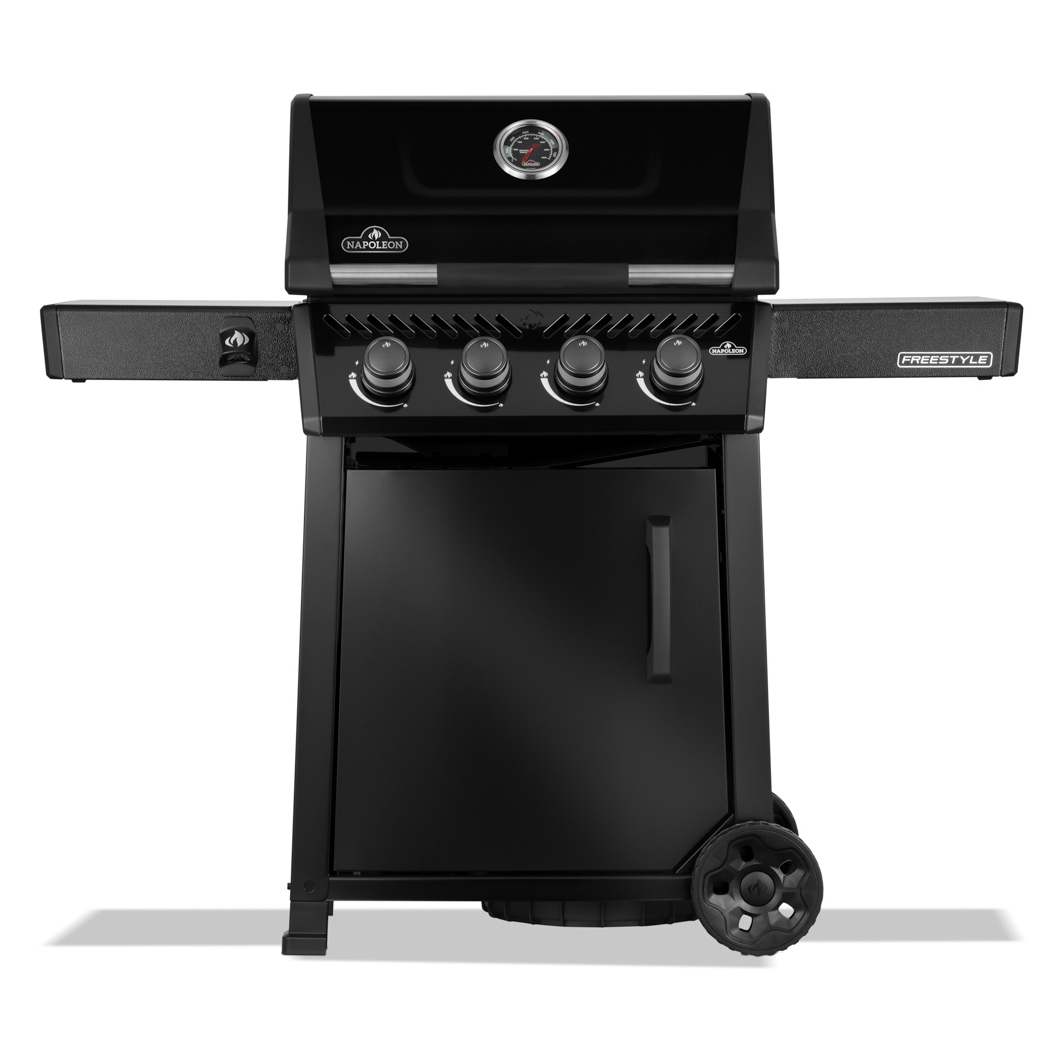
The Freestyle 425 is the gas grill with four main burners in Napoleon’s Freestyle series. In Germany it is called F425DPK-1-DE, is black and runs on propane. In our gas grills category it sits between the smaller Freestyle 365 and the Freestyle models with a side burner. At Santos Grills it is in our price box at approx. €509. Napoleon itself gives an RRP of €599 (retrieved on 02.11.2026) and does not sell directly; the “Where to buy?” button leads to the dealer search.
We have not handled the grill ourselves and have not grilled anything on it. The information below comes from Napoleon’s German product and series pages, from the operating manual N415-0850CE-DE and from the assembly instructions N415-0851CE. Both manuals apply to several Freestyle models; where they show something only on a different model, this is noted.
Burners, grates, cart: what is fitted
Under the lid are four stainless steel main burners, each with its own control knob. The maintenance chapter of the manual refers to thick-walled 304 stainless steel. Together they deliver 13.6 kW, and the F425DPK has no more output than that, because it has no side or rear burner.
Above the burners sit stainless steel flame tamers, called sear plates in some places and flavour bars in others in the manual. On these go the main grates made of porcelain-coated cast iron, called Iconic WAVE by Napoleon, in the parts list S83008. The main grate measures 60 x 45 cm, and according to the technical specifications 26 burgers fit on it. Above it hangs a stainless steel warming rack, and with it Napoleon arrives at 3,684 cm² of total cooking area. Multiplied out, the main grate is 2,700 cm². The remaining 984 cm² are probably the warming rack; it is not stated separately anywhere.
Ignition is by JETFIRE. In the lid there is the ACCU-PROBE thermometer, according to Napoleon’s Freestyle overview. The parts list gives the lid as the black cover N010-1535-BK, and it is the same assembly as on the Freestyle PRO 425.
Below, the cart is closed; Napoleon speaks of a closed cart design. On the sides are fold-down shelves with tool hooks and a bottle opener, and Napoleon describes the wheels as all-terrain. The 7-inch wheels (just under 18 cm), the powder-coated shelves and the retaining ring for the gas bottle from the feature overview in the manual should not be transferred to this grill: what is shown there is a Freestyle PRO with an infrared side burner.
Assembled, the Freestyle 425 is 132 cm wide, 63.5 cm deep and 116 cm high, and 154 cm with the lid open. If you fold the shelves down, 84 cm of width remain. It comes in a carton of 50.80 x 71.76 x 79.38 cm that weighs 51.59 kg. According to the assembly instructions, no tools are included. They advise unpacking all parts beforehand, placing the assembly on a solid, level and horizontal surface and using the main carton as a mat to protect against scratches.
In detail: how much output reaches each square centimetre
A kW total says little as long as you do not know how much grate it has to heat. We therefore divide the main burner output by the main cooking area. For the Freestyle 425 that is 13.6 kW on 2,700 cm², so 5.0 W per square centimetre. The Freestyle 365 delivers 12 kW on 51 x 45 cm, which is 2,295 cm² and 5.2 W. It is therefore even slightly ahead. The fourth burner makes the grate wider, not hotter.
Calculated in the same way from manufacturer figures, the Weber Spirit E-410 with 8.21 kW on 2,761 cm² comes to 3.0 W, and the Broil King Regal 590 with 16 kW on 4,032 cm² to just under 4.0 W. Napoleon heads the kW column in the manual with “heat input”. What is meant is the energy that flows into the burners as gas. How hot the grate ends up also depends on the lid, the outside temperature and the wind. For comparing two grills the quotient is still useful, but it does not replace a temperature figure.
What the manual says about grilling itself fits on one page. You preheat with all main burners on the highest setting with the lid closed, for about 10 minutes; if the grill does not get hot enough, the troubleshooting section advises 10 to 15 minutes. Fish and vegetables that cook only briefly may sit with the lid open. With the lid closed it gets hotter and more even according to Napoleon, meat cooks more evenly, and the cooking time can be shorter. Lean meat such as chicken breast or pork sticks less if you oil the grates before preheating.
For indirect cooking, on the other hand, the fourth burner has a real benefit. For roasts and anything that takes longer than 30 minutes, the manual says: switch on the opposite burner and place the food where there is no flame. With four burners side by side you can light the two outer ones and leave the middle ones off, or you heat one half with two burners and leave the other cold. If the burners are evenly spaced, with two burners switched off about 30 cm of grate width remain without a flame beneath, by calculation. How to divide the zones for roasts, poultry or ribs is explained in our guide to direct and indirect heat.
Against flare-ups you trim excess fat or turn the temperature down. If it flares up anyway, you push the food out of the flames, turn the heat down and leave the lid open.
Freestyle 425 or Freestyle 365: is the fourth burner worth it?
If you often grill for larger groups or want to cook indirectly, yes. The 425 has 17.6 percent more main grate and one more zone. If you mostly grill for a few people and directly over the flame, the 365 is enough in our assessment, because the fourth burner does not bring more heat per area.
Both belong to the same series and have JETFIRE ignition and Iconic WAVE cast iron grates. The differences in numbers: 13.6 instead of 12 kW, 60 instead of 51 cm grate width at the same depth, 3,684 instead of 3,194 cm² total area. At Napoleon the 425, with an RRP of €599, is €100 above the 365 with an RRP of €499.
In our price box the Freestyle 365 is at approx. €409, the Freestyle 425 at approx. €509. The fourth burner therefore costs about €100 extra there. Retailer prices do change, though, so compare both on the day you order.
What are the alternatives?
| Model | The difference | Price | Our rating | Choose this one if |
|---|---|---|---|---|
| Napoleon Freestyle 425 (this one) | 4 burners, 13.6 kW on 60 x 45 cm, no side or rear burner | approx. €509 | 8.8 | you grill for larger groups and need an indirect zone |
| Napoleon Freestyle 365 | 3 burners, 12 kW on 51 x 45 cm | approx. €409 | 8.8 | you mostly grill for a few people and want to save the roughly €100 extra for the fourth burner |
| Weber Spirit E-410 | 4 burners, 8.21 kW on 2,761 cm² | approx. €548 | 8.9 | you want to buy from Weber and accept less output per area |
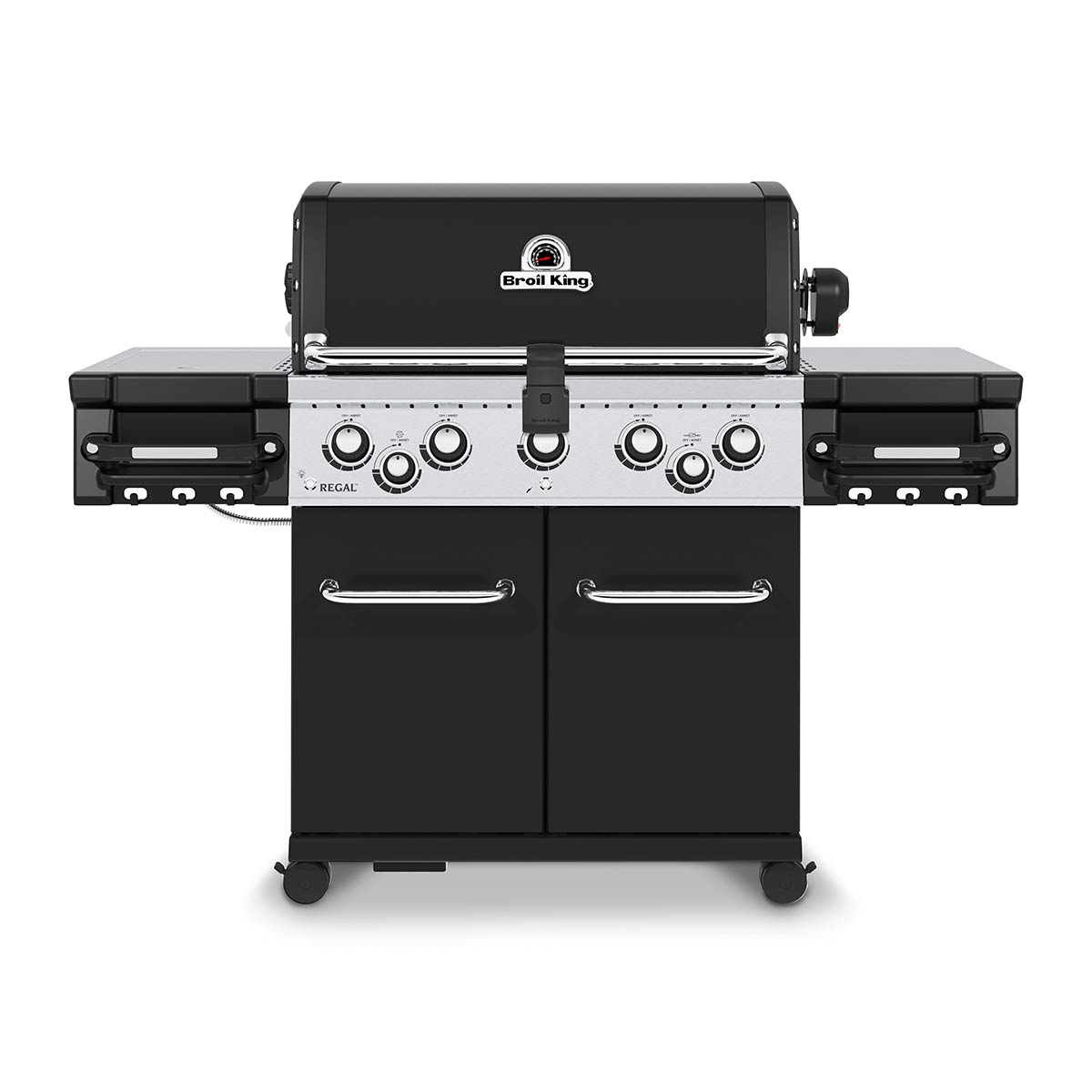
| Broil King Regal 590 | 5 burners, 16 kW, rear burner with 4.4 kW, rotisserie set included | approx. €1,649 | 9.4 | you often grill on the rotisserie and can spend a good three times as much |
The prices are retailer prices from our price box and may look different today. The rating is our editorial assessment from manufacturer data; we have not measured anything on any of the four grills.
Site and gas connection according to the manual
The first line of the manual is in capitals: use only outdoors in a well-ventilated area. If you smell gas, you turn the gas off at the appliance, extinguish every open flame and open the lid. If the smell persists, you keep away from the appliance and call your gas supplier or the fire brigade immediately.
On the balcony, Napoleon’s sources contradict each other. The product text calls the grill “ideal for patios, balconies and smaller gardens”. The manual says the appliance is “intended for use on an outdoor patio or in your garden”. We follow the manual. Whether gas is allowed on your balcony at all is decided by your tenancy agreement and house rules; what to watch for is covered in our guide to grilling on the balcony.
The site must be above ground and open, with natural ventilation and no areas of still air, so that wind and convection quickly disperse gas leaks and combustion products. Not in a building, a garage or any other enclosed space, not in a built-in or slide-in installation, and the ventilation openings in the cylinder housing stay clear. From combustible materials you keep 610 mm clearance at the rear and 178 mm at the sides; next to vinyl cladding or glass panes Napoleon recommends a further 610 mm. With the shelves extended you therefore need a free width of 167.6 cm and a depth of 124.5 cm to the nearest combustible wall, calculated from the dimensions; your own space in front of the grill comes on top.
Page 7 also contains, among others, these warnings: do not operate under combustible coverings or structures, do not set up where strong wind hits, especially directly from behind, and hoses must not touch hot surfaces. According to the same page, an approved gas installer must carry out the connection and installation of the gas and hose connection and check it for leaks before operation. According to the manual, the grill can be operated safely down to an outside temperature of minus 17.8 °C.
For Germany the gas category I3B/P(50) applies: butane or propane at 50 mbar. As a bottle the manual names propane from 6 kg or butane with 13 kg, built and marked in accordance with national and regional regulations. The parts list gives regulator and hose as N530-0032 (DE). Whether it is in the box for the German sale is open: the manual on the one hand requires the supplied regulator and hose, but elsewhere writes “if not included” and then permits those that comply with national and regional regulations. Ask the retailer. A hose of 0.9 m is recommended, it must never be longer than 1.5 m, and it is replaced before the printed expiry date. No bottle you connect may be filled to more than 80 percent.
The connected bottle stands in the base cabinet on the lower shelf, but only if it stays within the maximum width and height; larger ones you place outside on level ground. What those dimensions are is not printed in the manual. According to page 2, an unconnected propane bottle must not be stored near this or any other appliance. When you open the bottle valve, all burner controls must be off. Which bottle size pays off for you is covered in the guide on the gas bottle for the grill.
You perform the leak test before first use, annually and after every replacement of gas components. After every bottle change you check the connection between pressure regulator and bottle. The steps according to page 12: do not smoke, remove all ignition sources, set all burner controls to off, open the gas supply valve, coat all connections and fittings of regulator, hose, manifold and valves with a mixture of half liquid soap, half water. Bubbles indicate a leak. Then you tighten loose connections. If the leak cannot be stopped this way, you close the gas supply immediately and disconnect the grill, have it checked by a certified installer or retailer and do not use it until the leak is fixed. You never look for a leak with an open flame.
The first start: burn-off, lighting, seasoning the grates
Before the first fire, packaging, promotional labels and cards come off the grill. You wash the grates by hand with warm water and mild washing-up liquid, not in the dishwasher, rinse them hot and dry them thoroughly with a soft cloth so they do not rust.
Then comes the burn-off: warming rack out, main burners on the highest setting for 30 minutes. That the grill smells during this is normal according to Napoleon; internal paints and lubricants from manufacturing burn off, and it only happens the first time.
To light it, you open the lid. You push a main burner knob and slowly turn it counter-clockwise to HIGH until the pilot flame burns, and hold it pressed until the burner lights. If the pilot flame does not appear, you immediately turn the knob clockwise to OFF and try once more. If pilot flame and burner do not light within 5 seconds, the knob likewise goes to OFF, and you wait 5 minutes until the gas has dissipated.
You season the cast iron grates before first use, and here the manual writes MUST in capitals. This is repeated every 3 to 4 uses. The grates sit on the grill at 176 to 204 °C for 30 to 60 minutes. Napoleon advises oils with a high smoke point and names avocado oil, safflower oil, sunflower oil and beef tallow; you should avoid butter and margarine.
Cleaning, care and maintenance
Before you start, all burners are off and the grill has cooled down. The manual requires protective gloves and safety goggles and reminds you that accumulated grease is a fire hazard.
You brush the cast iron grates with a brass wire brush. If rust forms, you use a scouring sponge or a brass brush and then re-season the grates. For the interior you take out the grates, brush loose residues from the sides and underside of the lid with the brass wire brush, scrape the sear plates with a scraper and remove ash with a wire brush. Then the sear plates come out, the burners are brushed off, and what is left you sweep into the grease tray. On porcelain parts you work with plastic scrapers.
You clean the grease tray every 4 to 5 uses. Only inserts approved by Napoleon may go in, no aluminium foil, no sand. A disposable grease tray, if you use one, is replaced every 2 to 4 weeks depending on use.
According to the manual, oven cleaner, the self-cleaning oven for grates or other grill parts, pressure washers, as well as abrasive cleaners and steel wool on painted, porcelain-coated or stainless steel parts are taboo. Cold water, including rain or a sprinkler, should not hit the hot grill, because the temperature shock can make the porcelain chip. According to Napoleon, barbecue sauce and salt act corrosively if you do not remove them regularly. You clean the control panel only with warm soapy water and a soft cloth, otherwise the printing wears off. If stainless steel turns golden or brown over time, that is normal according to the manual. In harsh environments, stainless steel and chrome surfaces should be cleaned with warm soapy water every 3 to 4 weeks.
Once a year a qualified specialist should thoroughly inspect and service the grill. A step-by-step guide for the spring clean is in our guide cleaning a gas grill.
Accessories, running costs and warranty
On the product page Napoleon lists three matching parts with a price: the grill cover 61444 for the Freestyle series with an RRP of €84.95 (on 02.10.2026 it was still €79.95), the rotisserie kit 69302 with an RRP of €149 and a cast iron charcoal tray with smoker basket, 67732, at an RRP of €54.95. The assembly instructions also list foil grease trays in a five-pack (62007). A gas bottle is not part of the delivery. If you add the cover at RRP to the price box price, you end up at just under €594, still without a bottle and gas.
Napoleon advertises a 10-year limited warranty. The terms in the manual graduate it by component. Ten years apply to cast aluminium parts and stainless steel base, stainless steel lid and porcelain-coated lid. Five years plus 10 apply to a painted steel lid, stainless steel tube burners, stainless steel flame tamers, porcelain-coated cast iron cooking grates and ceramic infrared burners. Porcelain flame tamers have three years plus 10, all other parts two years. Which lid row applies to the F425DPK depends on the lid material, and that is not stated in Napoleon’s information on this model. Plus10 means: for a further 10 years you get the replacement part at 50 percent of the current retail price.
Excluded are damages from improper operation, poor maintenance, grease fires, environmental influences, accidents, modifications, misuse or negligence, as well as scratches, dents, paint damage, coatings, corrosion or discolouration caused by heat or abrasive and chemical cleaning agents, and chipping on porcelain-coated parts. With replacement parts from other manufacturers the warranty lapses. According to the warranty text, your statutory warranty rights remain unaffected.
What Napoleon does not state
A few questions that suggest themselves before buying are not answered by Napoleon’s documents on the F425DPK. We have collected them here instead of spreading them through the text:
- Net weight: open, only the weight including carton is known.
- Maximum temperature under the lid: no manufacturer figure.
- Measured heat-up time: only the recommendation to preheat for about 10 minutes.
- Output per burner: only the total for all four.
- Material of cooking chamber, lid, base cabinet and door.
- Maximum dimensions of the gas bottle for the base cabinet.
- Wheel diameter on the F425.
- Country of origin or manufacture.
- Number of people: only the 26 burgers.
When the Freestyle 425 fits, and when another grill does
For how many people the area is enough, the calculation is yours. Napoleon only gives burgers. If you often have sausages, steaks and vegetables on at the same time and a roast cooking indirectly alongside, then 60 cm of grate width with four zones is, in our assessment, the reason to choose this model.
If you rent and want to grill on the balcony, it is the wrong choice as long as house rules or the roofing do not allow it; the manual intends it for patio and garden, and with safety clearance it needs a good 1.6 m of width. In that case, take a look at our Grill Finder, where electric and table grills can be filtered by space.
If you want to keep a pot hot next to the grate, take the variant with a side cooktop (details in the questions below). If you want to turn chicken or a roast on a spit, that only works here with the accessory kit and without a rear burner; the Broil King Regal 590 comes with a rear burner and rotisserie in the delivery, but it is in our price box at approx. €1,649 instead of approx. €509.
If you buy second-hand, the manufacturer’s warranty does not apply, because it is only for first buyers. If you value the ten years, buy new and ask beforehand whether the retailer is one of Napoleon’s authorised dealers.