An event grill from the wholesale market
The METRO Professional 8-burner gas grill is a mobile stainless steel grill with eight burners in a row, built for serving stands at fairs and in catering. METRO lists it in its wholesale market as “Edelstahl-Eventgrill 8-flammig” (stainless steel event grill, 8 flames) under article number 780-0838i. In our gas grills category, at approx. €872 (Amazon page on 20.10.2026: €871.90), it sits in the same price range as well-equipped hooded grills for the garden, but it is a very different kind of device.
METRO Professional is the wholesaler’s own brand. The manual names MCC Trading International GmbH in Düsseldorf as the distributor, and according to the METRO marketplace the grill is made in China. Our most important source is the German assembly and operating manual (pages 18 to 26 of a multilingual booklet), supplemented by the product pages in the METRO wholesale market and on the METRO marketplace, as well as the bullet points in the Amazon catalogue.
On intended use, METRO writes three sentences. The grill is suitable for grilling food in well-ventilated outdoor areas and indoors. It is intended for commercial use. And it must not be used for purposes other than those described, to avoid injury and damage to property. “Indoors” does not mean a garage, which the manual expressly excludes elsewhere (more on that below). The marketplace text, incidentally, mentions only commercial catering use outdoors. According to the manual, the grill complies with the standard EN 203-1:2021, the European standard for gas appliances in commercial kitchens.
What the photo shows and what the data table says
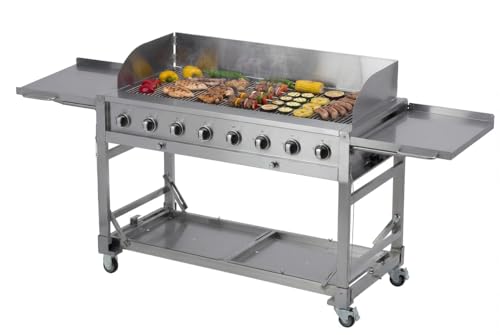
The product image shows a long, rectangular burner chamber on a stainless steel frame with four casters. At the back and on both narrow sides, a tall metal sheet rises above the grate as a windshield. At the front, eight control knobs sit side by side, horizontal shelves extend to the left and right, and there is another shelf in the lower frame.
METRO lists the components like this: 8 gas igniters, 8 porcelain flame spreaders, 4 stainless steel grill grids and a stainless steel windshield. In addition there are 2 powder-coated grease trays, a control panel made of 430 stainless steel, 8 control knobs made of ABS plastic and 2 stainless steel folding handles with a pull-out holder. According to the marketplace, the housing, grate and frame are made of stainless steel. Of the four casters, two are swivel casters with brakes.
The lid is flat, can be folded up and, according to METRO, can also be used as a side shelf. The manual refers in several places to “covers” in the plural, so it is quite possible that the two shelves in the photo are the opened lid sections. This is not documented. For the purchase decision, something else matters anyway: this lid is not a cooking hood under which heat builds up.
On the grilling area, the sources differ by one centimetre. The manual’s data table gives a cooking zone of 120 × 48 cm, while the marketplace and Amazon give 120 × 49 cm (METRO calculates 0.59 m² from this). We go with the manual. The grilling height is 89.5 cm, which is roughly the height of a kitchen worktop.
Opened out, the grill measures 260 cm in length, 65.5 cm in depth and 107.5 cm in height according to the manual, and 141.5 cm, 65.5 cm and 91.5 cm when folded. The table gives the values as H × W × D and puts the 260 cm in the depth column; evidently the long side is meant. The wholesale market (109 × 260 × 65 cm) and the marketplace (112 × 259 × 66 cm) differ by a few centimetres. METRO gives the weight as 62 kg, and the manual says it bluntly: the unit is large, so assemble it with two people.
In detail: 32 kW across 120 centimetres, and why the lid stays open
According to the data table, each of the eight main burners has a nominal heat input of 4.0 kW, 32.0 kW in total. The burners are made of stainless steel. Arithmetically, each one covers a strip of 15 × 48 cm, and spread across the whole cooking zone that comes to a good 55 kW per square metre. For an open grill, this figure says only so much about how hot it really gets at the grate, because without a hood a lot of heat is lost upwards and sideways.
That is exactly where the difference from a hooded grill lies. Under a closed hood, hot air circulates, and a roast cooks even over a switched-off burner. That is the principle of the indirect zone. With the METRO, the manual requires you to open the cover and unfold the windshield before lighting, and you may only operate it with the windshield properly unfolded. So you grill open, directly over the flame. The windshield keeps side wind away from the flames, but it does not replace a hood. How the two cooking methods work together is explained in the guide Direct and indirect heat.
There are zones all the same, just side by side rather than one above the other. Each burner has its own control knob, so you can grill on full flame on the left and run two burners low on the right to keep finished food warm. Ignition, however, is by group. The grill has two battery-powered electronic ignition devices, one each for the left and right burner groups, and according to the manual you light the remaining burners via their controls once the first is burning. We therefore read the 8 gas igniters in METRO’s list as electrodes at the burners, triggered by two igniters.
The porcelain flame spreaders sit above the burners. On gas grills, covers like these protect the burner openings from dripping grease and spread the heat of the narrow flame outwards; some of the grease vaporises on them. That is the usual function of the component, and METRO itself does not describe it in detail for this model.
There is also flame monitoring. If the heat sensor no longer detects heat, for example because wind has blown out a flame, a signal goes to the shut-off valve, which interrupts the gas supply.
Do I need two gas bottles for the METRO?
Very likely yes. According to the data table, a single pressure regulator is rated for 1.5 kg of gas per hour, but at full power the grill uses around 2.5 kg. The parts list shows two regulators with hose. The manual does not, however, literally require two bottles anywhere.
The exact values: 2484 g/h with propane, 2521 g/h with butane. The grill runs on low-pressure propane or butane (LPG), and natural gas is excluded. For Germany, appliance category I3B/P (50) applies, meaning butane G30, propane G31 and their mixtures at 50 mbar, with regulator type 424DT and a 0.89 mm nozzle on each main burner. You may only use the regulators supplied or equivalent ones to EN 16129. According to the marketplace, the regulator, hose and hose rupture valve are included. When connecting, a note from the manual helps that would otherwise cost you nerves: the gas connections have a left-hand thread, so the nut is tightened anticlockwise. Sealing tape or liquid sealant is off limits, and you secure the connection only with the supplied fittings.
METRO recommends bottles of 5 or 11 kg. With two full 11 kg bottles, so 22 kg of propane, that is enough on paper for just under 9 hours with all burners on HI, and with two 5 kg bottles for around 4 hours. On a lower flame the gas lasts longer; how much longer depends on your settings. For events in spring or autumn, one sentence from the manual matters: butane bottles are best suited to summer, because below +10 °C they work significantly less efficiently. What the bottle sizes cost and how you swap them is covered in the guide Gas bottle for the grill.
What the manufacturer does not state
These points appear neither in the manual, nor on the two METRO pages, nor in the Amazon catalogue:
- a manufacturer warranty beyond the statutory warranty rights
- a maximum temperature at the grate
- a lid thermometer
- bar thickness of the grates and the stainless steel grade of the housing, frame and grate (grade 430 is documented only for the control panel)
- the burner design
- spare part numbers and how long spare parts remain available
- a customer service address; the manual refers you to the place of purchase
- a number of people the grill is designed for
- a statement on use on a balcony
- market launch of the model
- side burners, rear burner, warming rack, lighting: the feature list on metro.de does include such fields, but without a value. We read them as empty filter fields, not as equipment.
Organisers miss the number of people most. Earlier versions of this page mentioned 30 to 50 guests, and there was no source for it. How much food you should plan per guest and how to derive the area you need from that is worked out in the guide Planning a barbecue party.
These three alternatives are worth a look
| Model | The difference | Price | Our rating | Choose this one if |
|---|---|---|---|---|
| METRO Professional 8-burner gas grill (this one) | 8 × 4 kW on 120 × 48 cm, flat folding lid, mobile and foldable | approx. €872 | 8.5 | you grill commercially for many guests at once and take the grill with you |
| Broil King Crown 590 | Hooded grill with 5 burners, main grate approx. 65 × 44 cm | approx. €967 | 9.0 | you grill privately in the garden and also want to cook with the lid closed |
| BURNHARD Fat FRED Deluxe+ | Hooded grill with 89 × 41.5 cm, rear burner and side burner | approx. €1,399 | 8.6 | you often host many guests at a fixed spot |
| Broil King Regal 590 | Hooded grill with 80 × 48.8 cm, rear burner and side hob | approx. €1,649 | 9.4 | you want a garden grill for all cooking methods and do not need catering quantities |
The prices come from our price boxes and change constantly at the retailers. The rating is our editorial assessment of the manufacturer data; we have not measured anything on any of the four grills.
When the METRO fits and when another grill does
The first question is not the number of guests, but who is standing at the grill. METRO built the unit for commercial use by professionals. If you grill privately, we would not buy the METRO, not even for the one big garden party a year. The Broil King Crown 590 costs approx. €967 and the METRO approx. €872, so a similar budget. For that you get a hood and with it indirect cooking, on much less area.
Second, space. Set up, the METRO needs the length given above plus room for two bottles beside it, and it stands on a level, non-combustible surface. On a lawn at a club event, that means slabs or solid ground under the frame. For a yard behind a snack bar, it is more of a detail.
Third, the cooking method. If you mainly grill bratwurst, steaks, skewers and vegetables in quantity, the open grate suits you. If you want to cook spare ribs, a whole chicken or a roast with the lid closed, the METRO is the wrong tool. The BURNHARD Fat FRED Deluxe+ has a hood, rear burner and side burner and costs approx. €1,399, the METRO approx. €872. The Broil King Regal 590 is at approx. €1,649; in our comparison it is the all-rounder, but not a unit to take with you.
Fourth, the budget beyond the purchase price. The cover is included; it is made of 600D polyester with a PVB coating and has two hanging rings, two vents and a drawstring. You buy the gas bottles and two AA batteries (1.5 V, LR6) for the ignition separately. And every one to two years a new hose is due, which according to the manual is replaced by a qualified technician or the retailer.
Setting up, connecting, cleaning: what the manual prescribes
The general safety instructions on page 19 are long. They include the following points, and you should still read the manual in the box in full:
- never operate in enclosed environments such as garages or sheds, because of carbon monoxide and the risk of explosion
- place on a safe, level, stable and non-combustible surface, not near heat sources
- before use, lock the wheels with the brakes, and do not move the unit during use
- no modifications to the unit, only accessories recommended by the manufacturer
- not under gazebos, parasols or similar, at least 3 m distance from such objects
- not in the immediate vicinity of aerosol cans, flammable liquids, volatile gases or other flammable substances, and do not store such substances nearby either
- do not leave unattended during use
- no liquid fuels, and never charcoal or other solid fuels
- do not lean over the grilling area when lighting and grilling
- not suitable for people (including children) with reduced physical, sensory or mental capabilities; always supervise children
The gas side is just as strict. You check connections regularly and after every bottle change, never with a match or open flame. You do not adjust the regulator or gas supply, the unit does not run without a pressure regulator, and after every use you close the bottle and disconnect the hose. You store bottles upright, not indoors and not near heat sources. You check the hose for cuts, cracks and excessive wear before and after every use. It must not touch hot surfaces, nobody may trip over it, and it must not be kinked, twisted or laid over sharp edges. You have brittle hoses replaced, and work on them is done only by a specialist. Before connecting, you also check the bottle head, regulator and burners for spiders, small insects and cobwebs, because they can cause a flashback.
For the leak test, all controls are on OFF, you open the bottle valve and brush leak-detection spray or a solution of half water, half soap onto every connection, in a well-ventilated place with no flames or sparks nearby. If bubbles form, you close the gas, tighten the connections and test again. If the bubbles remain, you do not use the grill and contact the retailer. After connecting, you wait 5 minutes to see whether gas escapes anywhere.
If you smell gas, you do not ignite. You immediately close the gas supply at the unit and at the bottle or regulator, extinguish open flames nearby such as candles or torches, switch off electrical devices in the vicinity and ventilate. If the smell is still there afterwards, that is the end of it: only an authorised specialist may then repair it.
Before the first grilling session, you burn off the grill with the windshield unfolded for about 10 to 15 minutes at high temperature. The flame must be blue and even, and a yellow flame indicates too little oxygen; you check this on every use and call a specialist if the flame pattern looks abnormal. A grease fire is never extinguished with water, and all controls go to OFF. To switch off, you first close the bottle valve and wait until the flame is completely out, then turn the controls to OFF and let the grill cool for about 5 minutes with the cover open. The protective cover goes on only when it is completely cold.
Cleaning is done cold only. After every use, you wipe the grill with a slightly damp cloth and a little soap. For the stainless steel surfaces, the manual specifies mild washing-up liquid in warm water; bleach, chemical, alkaline or abrasive cleaners as well as steel wool and steel brushes are excluded. It permits a wire brush in exactly one place, for rust on the surface of the burners. You clean the burners at least once a year, or when they are dusty, with a pipe cleaner, but never immerse them in water. You scrape grease out of the fire chamber with a plastic or wooden spatula after removing the burners. You empty the grease trays regularly even while grilling and clean them after every use with warm water and mild washing-up liquid.
The care routine has a reason. According to the manual, dirt, grease and soot, or rain without subsequent cleaning and drying, lead to corrosion. 430 stainless steel, of which the control panel is made, contains no nickel and develops surface rust more quickly than the chromium-nickel steel 1.4301 (304). More on cleaning is in the guide Cleaning a gas grill. All work beyond the manual, including conversion to a different gas type, belongs with an authorised service point or qualified specialist staff. According to METRO, the grill has no parts you can repair yourself.
Who is it suitable for?
Before guests and area come into it, the first page of the German section of the manual states in capital letters who is to operate the grill. The warnings there read, in essence:
- suitable only for professional use and to be used only by qualified professionals
- installation and, where applicable, conversion to other gas types only by qualified professionals
- accessible parts can become very hot, keep children away
- keep away from flammable materials during operation
- do not move during operation
- close the gas supply at the gas bottle after use
- no modifications to the unit; do not alter parts sealed by the manufacturer or its agent
- read the operating manual before commissioning
That clearly defines the target group: caterers, snack businesses, canteens with an outdoor stand and clubs in which someone with the appropriate qualification sets up, connects and looks after the unit. For them, the METRO delivers what a garden grill does not have: a long open surface with eight separately adjustable burners and a frame that folds together for transport.
We would advise against it for two groups. Private users looking for a large grill for family celebrations, because the manual simply does not provide for them as users. And anyone who wants to cook with the lid closed, even in commercial use. If you are unsure which size and design suit your needs, the Grill Finder narrows it down in a few questions.