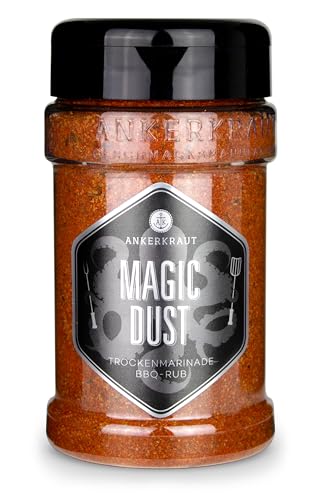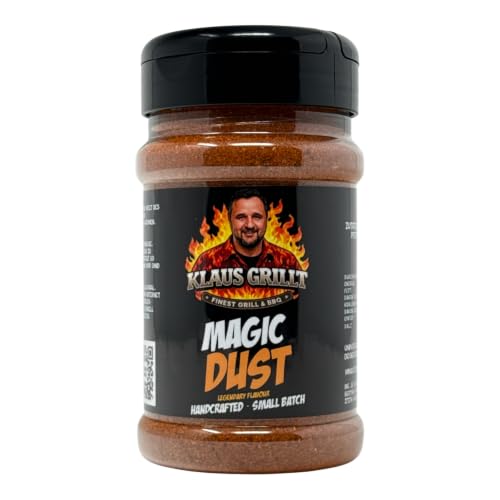
Several brands sell barbecue seasonings under the name Magic Dust, in our catalogue for instance Ankerkraut as well. This one carries the Klaus grillt logo and comes in a 240 g shaker. The manufacturer’s shop calls it a BBQ seasoning blend, that is, a rub that goes dry onto meat or vegetables before they hit the grate.
Nobody here has tasted the blend, and nothing was grilled with it either. Where flavour is concerned, we therefore repeat the manufacturer’s words and say what we make of them. Two things, however, are out in the open and more reliable than any description of taste: the ingredient list and the nutrition table. From them you can read off fairly precisely how the rub behaves over the embers.
In our catalogue it sits in the category Rubs & Sauces, alongside blends whose name already points at a particular meat.
Which shaker is behind our link
On Amazon the item is called “Klaus grillt Magic Dust 240g Streuer” under ASIN B0H82MT1R4. In the manufacturer’s shop rubs.kaufen the same shaker has the article number KGWM0006 and the EAN 4260769225755.
That settles an error from the earlier version of this page, which described a 250 g bag. The shop does not carry a bag for this blend at all; two shakers are listed: this one and a large one with 750 g.
The product photo shows a transparent, round container with a black lid, and through the wall you can see the red-brown powder. The label shows a portrait in front of drawn flames, below it the lettering “Klaus grillt” and “Finest Grill & BBQ”. Large follows “Magic Dust”, smaller “Legendary Flavour” and “Handcrafted · Small Batch”. On the left edge sits a QR code.
According to our price box, the shaker costs approx. €9.95 on Amazon. The manufacturer’s shop asked the same amount on 10 November 2026 and shows €41.46 per kilogram for it. Calculated per 100 g, that is about €4.15.
Who mixes the rub and who owns the name
Klaus grillt is a grilling channel. The manufacturer’s shop describes it on its page about joint videos like this: Dutch oven, smoker, gas and charcoal grill, everything goes on the grate. The shaker still does not come from the channel’s kitchen.
According to the shop and the Amazon catalogue, it is made by Big Js Seasoning GmbH, Bertha-von-Suttner-Straße 4 in 27374 Visselhövede. In the imprint the company is registered at the local court in Walsrode under HRB 209063, and the managing director is Jan-Markus Eckenberger. The brand itself belongs to someone else: according to the same imprint, “Klaus grillt” is a registered trademark of Klaus Glaetzner. So name and logo come from the channel, while mixing and filling are done by a seasoning maker in Lower Saxony.
About production, Big Js writes that every batch is freshly mixed, filled and shipped from the manufactory in Visselhövede. That fits the print “Small Batch”. How small such a batch is remains open.
The reverse route exists too. Below the Magic Dust recipe on klaus-grillt.de, a button “Jetzt Kaufen” leads directly into this shop, marked as advertising.
Nine ingredients, no chilli
The manufacturer’s shop and Amazon print the ingredient list word for word identically: spices (paprika, garlic, pepper, onion, nutmeg, allspice, cinnamon), salt, sugar.
Seven spices plus salt and sugar make nine ingredients. What is missing is revealing. Chilli, cayenne, mustard and smoked ingredients are not in it, nor are anti-caking agents, flavourings and oil. The only hot component is pepper. Nutmeg, allspice and cinnamon are better known here from gingerbread and mulled wine than from BBQ rubs, and exactly these three set the blend apart from a plain paprika, sugar and salt rub.
The manufacturer keeps its own flavour description general. It speaks of a balanced combination of paprika, garlic, onion, pepper, herbs and some sweetness. Two things do not fit the list here: herbs are not among the ingredients, and cinnamon, allspice and nutmeg do not appear in the description.
The earlier version of this page also named rock salt, cane sugar and rapeseed oil as ingredients. No manufacturer source confirms that. The shaker simply says salt and sugar, and oil does not appear in the list.
Per 100 g the shop publishes these nutritional values: 1082 kJ (257 kcal), 4.3 g fat, of which 0.9 g saturates, 45.7 g carbohydrates, of which 42.5 g sugars, 5.0 g protein and 31.6 g salt. Sugar and salt together come to 74.1 g, so just under three quarters of the shaker’s contents.
One detail does not quite add up. Under EU law, ingredients are listed in descending order of weight, and here salt comes before sugar. In the nutrition table, however, the sugar is 10.9 g above the salt. The spices may supply part of that, since paprika and onion powder naturally contain sugar, and the table counts every sugar. Whether that explains the whole gap cannot be calculated from the outside.
In detail: what sugar and salt mean over the embers
Household sugar begins to caramelise at roughly 160 to 170 °C. If the surface gets hotter, it breaks down further, the crust turns black and tastes bitter. Paprika powder, the first spice on the list, darkens similarly fast under strong heat.
How hot the surface gets depends on its moisture. As long as water evaporates at the meat’s surface, it stays below 100 °C, even if the cooking chamber is at 120 °C. Cooked indirectly, in a smoker or in the oven, it dries out slowly, and the sugar browns gradually. Directly over full heat, the water is gone after a few minutes, and then the temperature of the crust quickly rises above the threshold at which it burns.
That matches what Big Js promises: a crusty, aromatic surface. We would therefore use the blend above all for ribs and large cuts that cook long and indirectly. Chicken legs we would first let draw through indirectly and only put over the embers for the last few minutes. How long ribs stay in which phase is shown in our guide to the 3-2-1 method for spare ribs.
With salt the same sober look is worthwhile. Almost a third of the powder is salt. The German Nutrition Society (Deutsche Gesellschaft für Ernährung) gives a reference value for adults of at most 6 g of salt a day. Anyone told to eat low-salt can hardly use a rub with this share the way rubs are usually used, as a covering layer. And if you brine your meat beforehand or dry-salt it, you salt a second time with Magic Dust.
What Klaus grillt intends the blend for
According to the product page, the rub rounds off meat, ribs, poultry and vegetables. As cooking methods the shop lists classic grilling, smoking and the oven. Pulled pork and burgers, which used to be listed here as uses, do not appear separately in this list, but both fall under meat.
More informative is the channel’s website. The recipe for Magic Dust is there in the section for rub and seasoning recipes, subsection poultry. It is a do-it-yourself guide, not the label of the finished product, and even the wording differs: the house recipe calls for sea salt and brown sugar or cane sugar. Whether the manufactory in Visselhövede mixes to exactly this recipe is clear neither from the shop nor from the recipe page.
If you prefer to mix yourself and keep the shares of salt and sugar in your own hands, you will find the basic formula in our guide Making BBQ Rub Yourself.
Is the 750 g shaker worth it?
Yes, if you use the rub regularly. In the manufacturer’s shop the large shaker costs €24.95, according to the shop €33.27 per kilogram. For the 240 g shaker it is €41.46 per kilogram, so a good €8 more per kilo.
It becomes clearer with three small shakers from the shop: they add up to 720 g and cost €29.85 together. The large shaker has 30 g more and is €4.90 cheaper. It has its own article number, KGWM0007, and the EAN 4260769226226. Our Amazon link, however, leads only to the small shaker.
The only argument against the bulk purchase is the stock. Ground spices lose aroma over the months, especially with light, warmth and a frequently opened lid. If you grill a few times in summer, the small shaker is the more sensible size, even if the kilo in it costs more.
What the manufacturer leaves open
On the product page in the manufacturer’s shop, in the imprint, on the recipe page of klaus-grillt.de and in the Amazon catalogue we found nothing on these points: an allergen, gluten or lactose statement (the lactose and gluten freedom claimed here earlier is therefore unsubstantiated), a heat level, a dosage per kilo of meat including resting time, the shaker’s best-before date, the kind of salt and sugar, the shares of the individual spices, the origin of the raw materials, material and filling volume of the shaker, an explicit assurance of no additives, and who developed the recipe of the finished product and since when it has existed. An anti-caking agent is not in the ingredient list; that is all that can be said about additives.
Three alternatives from our catalogue
| Product | Type and quantity | Price | Our rating | Choose this if |
|---|---|---|---|---|
| Klaus grillt Magic Dust (this one) | BBQ rub without chilli, 240 g in a shaker | approx. €9.95 | 8.7 | you are looking for a mild all-purpose rub with nutmeg, allspice and cinnamon |
| Ankerkraut Magic Dust | All-purpose rub of the same name, 230 g in a shaker | approx. €7.99 | 9.0 | you want to spend less on a shaker of similar size |
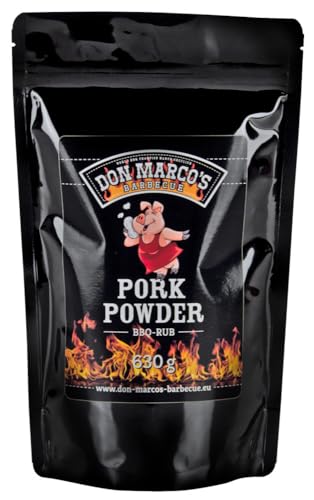
| Don Marco’s Pork Powder Rub | BBQ rub for pork, 630 g in a bag | approx. €27.90 | 9.4 | you mostly season pork and buy a large quantity at once |
| Ankerkraut Pull that Piggy | BBQ rub for pulled pork, 250 g | approx. €8.99 | 8.3 | you need the rub almost only for pork shoulder or neck |
The prices are guide values from our data sheets and change. The rating is our editorial assessment based on manufacturer information and price; we have tasted none of the four blends. For the Klaus grillt shaker you pay €1.96 more than for Ankerkraut Magic Dust, according to the price box, and get 10 g more.
Who the rub suits and who it does not
We find it suitable if you cook ribs, poultry or large cuts of pork slowly and indirectly and want a sweet crust geared not to chilli but to spices like allspice and cinnamon. Then the high sugar share works for you instead of against you.
If you like it hot, you are better served by a rub that carries chilli in the ingredient list. The pepper line alone does not add up to heat you could compare with a cayenne blend.
For steaks that you sear over maximum heat in a few minutes, we would not use it. Salt and pepper are enough there, and the sugar would have no time to brown slowly.
It is the clearly wrong choice for two groups. First, everyone who has to watch their salt intake, for example because of high blood pressure: with almost a third salt, seasoning can hardly be separated from salting. Second, people with coeliac disease or severe food allergies, as long as the manufacturer gives no written assurance on gluten and traces. For both, a self-mixed version with your own salt and sugar measure is the safer route, following the channel’s recipe or our basic formula.