A dry rub, not a bottle
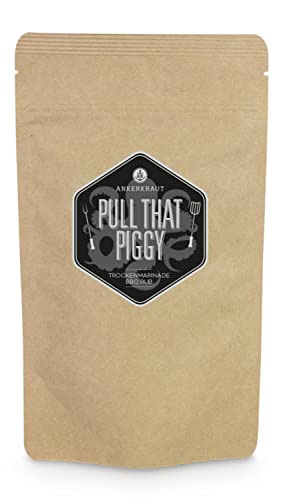
If you expect a liquid marinade on this page, you will be disappointed, and that is our fault. Under the ASIN B00IYHAAHY, Amazon sells the Ankerkraut rub Pull that Piggy in a 250 g pouch. The label says “Trockenmarinade BBQ Rub” (dry marinade BBQ rub) under the product name, and on its own product page Ankerkraut speaks of a mildly hot dry marinade for low & slow. Earlier versions of this page described 250 ml in a squeeze bottle with an oil and vinegar base. None of that is correct. We have therefore rewritten the text, using only the manufacturer’s page and the Amazon catalogue data.
The blend is intended for pulled pork. As the cut of meat, Ankerkraut recommends pork neck or pork shoulder, that is, the marbled parts that fall apart after many hours of indirect heat. In our Rubs & Sauces category, the pouch therefore belongs among the pork rubs and competes with powders that go onto raw meat before cooking, not with sauces that you pour over it at the end.
The item has been listed on Amazon since 4 June 2018, with Ankerkraut GmbH registered as the manufacturer.
Ingredients and nutrition, in order
According to Ankerkraut, Pull that Piggy consists of sweet paprika, sea salt, raw cane sugar, onion, garlic, black pepper, cumin, celery, oregano, smoked jalapeño and bay leaves. The food information regulation (which applies in the EU) requires ingredients to be listed in descending order of weight. Paprika is therefore the largest item, bay leaf the smallest, and salt weighs more than sugar.
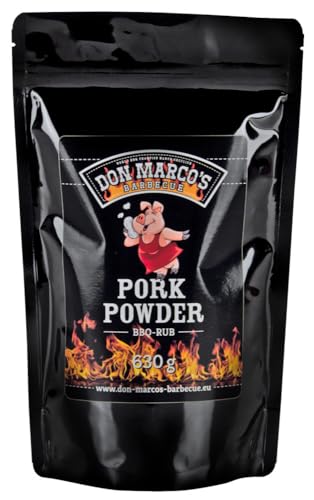
Two values from the nutrition table are more interesting. Per 100 g, the blend contains 38 g sugar and 27.2 g salt, so 65.2 g together. Almost two thirds of the pouch is therefore sugar and salt. That much added sugar is not quite in there, though, because the “of which sugars” value covers all sugars, including the natural share from paprika and onion. For comparison: according to our research, Don Marco’s Pork Powder comes to 25.3 g sugar per 100 g.
The smoky note has exactly one source. In brackets after the smoked jalapeño, the ingredients list gives its components, jalapeño and smoke. In the shop, the product is tagged with the keywords smoke flavour, jalapeño, cumin and paprika, and also with no cinnamon, no honey and no cayenne pepper. If you associate pulled pork with the sweet cinnamon direction of some rubs, you are therefore off the mark here, at least on paper.
In detail: binder, wrap and a day of lead time
Ankerkraut describes the process in one sequence: drizzle the meat with a little oil or brush it with mustard, then rub it in generously with the rub, pack the piece airtight and let it rest in the fridge for 12 to 24 hours. The old version of this page spoke of 2 to 12 hours. That range did not come from the manufacturer.
Why so long? The technical logic behind it is called dry curing or dry brining. The salt in the rub first draws liquid out of the surface and dissolves in it, and this brine is taken back into the meat over several hours. Water-soluble components travel a little way inward with it, while the fat-soluble aromas of paprika and pepper tend to stay on the outside. With a rub containing as much salt as this one, the effect is particularly pronounced. Whether twelve or 24 hours makes the bigger difference with this particular blend, nobody has measured for us; the range is the manufacturer’s.
Oil and mustard do the same job when rubbing in: the powder should stick instead of trickling off when you turn the meat. Mustard is thicker than oil and therefore holds more powder on the surface. If you react to it allergically, use oil; more on that below. What “airtight” means in concrete terms, the instructions leave open. We would use cling film in two layers or a vacuum bag, because otherwise the piece dries out in the fridge and picks up odours from other food.
During cooking itself, the sugar then matters. Over indirect heat in a smoker, it browns slowly and contributes to the dark outer layer called bark in pulled pork. Directly over embers or a burner, sugar burns faster than the other components. If you cook the neck on a gas grill, you should therefore not place it over the lit burners. How cooking in a smoker or kettle grill works step by step is covered in our pulled pork guide.
How much rub does a pork neck need?
Ankerkraut calculates about 1 to 2 tablespoons for 250 g of meat. Per kilo, that is 4 to 8 tablespoons, so for a 2.5 kg neck, 10 to 20 tablespoons.
How many necks a pouch yields cannot be reliably derived from this. A tablespoon of powder weighs different amounts depending on grind and how full it is, and no gram value per spoon is given anywhere. If you want to know, weigh a level spoon from your own pack on the kitchen scale and divide the pouch contents by that value.
It also remains open whether the 250 g of meat means with or without bone. With a bone-in shoulder that makes a difference, with a boned neck hardly any.
Our assessment: for a first attempt, we would stay at the lower end of the range. The salt content is high, and a rub cannot be taken back out of the meat after a night in the fridge. Adding seasoning later, on the other hand, always works, if necessary while pulling.
Pouch, shaker or 750 g: what a kilo costs
The 250 g pouch costs approx. €9 at Amazon (Amazon page on 21.10.2026: €8.99), which works out at approx. €35.96 per kilo. In the Ankerkraut shop, Pull that Piggy comes in three sizes (as of 21.10.2026):
- 220 g in a shaker for €9.49, a base price of €43.14 per kilo according to the shop
- 250 g in a pouch for €8.99, €35.96 per kilo by our calculation
- 750 g in a pouch for €22.95, €30.60 per kilo by our calculation
The pouch at Amazon and the 250 g pouch in the manufacturer’s shop carry the same article number, so it is the same product. Price-wise, Amazon and the manufacturer’s shop are level for the 250 g pouch, though shipping costs may be added in the shop. The shaker holds 30 g less and, according to the shop, has the highest base price of the three sizes.
If you smoke several necks a year, the large pouch works out cheapest. Three 250 g pouches together cost €26.97 in the manufacturer’s shop, a 750 g pouch €4.02 less. The product page also contains the sentence “This packaging can be refilled and reused”, without making clear which of the three variants it refers to. We would buy the shaker once and then refill it from the large pouch.
Allergens, heat and what remains open
Celery is in the ingredients list and is highlighted there as an allergen. In addition there is the note that the rub may contain traces of mustard. For people with a mustard allergy, that means two things: only oil comes into question as a binder, and even then the trace risk of the blend remains. Whether that is acceptable, you decide with your doctor, not with a grilling portal.
“Mildly hot” is the manufacturer’s only statement on heat. The heat comes from pepper and the smoked jalapeño. A second look at the shop keywords is worthwhile here: Pull that Piggy is also marked there as “without chilli”, although the jalapeño is botanically a chilli (Capsicum annuum). If you must avoid capsaicin for health reasons, stick to the ingredients list and not the shop filter; how Ankerkraut defines the keyword, the shop does not explain anywhere.
On some questions, Ankerkraut says nothing at all on the product page: there is no heat scale, nor a best-before date, shelf life after opening or any storage advice; there is no gluten-free, vegan or vegetarian labelling, nor the origin of the individual raw materials or the percentage shares of the ingredients, and for the pouch, the material and whether it can be resealed remain open (Amazon says only “aroma-tight pouch”). The page does contain an info block on organic with the control body DE-ÖKO-005, but the product’s feature bar shows no organic mark. We therefore do not treat Pull that Piggy as an organic product.
What else comes into question?
| Product | Type and quantity | Price | Our rating | Choose this if |
|---|---|---|---|---|
| Ankerkraut Pull that Piggy (this one) | Dry rub, 250 g pouch, with celery | approx. €9 | 8.3 | you want to season pulled pork smoky and mildly hot |
| Don Marco’s Pork Powder Rub | Rub in a 630 g pouch, less sugar, no celery | approx. €27.90 | 9.4 | you often smoke large cuts or must avoid celery |
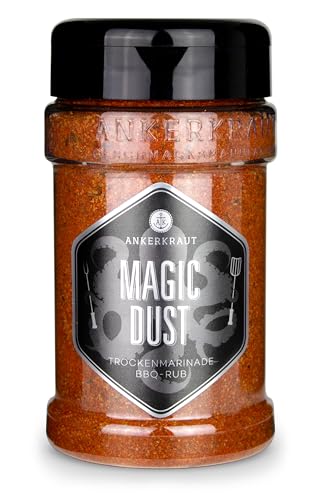
| Ankerkraut Magic Dust | All-round rub in a 230 g shaker | approx. €7.99 | 9.0 | you want a rub for beef and poultry too and tolerate mustard |
| Klaus grillt Magic Dust | Rub, 250 g, with cinnamon and allspice | approx. €9 | 8.7 | you prefer your pulled pork sweet rather than smoky |
Prices are guide values from our price boxes and change. The rating is our editorial assessment from the data comparison and is not based on any tasting.
Calculated per kilo, the 630 g pouch from Don Marco’s is more expensive than Pull that Piggy at Amazon despite the larger pack. The lowest price per kilo in this round is the 750 g pouch from the Ankerkraut shop.
When Pull that Piggy fits and when another rub does
The first question is time. If you decide on Saturday lunchtime to make pulled pork in the evening, you will not manage with the manufacturer’s recommendation: the neck should lie in the fridge for at least one night beforehand, and only then come the many hours in the smoker. A rub is not the cause of that, but Pull that Piggy is expressly designed for this process.
The second question is allergens, and this is where the alternatives clearly separate. If someone in the household must avoid celery, Pull that Piggy is out, and Don Marco’s Pork Powder is the obvious replacement. With a mustard allergy it is the other way round: Ankerkraut Magic Dust contains mustard flour and is then out of the question, Pull that Piggy only with the trace caveat from above.
Third, the sugar. If you want a crust with less sugar or watch it for dietary reasons, you will find a clearly lower value in Don Marco’s Pork Powder. For the salt content, we have no comparison figure for the siblings that we would have checked ourselves.
For the flavour direction, the ingredients list helps more than any description. Pull that Piggy relies on paprika, cumin and smoked jalapeño and, according to the shop, does without cinnamon and honey. If you prefer your pulled pork sweet with cinnamon, you end up, going by the ingredients, with Klaus grillt Magic Dust.
On budget, Pull that Piggy sits in the middle. The pouch is in the price box at approx. €9, Ankerkraut Magic Dust at €7.99 and Klaus grillt at approx. €9.
Who is it for?
Pull that Piggy is made for people who season pork neck or pork shoulder a day ahead and cook low & slow. The manufacturer’s details in the Amazon catalogue name spare ribs and other pork as further uses, as well as lamb and game, vegetables and tofu. In the Ankerkraut shop, by contrast, the rub is assigned only to the meat type pork, so the broader list comes from the Amazon text alone.
The pouch is wrong for anyone who is actually looking for something liquid: a marinade for soaking overnight or a sauce that goes under the meat after pulling. Pull that Piggy is neither, and the word marinade in the Amazon title does not change that.