A grill trolley that Campingaz itself no longer lists
The 3 Series RBS LX is a gas grill on a base cabinet with two doors, two burners and two folding side shelves. Campingaz belongs to the Coleman Company, which is why the Amazon catalogue shows Coleman as the manufacturer. The article number 2000031520 is the same on Amazon and on the old manufacturer page, so the listing and the technical data belong to the same unit.
One restriction up front, because it shapes everything else. On campingaz.de the grill is no longer listed; there are only spare parts and accessories for the 3 Series RBS. What is written here comes from the archived product page (versions from 2018 and 2022), from the manufacturer’s spare parts list and from the Amazon catalogue. We found no instruction manual anywhere.
The Amazon catalogue gives 13 December 2018 as the release date. On its own product page, Campingaz priced the LX at €649.00 in July 2018 and at €749.00 in June 2022. It costs approx. €476 (Amazon page on 20 October 2026: €475.99). In our comparison, it scores 8.5 out of 10 points. How it relates to the other gas grills in our catalogue is shown by the table further down.
In detail: burners on the wall instead of the floor
On most gas grills, the burner tubes lie at the bottom of the tub. Above them sit cover plates or flavouriser bars, and above those the grate. Whatever drips from the food falls downwards towards the flame, and when hot fat hits an open flame, it ignites and flares up through the grate.
With the Radiant Burner System, RBS for short, Campingaz has turned the arrangement around. According to the manufacturer page, the two separately adjustable ceramic burners sit “not on the floor, but at the sides of the grill tub”, and according to the Amazon text at the front and back. A heat reflector is placed in the tub, which is meant to radiate the burners’ heat evenly to the cooking area. Down below, where other grills have their flames, fat and meat juices end up in removable catch trays. From this, the manufacturer concludes that nothing can drip into the flame any more.
The wording deserves a close look. The manufacturer page promises “reduced flare-ups”, plus less smoke and fewer odours. In the Amazon text, this has become “no flare-ups”. We stick to the more cautious Campingaz version. In our assessment, a residual risk remains as long as fat collects in a full tray that sits directly under a hot cooking chamber. So empty the trays regularly.
On heat distribution, the same page gives two figures that contradict each other. The product text says that over 250 °C is reached on 90% of the cooking area. In the section on the RBS, it is 97% of the area at 250 °C. Neither figure says how or where it was measured. We would go with the lower one.
Campingaz states the output as 9.4 kW for both burners together, spread over 2,800 cm² of cooking area. That works out at around 3.4 watts per square centimetre. For the Spirit II E-310, Weber gives 7.0 kW over 2,314 cm² of main grate, so around 3.0 W/cm². For the Campingaz, this calculation is only a rough guide. Part of its heat reaches the food via the reflector instead of directly from below through the grate, and only the manufacturer knows what share that is.
Two burners mean two zones. Because they sit at the front and back, the boundary runs, as we read it, between the front and rear halves of the grate, not between left and right as on grills with burner tubes running front to back. As cooking methods, Campingaz names direct grilling and indirect grilling “with the oven function”. What Campingaz means by that exactly is not stated. As we read it, it means the closed lid with one burner turned down or off. How clearly the two zones differ, when the reflector is meant to spread the heat across the area anyway, is not described anywhere. Our guide to direct and indirect heat explains what separates the two cooking methods.
Grate, plate and the ring in the middle
According to Amazon, the cooking area measures 70 x 40 cm, and Campingaz gives 2,800 cm²; the two fit together. It is made of enamelled cast iron and split in two into a grate and a grill plate. In the spare parts list for the LX and LX Plus, the parts are called “reversible cast iron grill plate, matt enamelled” with the number 5010003317 and cast iron grate with frame and ring, also matt enamelled, number 5010003318.
None of the sources reveals how the 70 cm is divided between grate and plate.
Cast iron stores a lot of heat and releases it where the food rests. On the grate this produces the dark sear marks, and on the solid plate an even browning. The plate has no gaps through which prawns, diced vegetables or a flaking fish fillet could slip. The enamel protects the iron from rust as long as it stays undamaged. For cleaning, that means a wooden scraper or a brass brush rather than a steel spatula, which chips off edges.
Above the cooking area hangs a chrome-plated warming rack of 75 x 17 cm. Amazon calls it “swing-along” (“mitgehend”). No manufacturer source says how it is attached. Usually that means the rack swings along when you open the lid. This is not documented for the LX.
The ring in the cast iron grate belongs to the Culinary Modular System. According to the manufacturer page, you take the round insert out of the grate and put one of the Culinary Modular inserts in its place. Named are a pizza stone, paella pan, chicken roaster and wok. The data sheet lists the LX as prepared for this; the inserts themselves are accessories.
Trolley, lid, ignition: what the photo and data sheet show
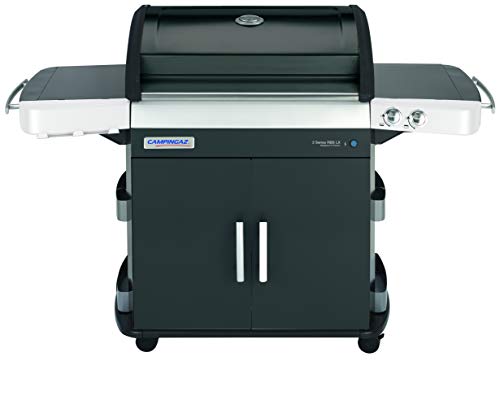
In the product photo, the LX stands on a dark grey base cabinet with two doors and vertical bar handles, with four castors underneath. The data sheet confirms steel as the material of the undercarriage, two doors and four swivel castors. To the left and right of the lid, the two side shelves are folded out, with bar handles at their outer ends. The two control knobs are not in a panel under the lid, but to the right of the lid at the height of the side shelf.
The gas bottle goes in the base cabinet. The data sheet lists a bottle holder, and the spare parts list a bottle strap with the number 31906 in the LX column.
The lid is domed and black, with a silver strip and the handle running along the front, and the thermometer sits at the top in the middle. It has no viewing window. On the material, two manufacturer sources contradict each other: the data sheet names stainless steel and die-cast aluminium, while the spare parts list for the LX and LX Plus names an “enamelled lid with thermometer, black” (5010003285). The photo fits both readings. It is similar with the control knobs. The running text of the product page mentions illuminated knobs, while the data sheet says no for this point.
Ignition is electronic, according to the spare parts list with a push-button igniter and an ignition box with two outputs, matching the two burners. The LX has no side burner. For a pot of side dishes, you therefore need another hob.
Open, the grill measures 1710 x 658 x 1500 mm (length, depth, height) according to the manufacturer. We read this as the dimension with the shelves folded out and the lid open, because closed it is clearly shorter and lower. The cooking area sits at a working height of 92 cm. Campingaz gives 70 kg, Amazon converted approx. 69 kg. That is more than one and a half times the 44.50 kg that Weber gives for the Spirit II E-310, and on four small swivel castors that much weight rolls over patio slabs, but hardly over lawn.
How long does a gas bottle last?
At full output of both burners, around 7 hours with a 5 kg bottle and around 16 hours with an 11 kg bottle. The basis is the consumption of 684 g/h that Campingaz states. Turned down, for example when cooking indirectly with one burner, the bottle lasts correspondingly longer.
The calculation is simple: 5,000 g divided by 684 g/h gives 7.3 hours, and 11,000 g gives 16.1 hours. Whether the 684 g/h explicitly stands for full load, the page does not say. We read it that way because consumption figures for gas grills usually relate to the rated output. What a refill costs depends on the retailer and the type of bottle, as exchange and owned bottles are charged differently. Our guide to the gas bottle for the grill explains the differences.
Among the spare parts, at the time of our research the Campingaz shop had the cast iron grill plate for the 3 Series RBS for €44.99 and a heat deflector for grills with RBS burners (81008ZCL) for €13.99. In the shop, the plate carries the same number as in the LX spare parts list. For the deflector, we would ask before ordering, because the address of the shop page names the C-Line 2400 series.
Cleaning and safety when the manual is missing
The Amazon text describes the InstaClean system literally like this: “the inner parts of the burner box can be removed individually and cleaned in the dishwasher after pre-cleaning, soaking and removal of coarse dirt”. The order is therefore fixed. First pre-clean, soak and remove the coarse dirt, then into the machine.
Which parts count among these inner parts is not stated there. The grate and grill plate are not explicitly named. Before enamelled cast iron goes into the dishwasher, we would ask Campingaz rather than try it out.
The manufacturer page adds that the side-mounted burners need “no cleaning at all”. That follows from the design. With floor burners, fat and crumbs fall into the burner openings over time, while with burners in the side wall hardly anything arrives there. How you otherwise keep a gas grill clean is covered in our guide to cleaning a gas grill.
For set-up, minimum clearances and gas connection, we lack a Campingaz document for this model, so we write nothing about them as a manufacturer statement. In general, the following applies to every gas grill, whatever the brand:
- Only use it outdoors, never in a garage, garden shed or tent. Incomplete combustion produces carbon monoxide, which you can neither see nor smell.
- After every bottle change and at the start of the season, check all connections with leak-detection spray or soapy water. If bubbles form, the spot is leaking, and the grill stays off.
- Look at the hose regularly for cracks and brittle spots, and route it so that it does not touch hot parts.
- Light it with the lid open, so that no gas collects under the lid.
What Campingaz does not state
For the 3 Series RBS LX, the following are missing from all manufacturer sources we could find: the instruction manual and with it all safety, set-up and gas connection instructions, minimum clearances to walls and combustible materials, a statement on balcony use, the gas type, whether pressure regulator and hose are included, the largest bottle that fits in the base cabinet, the output per burner, maximum temperature and heat-up time, the material of the burner box and side shelves, the full scope of delivery, the warranty terms in detail and the country of production. The lid material, the illuminated knobs and the heat distribution are contradictory, as described above.
These three alternatives are worth a look
| Model | The difference | Price | Our rating | Choose this one if |
|---|---|---|---|---|
| Campingaz 3 Series RBS LX (this one) | 2 ceramic burners in the tub sides, fat drips into trays instead of into the flame | approx. €476 | 8.5 | you do not want to clean burners and want to use the area with interchangeable inserts |
| Weber Spirit II E-310 | 3 stainless steel burners, so three zones side by side, and a much lighter trolley | approx. €460 | 9.2 | you want a third zone for about the same money and move the grill around often |
| Char-Broil Advantage CORE B | also a radiant principle against flare-ups, via a TRU-Infrared plate over the burners | approx. €537 | 8.3 | you want the radiant heat principle for less money |
| Broil King Regal 590 | 5 main burners, plus a rear burner and side hob | approx. €1,649 | 9.4 | you regularly grill for large groups and have the budget for it |
The prices come from our price boxes and change. The rating is our editorial assessment from the data comparison; we have not measured anything.
When this grill, when another
According to our price boxes, the Weber Spirit II E-310 costs approx. €460, the Campingaz approx. €476, and the Weber is 0.7 points ahead in our rating. The Campingaz has the larger area, as calculated above. In the Weber’s favour is the third zone: with three separately adjustable burners, you can run one on high, one on medium and one on low or off, while with the Campingaz it stays at two settings side by side. Then there is the lighter trolley, with the figures given above under the dimensions. If you regularly push the grill back and forth between garage and patio, we would pick the Weber.
The Char-Broil Advantage CORE B costs approx. €537 (this one: approx. €476) and follows the same basic idea, bringing heat to the food as radiation instead of letting fat drip into open flames. In our rating, it is 0.2 points behind the Campingaz.
The Broil King Regal 590, which costs approx. €1,649 against the Campingaz’s approx. €476, plays in a different league. It has five main burners with a combined 16 kW on an 80 x 48.8 cm grate, plus a rear burner and a side burner. That is a different size class with a different budget.
Our assessment of the LX itself: it suits you if the grill gets a permanent spot on a patio or in a garden, you dislike scrubbing burners and the grease tub, and you want to use the Culinary Modular accessories, such as a pizza stone or wok in the grate. If you want to be sure parts will be available after buying, you are at an advantage here despite the discontinued listing, because Campingaz still carries the spare parts.
We would not choose it for a small balcony, as described under the dimensions. Nor would we if you want to keep a pot hot next to the food, or want a manufacturer’s manual in hand before the first ignition. What generally applies to grilling on a balcony is summarised in our guide to grilling on a balcony. If you are still undecided between gas, charcoal and electric, the grill finder gives you a shortlist.