A stove with a griddle plate, packed in a case
Z.M.C sells a single-burner gas stove for butane cartridges together with a grill plate. We list it under grill accessories, although it is a stove first. Grilling is done on a plate that sits on the gas flame, so without embers and without a grate.
According to the Amazon bullet points, the box contains a plastic carry case, an instruction manual, four gas cartridges of 227 g each, the grill plate measuring 33 x 26 x 4 cm and an adapter for LPG gas cylinders. The variant is called “Gaskocher+Grillplatte mit 4x Gaskartuschen” (gas stove plus grill plate with 4 gas cartridges) in the catalogue, and black is entered as the colour.
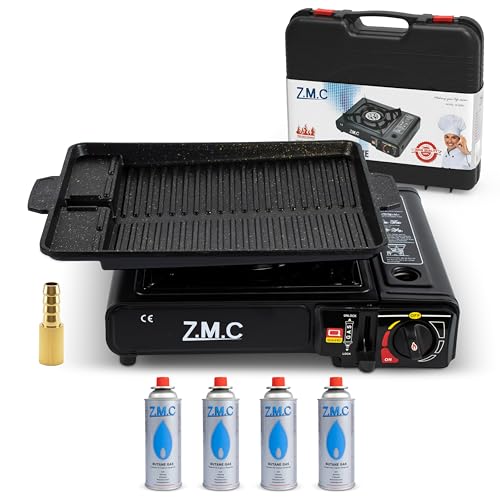
The product photo shows a flat, rectangular box, as you know it from suitcase-style stoves. On the right of the front there is a control knob, next to it a slider labelled UNLOCK, GAS and LOCK; behind it, judging by the design, is the cartridge compartment. On the left of the front a CE mark is printed. In the picture the plate lies across the top and covers it almost completely. Next to the stove lies a small brass part, presumably the adapter, and the four cans stand in front. Everything in this paragraph comes from the picture, not from a data sheet.
The price is approx. €35 (Amazon page on 20 October 2026: €34.99). The four cartridges are already included.
Burner, pressure regulator, ignition
For the one burner, Z.M.C states a heat output of 2.2 kW and a gas consumption of approx. 150 g per hour. It is lit by an automatic piezo ignition, without matches or a lighter according to the bullet point. You set the flame with the control knob, and with the same knob you quickly turn off the gas when needed.
The catalogue says exactly one sentence about the housing: “The metal housing is sturdy and the pressure regulator ensures constant output.” What sturdy means in terms of sheet thickness or load capacity cannot be read from it.
The pressure regulator is the more interesting part of this sentence. A butane cartridge releases its gas at the vapour pressure the contents currently have, and this pressure depends on the temperature of the can. A regulator keeps the pressure at the burner constant as long as the cartridge supplies more than the regulator lets through. As a result, the flame size varies less when the sun shines on the can or the fill level drops. If the vapour pressure falls below the regulated value, for example in the cold, even the best regulator can no longer compensate. The pressure this one regulates to is unknown.
For the dimensions the catalogue gives 13.39 x 10.24 x 3.15 inches, which converts to approx. 34 x 26 x 8 cm. Whether this refers to the stove, the case or the whole package remains open. It is striking that length and width are almost to the centimetre the same as the grill plate. We conclude nothing from this, because catalogue dimensions are overall dimensions, and the plate has handles at the sides that may be included in the measurement.
In detail: what 2.2 kW and 150 grams per hour add up to
The two manufacturer figures can be checked against each other. Butane has a calorific value of around 12.7 kWh per kilogram, which is a physical material value and not a Z.M.C figure. Burning 0.15 kg per hour therefore releases approx. 1.9 kW. If you use the gross calorific value, which includes the water vapour (around 13.7 kWh per kilogram), you end up at approx. 2.1 kW. The stated 2.2 kW is therefore slightly above both values. That fits the “approx.” in front of the consumption, and manufacturers like to round such figures up. Roughly speaking, the two figures agree; it is not a contradiction.
The burn time is more interesting. According to the bullet point, the flame lasts 1.5 to 3 hours, “depending on the gas regulation”. It does not say explicitly which cartridge size the sentence refers to; 227 g cans are included. Dividing 227 g by 150 g per hour gives a good 1.5 hours. The lower limit therefore corresponds almost exactly to continuous operation at full flame. The upper limit of three hours assumes an average consumption of around 75 g per hour, which would be half the output. That is how we read the range; Z.M.C does not explain it itself.
And what does 2.2 kW mean at the pot? Bringing one litre of water from 20 to 100 °C takes about 0.093 kWh in theory. With 2.2 kW that would be a good two and a half minutes without any loss. In reality it takes noticeably longer, because a large part of the heat goes past the sides of the pot into the air. How large this share is depends on pot size, lid and wind, and we have no boiling time from Z.M.C. For two people, one pan and a coffee, the output of such a burner is, in our assessment, perfectly adequate. If you are planning a five-litre pot of pasta water, you will need patience.
Is the grill plate any good for grilling?
For flat food such as vegetable slices or thin steaks, yes; as a replacement for a grill, no. The plate sits on a single gas flame, it has a grease drain hole, and the smoky aroma of charcoal cannot arise on a gas plate.
In the photo the plate has longitudinal ridges in the middle section, there are separate, flat areas at both narrow ends, and a small handle sits on each outer side. The surface is dark with light speckles. Whether this is a coating, and which one, the picture does not reveal. Exactly where the grease drain hole is located is likewise not visible in the photo. Of the three catalogue dimensions, 33 and 26 cm describe the surface; whether the 4 cm refers to the edge height or the overall height with handles, the picture leaves open.
On the drain, Z.M.C writes that the hole drains off excess fat and ensures less greasy food and less smoke when grilling. That is a manufacturer claim. The operating instruction is given word for word in the bullet point: “During operation, a container should be placed under the grease drain opening to catch the fat or grilling juices.” Besides the stove, you therefore need space for a dish, and on a small camping table that gets tight.
A heat source under a surface of 33 x 26 cm has a consequence that has to do with physics and not with this device in particular: above the burner the plate gets hotter than at the edges. How large the difference is depends on the material and thickness of the plate, and we know neither. We would put thick pieces in the middle and push vegetables or already cooked pieces to the edges. Cooking and grilling at the same time is not possible, because the plate occupies the only burner.
Cartridge or gas cylinder: what can be connected
The catalogue lists “butane gas cartridge” as the fuel, nothing more. Whether it is a valve cartridge or a pierce cartridge, whether the connection follows MSF-1a or something else, remains open. On the product picture the supplied cans are slim and elongated, labelled “Butane Gas”. Stoves of this flat suitcase design with a LOCK lever generally take a horizontal valve cartridge in the side compartment. That is our deduction from the design, not a manufacturer commitment. For a repurchase we would therefore take a can of the same type as the supplied ones along and compare.
With the adapter for LPG gas cylinders, the situation is thinner than the scope of delivery suggests. All that is documented is that it is included. The thread, whether a pressure reducer is part of it and whether a hose is needed are unknown. In the picture the brass part looks like a hose nozzle, that is, a piece onto which a gas hose is pushed and secured with a clamp. Whether that is right, a photo cannot clarify.
The general rule for liquefied gas cylinders is that they are never connected directly to a device, but always via a pressure regulator. There is also a question the catalogue leaves open. The stove is described as a butane device, while the grey cylinders from the DIY store in Germany mostly contain propane. We do not know whether the Z.M.C may be run on propane. Our advice is therefore clear: do not connect a cylinder until the seller has confirmed the adapter, regulator and type of gas to you in writing.
Indoors during a power cut, outdoors on the balcony
Besides camping, Z.M.C expressly also mentions “use indoors when the power fails”. Cooking, frying and grilling without electricity is named by the manufacturer as the purpose, and it goes on: “Whether garden, balcony or motorway service station, the gas stove is always ready for use.”
The texts we could read say nothing more about where to set it up. You will look in vain there for ventilation requirements and minimum distances from walls or combustible materials, and the manual in which they should appear cannot be found online anywhere. Particularly for use in the home, this is the most important gap.
What we can therefore offer are general rules for open gas flames, not statements from the manufacturer. A gas flame consumes oxygen from the room air. If it becomes scarce, the gas burns incompletely, and carbon monoxide is produced. Whenever it is used indoors, a window should therefore be open, and the stove is never left unattended. The fact that no flame supervision appears in the manufacturer’s information makes the second rule even more important: if the flame goes out in a draught, gas can keep flowing out until someone turns the knob off.
On the balcony, it is not the manufacturer but the tenancy agreement and house rules that decide. What is usually regulated there and what neighbours pay attention to is covered in our guide Grilling on a balcony.
What the manufacturer does not state
We could not find a Z.M.C website; zmc.de and zmc-gmbh.de were not reachable, and the search for the model led only to retailers and price comparisons. A manual is not available online. All product information in this text therefore comes from the Amazon catalogue, retrieved on 5 October 2026. Information is missing on these points:
- Safety, ventilation and installation instructions and minimum distances
- Gas shut-off when the flame goes out
- Cartridge type and connection standard
- Operating pressure, gas category and a standard to which the CE mark refers
- Thread of the LPG adapter, pressure reducer and hose
- Material of the burner, pot support and grill plate, a possible non-stick coating
- Weight and dimensions clearly for the stove alone
- Maximum temperature of the plate, heat-up time, boiling time
- Largest permitted pot diameter
- Cleaning instructions for the stove and plate
- Warranty terms and spare parts
- Country of origin and market year
We therefore deliberately write no cleaning instructions. Whether the plate may go in the dishwasher or whether a wire brush will tolerate its surface depends on the material, and that is not known. The running costs cannot be put into figures reliably either, because we have no documented price for suitable replacement cartridges.
What else comes into question?
| Model | The difference | Price | Our rating | Choose this one if |
|---|---|---|---|---|
| Z.M.C Gaskocher 1-flammig mit Grillplatte (this one) | Grill plate, LPG adapter and 4 cartridges in the set | approx. €35 | 8.0 | you want a stove and a frying surface in one case |
| Campingaz Camp’Bistro DLX Stopgaz | Stopgaz shuts off the gas when the flame goes out, only Campingaz CP250 cartridges, no grill plate | approx. €45 | 8.1 | a gas cut-off matters more to you than the plate |
| Gas Bullet camping grill with pan & wok | 300 g screw-on cartridge, plus grill plate and wok attachment | approx. €54 | 7.7 | you would rather fry in a wok than cook in pots |
| Evergrill butane gas camping grill 2300 watt | Cartridge tabletop grill with 2.3 kW instead of a stove with a plate placed on top | approx. €60 | 7.6 | grilling comes first and no pot needs to go on the flame |
The prices are guide values from our price boxes and change. Our rating is an editorial assessment, not a measurement result. We list the two lower devices under gas grills, and the Campingaz like the Z.M.C under grill accessories.
When this stove, when another
First, the number of people. One burner means one vessel at a time. For two people with a pan and a coffee that works; for a family that wants pasta and sauce at the same time, it does not. If you regularly cook for four, look for a stove with two burners.
Then safety. If you cook in wind or buy the stove for emergencies in the home, a gas shut-off when the flame goes out is the strongest argument against this device. The Campingaz Camp’Bistro DLX has it; it is at approx. €45 in our price box, the Z.M.C at approx. €35, and it comes without a grill plate. For this case we would prefer it.
For grilling, a simple question helps: do you need the pot at all? If not, a cartridge tabletop grill such as the Evergrill with 2.3 kW is the more direct solution; it is at approx. €60, the Z.M.C at approx. €35. If you already have 300 g screw-on cartridges in the cellar, take a look at the Gas Bullet, which costs approx. €54 and comes with a wok attachment.
For continuous use on a gas cylinder on the balcony, we would only take the Z.M.C if the seller has answered the questions on adapter, regulator and type of gas beforehand. Without those answers it remains a cartridge device.
What it suits, in our assessment: a weekend by car at the campsite, a breakfast in the garden, a cooking spot in the cupboard for a power cut, if a well-ventilated place has been settled on for it. It would not suit tent campers who want to cook in the porch, or anyone who expects the aroma of charcoal from grilling. If you are unsure which type of grill suits you in general, the Grill Finder helps.