The Weber Stainless Steel Cleaner, article number 17682, is a spray cleaner for the exterior stainless steel parts of a grill. We have not held the bottle in our hands and have not cleaned anything with it. The information comes from weber.com (product pages, cleaning range, two care articles), from the Amazon catalogue and from the product photos; where we calculate or interpret, we say so. In our catalogue it is filed under Grill accessories.
Two bottles for approx. €20
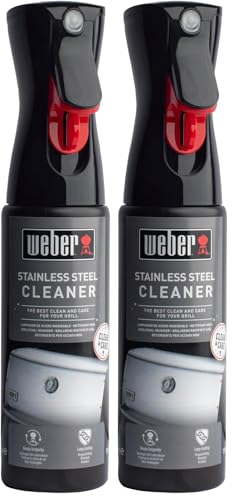
The ASIN B0F94872X3 is a twin pack. The Amazon title gives the model number 17682 and the addition “Pack of 2”; the catalogue lists two units and the classification Product Bundle. The heading of this page and the product line above speak of 300 ml; that amount is delivered twice. The product photo shows it the same way: two black bottles side by side, both printed with “Stainless Steel Cleaner”. On 14.10.2026 the Amazon page showed the size as “600 ml (2-pack)”. In the same variant family, Amazon also lists the ASIN B0DZNMXB87, which according to its title is the Weber Non-Stick Spray 17685 with 2 x 200 ml, so a different product. If you click through the variant selection, check for the model number 17682 in the title.
Amazon asks €19.78, so approx. €20 (as of October 2026), and itself works out €9.89 per unit. In the Weber shop a single bottle costs €11.99 including VAT, plus shipping (as of 14.10.2026). Two bottles would come to €23.98 there, which is €4.20 more than the twin pack. Per 100 ml you pay €3.30 at Amazon and €4.00 in the Weber shop. Weber charges €4.90 shipping on orders under €49; we have not checked Amazon’s shipping costs and so have not included them.
Weber sells the single bottle, and the quantity selector on the product page runs from 1 to 10. The seller listed there is Weber-Stephen Deutschland GmbH in Ingelheim; the page’s structured data also names “Weber, Llc” in Palatine, Illinois, with the founding year 1952. There are no colour or size variants of the cleaner.
What Weber intends the cleaner for
Weber describes it as a product with which you can protect and clean “the exterior stainless steel parts of the grill”. It is suitable for all Weber stainless steel grills and can in principle also be used on other stainless steel surfaces. That is the entire suitability statement: for this product Weber speaks throughout of stainless steel and mentions neither paint nor enamel nor kettle grills.
The safety information on the product page consists of an image without text. It shows two grill grates crossed out in red, one round and one rectangular, next to a circle with a spray bottle symbol. The image stands there without an explanatory sentence. This is how we interpret it: do not spray on grates. That fits the restriction to exterior parts.
Weber offers more than this one bottle. The cleaners and cleaning products section comprises eleven items (as of 14.10.2026), including four cleaners of 300 ml each at €11.99: the Stainless Steel Cleaner 17682, the Enamel Cleaner 17684, the Grate Cleaner 17875 and the Q and Pulse Cleaner 17874. Alongside them are the Cast Iron Protection Spray 17889 with 200 ml for €9.99, a cleaning sponge, a microfibre cloth and four cleaning sets.
The procedure according to Weber
Weber describes the application on the product page like this:
- Spray on the cleaner. According to Weber, the spray applicator delivers an ultra-fine mist from any angle.
- Leave to work briefly. Weber writes “short contact time”; only the Amazon text gives 30 seconds.
- Remove the dirt with a soft cloth.
- For stubborn stains, repeat the application.
- Wipe the surface with clear water.
- Polish with a dry, soft cloth; as an example, Weber names a microfibre cloth.
On temperature, Weber writes on the product page that it is best to use the cleaner when the grill is “not yet completely cooled down”. Weber gives no temperature figure, and a warning about hot surfaces is missing. Our assessment: without an upper limit, “not completely cooled down” remains open to interpretation, and when in doubt we would work on a cold grill.
When wiping stainless steel, Weber advises in a care article to wipe in the direction of the grain of the steel to avoid scratches.
What Weber says about the effect
Weber promises streak-free cleaning with additional surface care and names grease and food residue as what the cleaner removes. The Amazon text adds fingerprints on exterior stainless steel surfaces. Weber also advertises that the cleaner dissolves even stubborn dirt and penetrates deep into the material. This is not substantiated on the page; how far the effect reaches is better shown by the procedure, since for stubborn stains Weber provides a second round. Whether the cleaner also dissolves baked-on grease, the page does not answer.
On yield there are only vague descriptions. Weber writes that the 300 ml are enough “for many applications”; Amazon describes the bottle as suitable for regular care and for a seasonal deep clean.
Two ingredient lists on the same page
What is in the bottle, Weber answers twice, differently, on the German product page. The main part of the product page names white mineral oil and, under the EU detergents regulation, declares aliphatic hydrocarbons at more than 30 per cent. The window “Warnings and safety information”, by contrast, lists water (73.1 per cent), soy lecithin E322 (16 per cent), sunflower oil (10 per cent) and, as a preservative, lactic acid E270 (0.9 per cent). Weber leaves open which list belongs to the current bottle. The Weber pages for Austria and Ireland show the same contradiction.
Both lists cannot be correct at the same time: water at 73.1 per cent and more than 30 per cent hydrocarbons would add up to over 100 per cent. For a single bottle, at most one of the two lists can therefore be right; which one cannot be decided from the outside. If the second is correct, the product would be a water-based emulsion in which lecithin acts as an emulsifier holding water and sunflower oil together. That is our technical assessment; Weber does not comment on it.
The Amazon text sticks with the mineral oil and mentions a “special formula with white mineral oil”. For buyers with a soy allergy or reservations about mineral oil products, the contradiction is more than a footnote: before first use we would read the information on the bottle that is delivered.
Weber also calls the product environmentally friendly; Amazon’s attribute list additionally includes “biodegradable”.
How often you should clean the outside
For gas grills, Weber recommends in a care article cleaning the inside every three months and the outside once a month. The cleaner’s product page gives the reason for cleaning promptly: if the surfaces are not cleaned straight after grilling, the dirt crusts on and dries in.
The same care article describes the procedure for the outside of a gas grill in four steps: spray enamel and steel parts with the appropriate spray in each case (Weber distinguishes between enamel and stainless steel), wipe with a microfibre cloth, clean frames and covers with lukewarm soapy water, and finally wipe everything dry. The Stainless Steel Cleaner covers only part of this.
According to Weber, grill covers protect against dust, moisture and scratches. Our guide Cleaning a gas grill deals with the inside of the grill; the cleaner here concerns only the outside.
What else comes into question?
Our catalogue contains no second cleaner, so the products here come from neighbouring tasks: a grate brush, a grill cover and, as the overall winner of the category, a Dutch oven. Cover and cleaner are not competitors. The cover is meant to keep dust and moisture away, while the cleaner removes existing dirt. At approx. €87, the cover costs around €67 more than the twin pack and fits only by burner count and year of manufacture; for the cleaner, Weber lists no models.
| Model | The difference | Price | Our rating | Choose this if |
|---|---|---|---|---|
| Weber Stainless Steel Cleaner, twin pack (this one) | Spray cleaner for exterior stainless steel parts, 2 x 300 ml | approx. €20 | 8.4 | the dirt sits on the exterior stainless steel parts of your grill |
| Kona Safe/Clean grill brush | Brush for the grate, cleans with steam on the hot grate according to Kona | approx. €32 | 8.8 | your dirt sits on the grate and you do not want wire bristles |
| Weber grill cover Spirit II E-310/E-320 | prevent rather than clean afterwards: protection from dust and moisture according to Weber | approx. €87 | 8.7 | your Weber Spirit stays outside permanently and you want to prevent dirt |
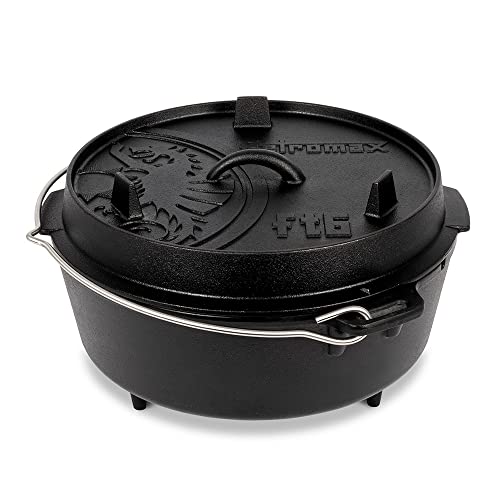
| Petromax Fire Pot ft6 with feet | not a care product, but a cast iron Dutch oven | approx. €75 | 9.0 | you are looking for accessories for cooking on embers and the cleaner would only be an addition |
The prices are guide values from our individual reviews (as of September to October 2026) and change. The ratings are our editorial assessment from comparing manufacturer data; between a cleaner, a grate brush, a cover and a Dutch oven, they say nothing about which is the better choice.
What Weber does not state
Beyond the gaps already discussed above, the following details are missing from the product page and the Amazon catalogue:
- Suitability for matt or brushed stainless steel and the level of gloss after application (Weber writes only “streak-free”)
- Any statement on residues on surfaces with food contact, for example whether anything remains after wiping with water
- Hazard classification, H and P statements, flammability and flash point as text
- Safety data sheet on weber.com (versions on retailer servers we did not accept as evidence)
- Fill weight and bottle weight separately (Weber calculates €39.97 per kilogram; Amazon gives only a total weight for the twin pack)
- Yield per bottle in area or number of applications
- Evidence or seal for “environmentally friendly” (Weber) and “biodegradable” (Amazon attribute list)
- Instruction manual or data sheet as a PDF
- Country of origin and production site
- Warranty, shelf life and storage instructions (Weber’s warranty page covers grills and components, not accessory liquids)
- Market launch of the cleaner
Who it suits, and when to choose something else
The cleaner suits grills with exterior parts made of stainless steel. That is the use Weber names, and on other stainless steel surfaces too you are within the manufacturer’s statement.
If you have an enamelled grill, the Enamel Cleaner 17684 is the bottle Weber intends for that. For painted surfaces there is no manufacturer statement; we would not apply anything there as long as the grill manufacturer says nothing about it. If the dirt sits on the grate, this bottle is the wrong one according to Weber’s safety image. Weber has the Grate Cleaner 17875 for that; the other direction is a grate brush like the Kona from the table. The interior, too, falls outside the scope, since Weber names the cleaner only for exterior parts.
Two bottles at once are only cheaper if you also use up the second. Per bottle, the twin pack saves you €2.10 compared with the Weber shop.
If you want to wipe the surfaces in a single pass, Weber’s procedure will not suit you: removing the dirt is followed by wiping with clear water and polishing.
The cleaner is wrong for anyone whose grill has no stainless steel parts, and for anyone who mainly wants to keep the interior clean.