A plug-together grill made of eight stainless steel panels
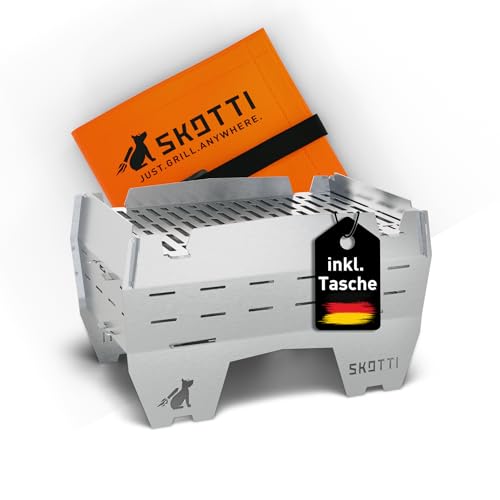
The SKOTTI Mini is a box of sheet metal that you put together from flat parts. In the product photo you can see four slotted side walls with their lower edges cut out as feet, a grate with lengthwise slots on top, and next to it the orange carry bag. Nothing here is round, and there is no lid.
It is built by Vennskap GmbH & Co. KG in Meerbusch, which is named as the manufacturer in the instructions. Amazon lists the brand as “SKOTTI USA”, which is the name in the catalogue, not the sender of the instructions. According to the company website, the SKOTTI brand has existed since 2018. In the instructions the device is soberly called “Mobiler Grill Typ Skotti Mini” (mobile grill type Skotti Mini), and that is exactly what it is: a backpack grill that burns wood or charcoal out of the box and only becomes a gas appliance with an extra burner, the SKOTTI Booster.
In our charcoal grill category, it therefore sits at the light, small end. On 20.10.2026 the Amazon page showed it at €77.95, while the manufacturer’s shop showed €79.00 on the same day, though marked “Ausverkauft” (sold out).
Dimensions, weight, material: three sources, small discrepancies
The most reliable figure is the grilling area: 24 x 16.5 cm, as stated in the data table of the instructions. For comparison, a DIN A5 sheet (the standard paper size in Germany) measures 21 x 14.8 cm, so the grate is only slightly larger. SKOTTI itself calls this a grilling area for 1 to 2 people. Set up, the Mini measures 25 x 17.5 x 14.5 cm according to the instructions, so the body is barely wider than its grate.
On the packed size, the manufacturer contradicts itself. The instructions give 32 x 22 x 4 cm for the packed bag, the data table on the product page gives 32 x 21 x 4 cm, and an advertising paragraph on the same page speaks of “only 3 cm flat”. The FAQ on the product page describes the packed size as barely larger than an A5 sheet. That does not add up when you calculate it: 32 x 22 cm is closer to DIN A4 (29.7 x 21 cm). For planning, we would work with the 32 x 22 x 4 cm from the instructions, as it is the largest of the three figures.
Weight is similar. The data table gives 1.9 kg, the FAQ “about 2 kg”, and the instructions give nothing at all. Amazon lists 4.19 pounds, which also converts to 1.9 kg.
According to the product page, the material is 304 stainless steel, a rustproof chromium-nickel grade like the one you also find in cooking pots. The instructions are more precise: 1 mm stainless steel for the grill body. For the grate, the product page says “3 mm Rost” (3 mm grate), without saying whether that means the rod thickness or the sheet thickness. SKOTTI describes the bag as waterproof and hard-wearing.
One oddity on the side: the English section of the same instructions gives completely different dimensions (12 x 7.5 cm grilling area) and speaks of a “Mobile gas grill”. That looks like a text block carried over from elsewhere. We stick to the German section, whose figures match the product page.
In detail: hobo stove, wood fire bowl, gas grill
The instructions describe three set-up variants, and all three are made from the same eight parts. They are numbered as follows: two long side panels (1 and 3), two short ones (2 and 4), a heat deflector plate (5), a wood fire plate (6), the base plate with a cut-out for the Booster (7) and the grill grate (8). The product page counts the same parts slightly differently and calls the heat deflector plate “Brennerschutz” (burner guard).
The basic assembly is always the same. Side panels 1, 2 and 3 are slotted into each other at small triangle marks, the base plate goes between them with the curve facing down, and finally you pull it backwards by its side hooks until it locks audibly, according to the instructions. After that the paths part.
As a hobo stove, one narrow side stays open. You slide the wood fire plate onto the base plate, insert the grate with the tab towards the open side and feed the fire with wood from there. The principle comes from the tin-can stoves that hikers build from food cans: air flows in at the bottom and at the opening, rises up through the fire and carries the hot gases directly to the bottom of the pot or the grate. Small twigs burn quickly in such a shaft, but you have to keep adding more. Whether the slots in the side walls serve the air supply or only the plug connection, the manufacturer does not say.
As a wood fire bowl, you fit the fourth side panel and close the box all round. Then charcoal or wood lies in the closed body, and the grate is expressly optional according to the instructions. This is the variant for charcoal.
For gas mode, the heat deflector plate goes with its curved side facing up into two slanted slots, the fourth side panel sits on top of it, and the grate goes on top. The order after that is fixed: first light the Booster, then place the fully assembled Mini over it.
In addition, the product page names two fuels that are not firewood, namely dry fuel cubes and an alcohol burner. Cooking is said to work on different levels, with normal cookware or with SKOTTI accessories such as pots, pans, planchas, cups and a Cafeterina (stovetop coffee maker). The SKOTTI Kast plancha plate costs €49.00 in the manufacturer’s shop (as of 20.10.2026). For set-up, SKOTTI states “under a minute”, while the Amazon text says “in a few minutes”.
Do you need the Booster?
Only if you want to cook without smoke and ash or go to places where wood fires are not allowed. For charcoal and wood, the Mini is complete. You buy the Booster in addition, as it is not in the box.
In the manufacturer’s shop, the Booster costs €79.00 on its own, exactly as much as the Mini there. As the “Adventure Bundle”, SKOTTI sells both for €149.00 instead of €158.00, which saves €9 (all prices manufacturer’s shop, as of 20.10.2026). So if you already know you want gas, you should not buy the Mini on its own first.
The Booster is a cartridge burner with 2.1 kW according to its instructions. On weight there are again two figures: 400 g without cartridge in the instructions, 540 g on the product page. According to the Mini product page, the heat can be finely regulated in gas mode, and firing works without smoke and ash. The Booster instructions require that it is operated exclusively outdoors, not exposed to strong wind, never covered with aluminium foil, and that gas cartridges are never stored near the grill.
Our assessment: for hikers who already own a cartridge stove, the Booster is a second gas appliance in the luggage. It becomes interesting for people who mainly use the Mini where smoke is a nuisance.
Balcony, distance, surface: what the instructions require
The slug of this page and the manufacturer’s advertising speak of the balcony. The product page names it generally as a place of use in the short FAQ and narrows this in the detailed FAQ: in gas mode with the Booster, the Mini is said to be suitable for balconies or small outdoor areas. For wood and charcoal, there is no balcony statement there.
The instructions themselves do not distinguish by fuel. Under 3.1 they allow two things: using the Mini only for private cooking and exclusively outdoors. Under 3.2 they forbid commercial cooking. Section 3.5, risks from fire, lists four points: never use the Mini unattended, never on a flammable surface such as a cloth or dry leaves, keep a safety distance from highly flammable materials while cooking, “grundsätzlich min. 10 Meter” (generally at least 10 metres), and never place flammable items on the Mini while it is in use or still hot.
Ten metres is not available on a normal balcony if there is an awning, a parasol or cushions nearby. We read it this way: with wood or charcoal, the Mini belongs on open ground according to the instructions, not between the house wall and the railing. Whether grilling is allowed on your balcony at all is also governed by your tenancy agreement and house rules. More on this in our guide Grilling on a balcony.
On positioning (5.1), the instructions give four points. The Mini and all individual parts can become so hot that you can no longer move it, so check before lighting whether the cooking spot meets the safety requirements. Place it on a level, stable surface. If it sinks into sand, snow or ice or stands crooked, use the edges in the standing surfaces and level it with a piece of wood or a stone. And always follow the assembly instructions, because incorrect assembly creates unpredictable hazards.
On hot surfaces (3.3): do not touch the Mini during use or directly after cooking, and supervise it until it has cooled down, which takes up to 30 minutes in summer. Otherwise, according to the instructions, accidents, burns or fire are a risk. On children (3.4): they must not operate the Mini and should also be kept away while it cools down.
Cleaning and storing
The product page advertises “Ab in die Spülmaschine” (into the dishwasher), and the Amazon text also calls all parts dishwasher-safe. The printed instructions, by contrast, have no care chapter of their own, even though their introduction promises care notes.
The product page is more detailed. It gives this order: let the Mini cool down completely before you start cleaning. Wipe the side and head panels with a damp cloth, with mild detergent if needed, and make sure no grease or ash residue remains. Check all parts regularly for dirt and clean them with a soft brush or cloth. Dry well after every cleaning and store dry during longer breaks to avoid rust, in the supplied bag or in a dry place. The FAQ adds that the stainless steel parts can be taken apart and cleaned with water and washing-up liquid.
304 stainless steel does not rust like normal steel, but in principle it can show surface rust if iron particles from outside adhere to it and moisture is added. The advice to dry it is therefore meant seriously, especially after a dishwasher cycle.
What the manufacturer does not state
Bundled so you know where the data ends: there is no figure, either on the product page or in the instructions, for the maximum temperature in any of the operating modes, the heat-up time with wood or charcoal, the charcoal quantity needed and the burn time of one filling, nor for the Booster’s gas consumption in grams per hour. A height-adjustable grate, an ash or grease catcher and a windshield appear nowhere. Also unknown are the country of production, the year of market launch (the file name of the instructions carries the date 14.02.2024), the material of the bag and the exact meaning of “3 mm Rost”. The instructions contain no warning about carbon monoxide, they only say “ausschließlich im Freien” (exclusively outdoors). And the manufacturer’s page links no Amazon number; that ASIN B0DBHQWDBN is the Mini rests on the Amazon part number SK133, which matches the manufacturer’s article number SK133.
What else comes into question?
| Model | The difference | Price | Our rating | Choose this one if |
|---|---|---|---|---|
| SKOTTI Mini camping grill (this one) | Wood and charcoal out of the box, gas only with Booster | approx. €78 | 8.0 | you travel on foot or by bike and cook for one to two people |
| FENNEK Grill light | pure charcoal plug-together grill | approx. €70 | 8.2 | you only grill with charcoal and will definitely never buy the Booster |
| Campingaz Party Grill camping stove | gas stove, cartridge instead of wood | approx. €77.46 | 8.0 | you want to cook with gas only |
| Weber Go-Anywhere charcoal | charcoal grill with lid | approx. €95 | 8.3 | you travel by car and want to grill with the lid closed |
The prices are guide values from our data sheets and vary by retailer. The rating is our editorial assessment from the data comparison; we did not measure anything on any of the four devices.
When the Mini, when another one
The Mini plays to its strength when weight and packed size really matter: on multi-day hikes, on bike tours, in a canoe. There the hobo set-up is the real reason to buy, because fuel lies along the wayside and you do not have to carry charcoal. Where wood fires are banned, you are left with dry fuel, alcohol or the Booster.
If you only grill with charcoal and need neither a pot nor gas, the FENNEK Grill light is the obvious alternative in our comparison: according to our price box it costs approx. €70, the Mini approx. €78, and it has the slightly higher rating with us.
If you never want to touch wood or charcoal, do the sums. Mini plus Booster together cost €149.00 as a bundle in the manufacturer’s shop, while a gas stove like the Campingaz Party Grill comes to approx. €77.46 according to our price box and needs no extra burner. For pure gas cooking, we would not buy the Mini.
With three or more people, the grilling area becomes a bottleneck, whatever fuel burns underneath. If you also want to cook with a lid, for example a whole chicken portion, you need a grill with a hood. The Weber Go-Anywhere costs approx. €95, the Mini approx. €78. But the Weber is a device for the car boot, not for the backpack.
The Mini is wrong for anyone looking for a charcoal balcony grill. The instructions require open ground and ten metres distance from anything highly flammable, which is hardly achievable between house wall and railing. If you do not yet know which type of grill suits your use, the Grill finder helps you narrow it down.