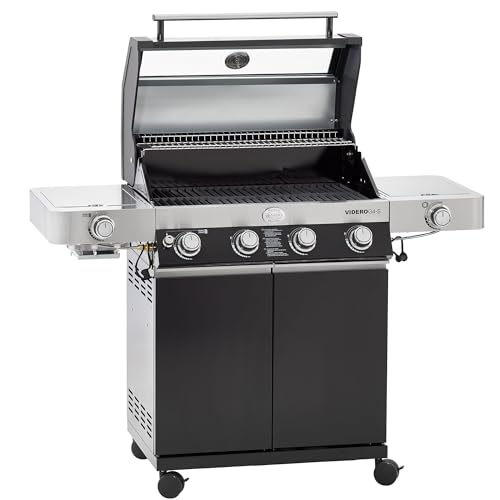
Prestige 500 RSIB is the name of this gas grill from Napoleon’s Prestige series, in black with the model number P500VRSIBPK-DE. It is not to be confused with the Prestige PRO 500, a separate appliance with an RRP of €3,999. According to Napoleon, the stainless steel version (P500VRSIBPSS-DE) has the same RRP of €1,999; output, rotisserie information and the fuel propane gas are identical there (retrieved on 5 October 2026). Besides four main burners there is a large infrared side burner called SIZZLE ZONE and an infrared burner at the back, which the manual lists as the rotisserie burner.
In our price box the grill is listed at Santos Grills at approx. €1,689 (as of October 2026), €310 below Napoleon’s RRP.
We have not handled the grill and have not grilled anything on it. Technology and operation come from Napoleon’s German product pages, the user manual N415-0800CE-DE (version of 11 November 2024) and the assembly instructions N415-0801CE. The manual covers four models (P500V, P665V, P500VX, P665VX) and illustrates the P500VX with a display. What appears only there, we do not transfer to the RSIB, which is a P500V. Figures marked “own calculation” are ones we calculated ourselves.
Burners, grates and cart
According to the stainless steel version’s page, the four main burners are made of stainless steel. Above them sit two-stage stainless steel flame guards, which the manual calls searing plates or sear plates, and on top of those the WAVE stainless steel grates, 8.5 mm thick. According to Napoleon, the main cooking area measures 71 x 46 cm, with room for 31 burgers, and the total cooking area is 5,658 cm². The warming rack can be taken out and stored in the grill. By calculation, four main burners plus side and rear burners make up the six burners that Napoleon counts for the Prestige 500 RSIB on the Rogue PRO-S 525 page.
The main burners are lit with JETFIRE 2.0, without a battery and with a jet of flame for each burner individually. According to Napoleon, cross-lighting clips automatically light the neighbouring burners if a burner goes out or does not light; Napoleon calls this cross lighting. The control knobs glow red while their burner is running, the others stay blue. A light bulb symbol on the control panel switches on the lighting for grilling in the dark.
The cart runs on lockable castors whose height is adjustable. The gas bottle sits close to the ground: before driving over uneven terrain you raise the castor height, otherwise the bottle and bottle holder can be damaged. There are also integrated tool hooks (the stainless steel version’s page counts six) and adjustable cabinet doors. According to Napoleon, the lid is a space-saving roll-top hood called LIFT EASE. For the materials of the lid and body there are three statements: the manual speaks of porcelain or stainless steel, the stainless steel version’s page of a stainless steel construction with powder coating, and the warranty terms list cast aluminium parts and stainless steel frames.
Assembly follows the assembly instructions, which run to 68 pages. Their pictograms show two people, safety goggles and gloves. No tools are included: slotted and Phillips screwdrivers, a socket wrench and an open-end wrench, both wrenches 3/8 inch (10 mm). Beforehand you take all parts out of the packaging and assemble on a firm, level, horizontal surface.
In detail: main burners, Sizzle Zone and rear burner
The product page states 24 kW. The manual breaks this down by burner group and by gas type: the main burners together deliver 14.0 kW with G31 and 16.0 kW with G30, the rear burner 5.0 and 5.7 kW, the side burner 4.5 and 5.0 kW. According to the common gas standard, G31 stands for propane and G30 for butane. With propane the sum is 23.5 kW, in line with the 24 kW. The sum is never reached, because according to the manual the rear and main burners must not run together. The largest simultaneous load that remains is main burners plus side burner, 18.5 kW with propane (both own calculation). Napoleon gives the values as gross heat output, meaning the energy of the gas that the burners burn.
With the main burners you grill directly or indirectly. Directly, burgers, steaks, chicken and vegetables lie over the heat, and the meat is first seared and then finished at a lower temperature. Indirectly, one or more burners run and the food lies where there is neither flame nor burner; Napoleon considers this suitable for large cuts of meat and for foods that tend to flare up. According to the manual, anything that takes longer than 30 minutes, such as a roast, can cook indirectly if the opposite burner stays on. You preheat with the lid closed and all main burners on the highest setting, about 10 minutes; the troubleshooting says 10 to 15. Fish and vegetables, which cook quickly, may sit with the lid open. The sear plates go in with the holes facing forward and the slots facing down; wrongly inserted plates are among the reasons for flare-ups and uneven heat.
The side and rear burners work differently. In an infrared burner the gas burns on a ceramic surface that glows and gives off its energy mainly as radiation to the food, rather than first heating the air under the lid. That is how the technology works in principle. On an English-language advice page with no model reference, Napoleon writes that infrared burners reach up to 1,800 °F, around 982 °C. For the Prestige 500’s SIZZLE ZONE this is not a measured value; no model value for it is available. How hot the grate ends up also depends in principle on the lid and the wind.
The SIZZLE ZONE has its own rules. The windguard must be installed during operation; according to Napoleon it keeps operation steady in winds of up to 11 km/h, can be folded and stored under the side burner lid. Pots and pans up to 25 cm in diameter are recommended as cookware. No more than 75 % of the cooking surface of a main or side burner may be covered with solid metal such as griddles or pans. With more, the infrared burner can flash back; signs are loud hissing, then a torch-like sound and a weak flame. You do not deep-fry on the side burner, and its lid stays open while it is running or hot. The infrared guide’s guide values for steaks, burgers and chicken are in the questions at the end. What a Sizzle Zone means on the data sheet and who it is worth it for is explained in our guide Grill features explained.
Is a rotisserie included?
According to Napoleon’s product page it is not: under technical data, “rotisserie included” says no, for both versions. Napoleon sells kit 69232 as an accessory, RRP €209.
Napoleon’s documents are not entirely consistent. The assembly instructions’ parts list gives the rotisserie motor, spit rod (34 inches, so 86.4 cm), forks, counterweight and motor bracket as standard parts for the P500V. But it is a spare parts overview and does not prove what is in the box; only the no is explicitly documented. The manual describes the rotisserie kit with the addition “if equipped”. Among the grill’s accessories, of the rotisserie parts only the stainless steel grill basket appears (RRP €74.95). The kit’s page names the PRO 500, P500 and LEX 485 series and grill hoods up to 78 cm width as suitable, but under compatible models lists only the built-in appliances BIPRO500RBNSS-3-DE and BIPRO500RBPSS-3-DE. Whether kit and grill fit together, you therefore clarify with the dealer before ordering. We would include the kit price straight away if the rotisserie matters to you.
Anyone who uses a rotisserie needs the rear burner. Because of the rule above, no main burner heats the main grate during this time (our inference). You take out the warming rack beforehand, because extreme heat can damage it. Napoleon describes the procedure like this: rear burner on high until the meat browns, then reduce the heat and keep the lid closed, checking the inside temperature with a thermometer. The motor carries up to 15 kg, you must never overload it, and the load must be balanced. As an example the manual gives a 1.4 kg chicken, which takes about 1.5 hours at medium to high heat. Three chickens can be skewered tightly together and pressed together with the second fork; the wings are first tied or skewered to the body. When handling the grill components you wear gloves.
Location, gas and ignition: what the manual requires
You need roughly 202 x 135 cm of free space if you add Napoleon’s minimum clearances to the outer dimensions of 166 x 66 cm: 17.8 cm to the sides, 68.6 cm to the rear, in each case to combustible materials (own calculation; the manual gives the clearances in inches, 27 to the rear and 7 to the sides). In height the grill measures 129.5 cm, 147 cm with the lid open, which counts under a roof.
According to the manual, the appliance is intended for an outdoor patio or the garden. It does not mention a balcony; whether a grill may stand there depends on the tenancy agreement, house rules and local law, as our guide to grilling on a balcony explains. Because of its dimensions alone, we would not buy the Prestige 500 for a balcony. The location should be above ground, naturally ventilated and free of stagnant air, so that wind and convection quickly disperse gas leaks and combustion products. It does not belong in a building, a garage or another enclosed area, nor in a built-in or slide-in structure, and the ventilation openings of the cylinder enclosure stay clear. The location must not be exposed to strong wind, especially not wind directly from behind. As the lowest ambient temperature for safe operation, the manual gives 0 °F, which is minus 17.8 °C. When a shelter still counts as outdoors, the manual defines in three cases, which are in the questions.
On page 2 of the manual it says in capital letters: use only outdoors in a well-ventilated area. If the instructions are not followed exactly, according to Napoleon this can lead to fire or explosion, with property damage, injury or death. If you smell gas, you shut off the gas supply to the appliance, extinguish open flames and open the lid. If the smell persists, you move away and immediately call your gas supplier or the fire brigade. Near the grill you neither store nor use petrol or other flammable liquids or vapours, and no lighters, matches or anything else flammable lie in the housing or spice compartment.
According to a warning on page 6, gas and hose are connected by a licensed gas installer. As a bottle, the manual permits a propane cylinder of at least 6 kg or a butane cylinder of 13 kg; the German product page lists only propane. For Germany the table lists the categories 3P(50) and 3B/P(50), gas at 50 mbar. Regulator and hose should come from Napoleon (for the scope of delivery see the list at the end); alternatively, regulators and hoses under European standards and regional regulations apply. You compare the details on the rating plate with the table, and the regulator must deliver the pressure listed there. A hose of 0.9 m is recommended, and it must never be longer than 1.5 m. It is replaced before the printed expiry date, does not run under the drip tray and touches neither hot surfaces nor dripping fat, because it could melt and cause a fire. Which bottle size suits a garden grill is explained in our guide to the gas bottle for the grill.
Napoleon requires the leak test before use, once a year and after replacing gas components, and at every cylinder change at the connection between regulator and cylinder. The procedure: do not smoke, remove all ignition sources, set all burner controls to off, open the gas supply valve, apply liquid soap and water in a 1:1 ratio to all connections and fittings of regulator, hose, manifolds and valves. Bubbles show a leak. You tighten loose connections. If the leak cannot be stopped, you immediately close the gas supply, disconnect the grill, have it checked by a certified installer or dealer and use it again only after repair. You never look for gas leaks with an open flame.
You light with the lid open. All burner controls are at OFF when you slowly open the bottle valve. With a main burner you push a knob in, slowly turn it anticlockwise to HIGH until the pilot flame burns, and hold it pressed until the burner lights. After grilling you shut off the gas supply at the connection. If the grill stays unused for longer, you turn off the gas at the cylinder, disconnect the hose between cylinder and grill and store the cylinder outdoors in a well-ventilated place away from children, not in buildings, garages, sheds or other enclosed spaces. The dust cap supplied with the cylinder valve belongs on it; other caps or plugs can lead to gas leaks.
Cleaning and care
When cleaning you always wear protective gloves and safety goggles, all burners are off, and the grill has cooled down. The manual calls accumulated grease a fire hazard; the grease tray, drip tray and sear plates are therefore cleaned regularly.
The Sizzle Zone’s ceramic tile gets no wire brush and no water, nor any other liquid: the sudden change in temperature can cause cracks in the ceramic. Most drips and food residues burn off there immediately. Every 3 to 4 uses you let the burner run for 5 to 10 minutes on the highest setting until residues are gone. The following also applies to the ceramic: cold water on a hot burner is taboo, a burner that is wet before use later creates steam and pressure and can crack, repeated soaking makes the ceramic swell. If there is water in the grill, you check the ceramic, remove the burner, turn it over and dry it thoroughly indoors. Rain, sprinklers or a hose must not hit the hot grill either: the porcelain can chip. Cracks make the burners unusable, and according to the manual the warranty does not cover damage from failure to comply.
Stainless steel grates are preheated at every use and cleaned of residues with a wire brush; with regular use they discolour permanently. Napoleon calls stainless steel cooking grates corrosion-resistant and lower-maintenance than cast iron.
With moderate use you clean the interior at least every 3 months: cooking grates out, loose residues with the brass wire brush, the sear plates with a spatula or scraper, ash with the wire brush, take out the plates, brush the burners and sweep everything into the drip tray. You clean the drip tray about every 4 to 5 uses. The disposable grease tray underneath you change every 2 to 4 weeks depending on use, and only for liners approved by Napoleon, never for aluminium foil, sand or anything else.
With moderate use you clean exterior surfaces once a month, with non-abrasive cleaners and always in the direction of the grain. The control panel gets only warm soapy water, because the lettering is printed on and abrasives or stainless steel cleaners gradually wear it away. You treat porcelain-enamelled parts carefully, the glass-like enamel can chip. Stainless steel turns golden or brown with heat; according to Napoleon this is normal and has no effect on performance. No oven cleaner on grill parts, no pressure washer, no abrasives or steel wool on painted, porcelain-coated or stainless steel parts, and grates do not belong in a self-cleaning oven. Barbecue sauce and salt are corrosive. In coastal regions, warm and very humid areas and near pools, stainless steel oxidises more easily; the stains look like rust but are easy to remove, and stainless steel and chrome surfaces there are cleaned every 3 to 4 weeks with warm soapy water. Cast aluminium gets warm soapy water at least once per season, because heat and weather can cause white spots (oxidation) on the cast parts. If something flakes off in the lid, according to the manual that is not a defect: hardened grease dries into paint-like flakes that peel off.
Spider webs and insect nests in the burner can turn the flame yellow or orange and lead to fire or flashback at the air shutter. Napoleon has fitted the burner with an insect screen at the air shutter, but that does not make the problem disappear. You clean nozzles with a paper clip or the supplied nozzle maintenance tool, and drill out blocked nozzles with the supplied drill bit without bending them or enlarging the holes. The air supply is set at the factory and may only be adjusted by a qualified gas installer. Correctly set flames are dark blue with light blue tips, occasionally yellow. Once a year a specialist should inspect and service the grill.
Warranty, accessories and what else costs money
The product page lists a “Limited Lifetime Warranty” with an asterisk; the terms are in the manual and on Napoleon’s warranty page. Lifetime there means a period of 30 years. Graded by component, the following applies:
- Lifetime: cast aluminium parts and stainless steel frames, stainless steel lid, porcelain-enamelled lid, stainless steel cooking grates, stainless steel side table
- 10 years plus l.d.: stainless steel tube burners, grates of porcelain-coated cast iron
- 5 years plus l.d.: stainless steel flame guards, stainless steel infrared burner for the rotisserie, lower ceramic infrared burner or ceramic infrared side burner (without grate), ceramic infrared burner for the rotisserie (without grate)
- 3 years: electrical components
- 2 years: other parts
“Plus l.d.” means: after that you get the spare part for the lifetime of the grill at 50 % of the current retail price. On the ceramic infrared side burner, the warranty page contradicts the manual: it gives 3 years for it, 5 for PRO models. Which statement applies, you clarify before buying with Napoleon or the dealer.
Under accessories, the product page lists, among others, a cover for PRO 500 and Prestige 500 (item 61500, RRP €94.95), a cast iron charcoal insert with smoker basket (67732, RRP €54.95), a stainless steel smoker box (67013, RRP €29.95), the grill mat 68001 in the size 119.5 x 81.5 cm (RRP €54.95) and a double-sided enamelled cast iron griddle (56041, RRP €69.95). The multifunctional warming rack 71500 costs an RRP of €109; the parts list gives it as a standard part only for the Phantom version. On the stainless steel version’s page there is also the lower cabinet set, left and right (68003, RRP €549). The prices are as of 5 October 2026.
Wear parts are mainly the disposable grease trays. The 3-pack 62070 is explicitly intended for the P500V and costs an RRP of €15.95; with a change every 2 to 4 weeks it lasts, by calculation, 6 to 12 weeks. The JETFIRE maintenance kit 62050 costs an RRP of €8.95. You find individual parts via the spare parts search on Napoleon’s site.
What Napoleon leaves open
The following is not in any Napoleon source we have read, or the sources contradict each other:
- the net weight of the grill
- an assembly time
- the heat-up time to a given temperature and a maximum temperature in the cooking chamber
- temperature and area of the SIZZLE ZONE
- how the total cooking area is made up of main grate, Sizzle Zone and warming rack
- the material of the lid and body of the black version
- a list of the scope of delivery for the RSIB: the manual describes the BBQ lighter and nozzle maintenance tool as supplied; on regulator and hose it says different things (pages 3, 9 and 11 speak of the regulator with hose supplied with the grill, page 8 of “if not included”); it nowhere lists a gas bottle as supplied
- the battery type for the rear and side burners (the parts list includes a housing for 3 D cells, without stating its purpose)
- whether the 6 kg minimum size of the propane cylinder refers to the fill quantity
- whether the hand washing of the grates before first use also applies to the RSIB’s stainless steel grates; the manual paragraph justifies it by protecting the cast iron
- whether the RSIB has a lid thermometer, a grate sensor or both; the parts list includes a temperature display kit, a measuring range is given nowhere
- gas consumption by gas type: the manual table shows 1164 g/h for the main burners, 415 g/h for the rear burner and 364 g/h for the side burner, without assigning the gas type, so we do not calculate a bottle run time
- the meaning of the abbreviations G30 and G31 (the assignment to butane and propane in this text follows the common gas standard)
- whether the minimum clearances apply from the side table or from the body
- country of production, market launch and whether it is a redesign
- noise, heat distribution, browning and build quality; we did not have the appliance in hand for these
What else is worth considering?
| Model | The difference | Price | Our rating | Choose this one if |
|---|---|---|---|---|
| Napoleon Prestige 500 (this one) | 4 main burners, infrared side and rear burners, rotisserie only as an accessory | approx. €1,689 | 9.1 | you want your own infrared zone and a rear burner and can make room for 166 cm of width plus clearances |
| Napoleon Rogue PRO-S 525 | same burner concept, but 154 instead of 166 cm width and a 15-year instead of a limited lifetime warranty | approx. €1,299 | 9.0 | your space is too narrow for the Prestige 500 including clearances |
| Broil King Regal 590 | 5 main burners, rotisserie burner 4.4 kW, rotisserie set with motor included according to Broil King, but only a 2.7 kW side hob instead of infrared | approx. €1,649 | 9.4 | you want to grill on the rotisserie from day one and can do without an infrared side burner |
| Napoleon Prestige 665 Connected | 5 main burners on a 94 x 46 cm main cooking area (41 burgers), display, app, gas bottle monitoring, 188 cm wide | approx. €2,499 | 9.3 | you regularly grill more than 31 burgers at once and want to use the display and app |
The prices come from our price box and may differ on the day you order. The technical details come from the manufacturer pages of Napoleon and Broil King, plus the Napoleon manual; the rating is our editorial assessment from the data comparison and not a measurement result.
Who the Prestige 500 suits, and when another grill
It suits you if you want to sear steaks on a dedicated infrared zone and cook roasts or chicken on the rotisserie, both in one appliance, and if your location does not get strong wind from behind.
Four reasons speak for another grill. If your space is not enough for around 2 m of width including minimum clearances, the Rogue PRO-S 525 is the narrower choice: with the same clearances as for the Prestige 500 it would come to around 190 cm (own calculation; you check its own clearances in its manual). With the side shelves folded down it measures only 127 cm according to Napoleon, and its packaging weight is 68.48 kg against 108.84 kg for the Prestige 500. If you want to grill on a rotisserie without buying a kit afterwards, look at the Regal 590: according to Broil King, a rotisserie set with electric motor as well as hose and pressure regulator are included, and the main burners deliver 16 kW together. If you need more grate, the Prestige 665 Connected has, according to Napoleon, a total cooking area of 6,867 cm² against 5,658 cm², but weighs 122.45 kg in the box, around 13.6 kg more. And if you want a display and temperature probes at the same width, look at the Prestige 500 Connected (not in our catalogue, differences in the questions).
You can sort budget, space and grilling style in advance in the Grill Finder. The Prestige 500 is wrong for anyone who wants to use the main grate and rotisserie at the same time (rule in the section “In detail”), and difficult for balcony-only households (see location).