The manufacturer calls the G280 the LotusGrill S; G280 is the type designation from the manual. It is a round tabletop charcoal grill in which a fan drives the embers. LotusGrill, based in Limburgerhof, calls it the little brother of the original; the original is the Classic, which we cover as the G340. The range also includes the XL (G435), the XXL and the Hybrid Classic with additional gas operation. The company page mentions, among others, the International Barbecue Award, the Red Dot Design Award and the Design Plus Award; the last page of the manual attributes the awards to the Classic, not the S. In our charcoal grills category, the S counts as a tabletop grill.
We have not handled the grill and have not grilled anything on it. The information comes from lotusgrill.de, from the multilingual manual for types S, Classic and XL (version 41, as of April 2026) and from the Amazon catalogue; what we calculate or infer, we mark. First, one point that affects the buying decision: the fan has no rechargeable battery. It runs on four batteries or on the USB cable.
Design and power supply
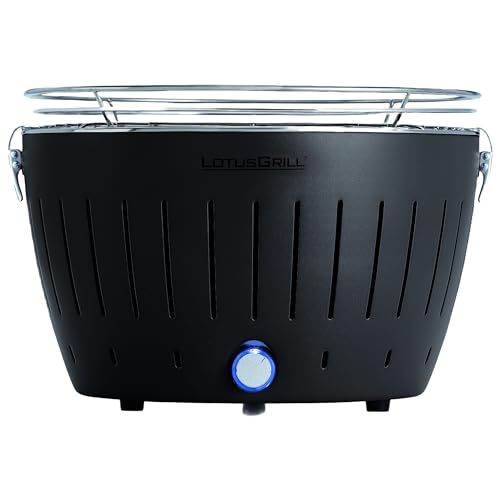
Round and wider at the top than at the bottom: approx. 292 mm diameter at the top edge, approx. 220 mm at the bottom, approx. 210 mm high. According to the product page and the manual’s dimension table, the grate measures approx. Ø 258 mm; the bullet point on the product page says approx. 26 cm. The product photo shows a red outer shell with vertical slots, a rotary knob with a blue light at the front and two buckles at the side. We assign the knob to the combined on/off switch with heat control and indicator light from the parts list. According to the manufacturer, the buckles join the grate, charcoal container and inner shell into one closed unit; according to the principle page, the grill can be taken apart easily and quickly.
The grill is built from two shells. The outer shell is made of powder-coated steel and carries the battery compartment and the electronics unit. Inside it sits the inner shell (the manual and the spare parts page sometimes speak of the inner bowl; in our reading it is the same component, and that is what we call it under care), on it the ignition bowl, above that the charcoal container with lid, and on top lies the grate. According to the product page, the inner shell, charcoal container, grate and locking buckles are made of stainless steel; the manual’s materials table also lists impact-resistant plastic.
The product page gives the weight as approx. 2.8 kg. The manual’s weight table gives 3.6 kg including carry bag, manual, batteries and USB cable; by our calculation the 0.8 kg difference is accessories, so the 2.8 kg is the weight of the grill alone. The Amazon catalogue converts to 3.0 kg and falls in between.
The fan runs on four AA batteries (1.5 V each, 6 volts together according to the manual’s table), which according to the manufacturer’s page are in the box. Only AA batteries approved for sale in the trade and in perfect condition may be used; under Germany’s battery law, empty ones belong at the dealers’ collection points, not in household waste. For the running time, the FAQ gives approx. 15 to 20 hours, on average up to 25 grilling sessions on one set with proper storage; this figure applies to LotusGrill in general. Alternatively, the supplied USB power cable feeds the fan. As soon as the round plug is in the grill, the battery compartment is disconnected. According to the manual, rechargeable batteries cannot be charged via the cable.
The manufacturer offers the S in six colours. Our Amazon listing is Fire Red with model number G-RO-280, which matches the item number of the red variant on lotusgrill.de.
In detail: what the fan changes about the embers
On a charcoal grill without a blower, the draught determines how quickly the charcoal burns through and how hot it gets. On the S a fan takes over this part, and according to the manual it stays on throughout the whole grilling process. You set the heat on the heat control, which according to the principle page works continuously. By our inference, you use it to control the amount of air reaching the embers.
It is lit with gel; the switch alone is not enough. The manual describes ten steps, here are the first seven in short form:
- Insert four AA batteries into the battery compartment in the base of the outer shell, mind the polarity, close the compartment.
- Place the inner shell in the outer shell.
- Fill the charcoal container completely with charcoal (the manual gives LotusGrill beech charcoal as an example) and put the lid on.
- Apply a ring of grill lighting gel about 10 mm wide around the centre hole of the ignition bowl and place the bowl on the inner shell. The manual recommends the LotusGrill safety fire paste.
- Switch on the on/off switch and first turn the control to the highest setting (to the right). The fan must be running so that the flame is not smothered during lighting. The manual warns here: do not reach into the open flame.
- Light the gel until it burns.
- Carefully and evenly place the filled charcoal container with lid onto the ignition bowl; the charcoal starts to glow in very little time.
In steps 8 and 9 the grate goes on: it is set with its four metal feet into the slots of the inner shell, the two brackets are hooked into the buckles and the buckles are pressed down. The tabletop grill is then one connected unit. Step 10 is regulating the heat on the heat control, and the fan keeps running.
After approximately 3 to 4 minutes the grill is ready to use according to the manual; the figure there applies jointly to the S, Classic and XL. The principle page advertises 3 minutes, the Amazon text 4 minutes of preheating. One load burns for 40 to 90 minutes depending on the type of charcoal, and you can refill at any time. Because the fan has to run already while lighting, in our reading the S is not ready for use without batteries or a cable.
LotusGrill calls the result low-smoke; the principle page says “clearly reduced smoke development”. In our reading, a grill with no smoke at all is not what is meant. As the reason, the principle page and FAQ give a stainless steel plate that covers the combustion chamber in the middle of the grate, so that no fat drips into the embers from above; both describe this for LotusGrill in general. Technically this makes sense: fat that falls onto glowing charcoal burns there and smokes. Where the fat goes instead, we infer from a note in the manual for very fatty food, where the inner bowl should be emptied regularly: it collects there. According to the manual, the grill may still smoke slightly on first use, because there can be oil residues on the charcoal container from production.
How many people does the grate serve?
The grate is approx. Ø 258 mm and the charcoal container holds max. 120 g charcoal (the product page gives its own fill quantity for briquettes). We would plan the S for one to two people and reach for the larger Classic from three.
The manufacturer’s own range serves as the yardstick. The Classic has a grate of approx. Ø 320 mm and is intended according to the manufacturer for up to 5 people, the XL (grate 40.5 cm) for up to 10. If you scale the Classic’s figure by grate area, a good 3 people remain for the S: (258 / 320)² gives about 0.65, times 5 is a little over 3 (our calculation). This is an upper limit. The calculation assumes that both manufacturer figures are generous to the same degree, and it uses the full disc of roughly 520 cm² by calculation, part of which is taken up by the stainless steel plate in the middle of the grate, insofar as it is also fitted on the S.
Where to set it up, safety and care according to the manual
The manual is unambiguous on where to set it up. The charcoal tabletop grill must not be used in enclosed and/or habitable spaces; buildings, tents, caravans, motorhomes and boats are named as examples. There is a danger to life from carbon monoxide poisoning. The manufacturer’s FAQ requires use outdoors only and describes carbon monoxide as an invisible, odourless gas; even if LotusGrill releases only little CO, it could be dangerous in enclosed spaces.
The advertising sees it differently. The S product page recommends it for travel and leisure “when camping, hiking or on the boat”, and the Amazon title names campers, hikers and boats. The product safety notice for LotusGrill charcoal on the accessories page also says that grilling in enclosed spaces requires an extraction hood; for the grill the manual applies, and we do not adopt that sentence. In our reading, only operation indoors is affected, not transport or storage in a motorhome.
For set-up, LotusGrill relies on the double shell: according to the principle page, the inner shell reflects the heat upwards, air circulates between the inner and outer shell, and the outer shell is said to “never get hot”. The grill can therefore be moved during operation and placed on any surface, according to the FAQ. “Never hot” is a promise without a temperature figure, so we would still put a heat-resistant mat under it on wood or plastic.
Whether you may grill with charcoal on the balcony is governed by your tenancy agreement and house rules, not by LotusGrill; in addition, gel burns in the ignition bowl during lighting. Our guide grilling on a balcony goes through it. For railings the manufacturer sells its own mount; the data are in the frequently asked questions.
For the safety and care notes we follow the wording of the German manual (version 41) and the product page. What already appears elsewhere in this section, we do not repeat in the lists: the ban on enclosed spaces (see above) and letting it cool down completely before cleaning (see the care list below). On intended use, the manual also says: the charcoal tabletop grill may be used for grilling with charcoal to prepare food suitable for grilling, is intended for private use only, and all requirements of the manual must be followed unchanged.
The safety notes appear under four signal words:
- Warning: Risk of burns. Risk of suffocation. Keep children and pets away.
- Caution: Use only fire starters complying with EN 1860-3. Wear gloves when touching the hot grill grate. Change the batteries only when the grill has cooled down completely.
- Attention: Do not use methylated spirits or petrol for lighting or relighting. Never pour water into the charcoal container to extinguish the glowing charcoal.
- Important: Place the grill on a stable surface before use. Use grill tongs for grilling (LotusGrill recommends its own accessories). Never leave the hot grill unattended. With very fatty food, empty the inner bowl regularly. Check the batteries before every use. Do not change empty batteries while the grill is in use.
The care section adds a further note: do not use water to cool down the hot grill, otherwise there is a risk of burns and scalds. For the cleaning itself, the manual lists these points:
- After each use, clean the grill grate, inner bowl and other soiled parts.
- Always wait with cleaning until the grill has cooled down completely, otherwise there is a risk of burns.
- The grill grate and inner bowl may be cleaned in the dishwasher or by hand with any standard washing-up liquid.
- For stubborn residues, use standard grill cleaners, for example the LotusGrill grill and oven cleaner. Never use acid, white spirit or other flammable substances for cleaning.
- Clean the outer shell with the electronics unit with a damp cloth or a brush.
- Clean the charcoal container dry only, for example with a brush, and never with water.
- Before longer periods out of use, take the batteries out of the device.
The manual calls wear, rust formation, deformation and discolouration of the parts directly exposed to fire, especially the stainless steel parts, normal and function-related; they are not a warranty case.
What is missing from the box, and what is available
According to the manufacturer’s page, the scope of delivery includes the grill, a colour-matched nylon carry bag, four AA batteries, the instruction manual and the USB power cable. Charcoal, fire paste or lighting gel and a USB power adapter are not included; the Amazon text also advises ordering fire paste and beech charcoal at the same time. On Amazon the S cost approx. €149 on 14.10.2026.
On charcoal, the current manual allows any ordinary charcoal. For the basic question of whether charcoal or briquettes suit you better, our guide charcoal or briquettes helps.
On the product page, LotusGrill lists for the S the travel hood S, glass hood S, charcoal container S, grill grate S, inner bowl S and carry bag S as accessories. The accessories page also has a grill hood S made of powder-coated steel with a safety glass insert and a thermometer in the knob, whose parts are dishwasher-safe; according to the manufacturer it turns the grill into an oven. In addition there is a cordierite pizza stone that is placed on the grate with or without the hood, and two stands: a grill stand set made of one base and two table plates, and a universal stand for any LotusGrill.
What the manufacturer leaves open
These points are not clarified by the manufacturer’s pages or the manual, nor by the Amazon catalogue:
- Number of people for the S, the number of sausages or steaks that fit on the grate at the same time, and the charcoal consumption per load (the FAQ gives 150 to 200 g only for the original model)
- Grilling area in cm² and the size and position of the stainless steel plate on the S
- Power consumption, speed and number of settings of the fan (the principle page says only “continuous”) and the minimum output of the USB power adapter; a power bank is mentioned only in the Amazon title, and a car adapter appears neither on the accessories page nor in the manual
- Maximum temperature or temperature range in degrees
- Minimum distances from walls, parapets, plants and combustible materials, and behaviour in wind
- Surface temperature of the outer shell in degrees and the time until the residual embers have cooled down
- Smoke quantity as a measured value and the comparison grill behind “clearly reduced”
- Ash chamber or ash catcher (the manual’s parts list and the spare parts page list none)
- Replacement for the outer shell with fan unit, switch and buckles, although the principle page promises all components as spare parts
- Stainless steel grade (V2A or V4A), wall thicknesses, type and heat resistance of the powder coating and the location of the impact-resistant plastic from the materials table
- Country of manufacture (only the company seat in Limburgerhof is documented) and the year the S was launched
- Test marks such as CE or GS (the manual refers to EN 1860-3 only for fire starters)
- Dimensions and weight of the grill hood S and pizza stone S, the load capacity of the railing mount, and whether the glass hood S on the product page and the grill hood S on the accessories page are the same part
- Prices for charcoal, fire paste and accessories (lotusgrill.de is not a shop)
- Warranty terms beyond the statutory warranty: the German and English versions of the manual say different things
On two measurements the manufacturer’s pages contradict each other: the grate measures Ø 258 mm in the dimension table, the replacement grate S Ø 255 mm. The charcoal container holds max. 120 g on the grill’s product page, while the replacement charcoal container S is given as approx. 150 g. In the text we stick to the grill’s product page.
On matching our listing: the ASIN is based on the Amazon title (“LotusGrill S Small Kompakt Feuerrot”) and the model number G-RO-280. The catalogue dimensions of 29.2 × 29.2 × 21.0 cm match the manufacturer’s figures for the upper diameter and the height.
What else comes into question?
| Model | The difference | Price | Our rating | Choose this one if |
|---|---|---|---|---|
| LotusGrill G280 (this one) | Grate approx. Ø 26 cm, approx. 2.8 kg, charcoal container max. 120 g | approx. €149 | 8.6 | you grill alone or as a pair and every kilo counts when carrying |
| LotusGrill G340 | Grate approx. Ø 32 cm, up to 5 people, approx. 3.7 kg | approx. €179 | 8.8 | you regularly grill for three or more and are happy to carry 0.9 kg more |
| Enders Aurora Stone | Flat rectangular grill, grate 37 × 25 cm (925 cm² according to Enders), approx. 3.7 kg | approx. €72 | 8.2 | you want more grate area and prefer a flat unit to a round one |
| Weber Go-Anywhere | Heat control via two vents, 6.78 kg according to Weber | approx. €95 | 8.3 | you want to control the heat with vents rather than a fan and are happy to carry more weight |
The prices are guide values from our price boxes and apply as of the date of the respective box, not at a common date. The rating is our editorial assessment from manufacturer data, not a measurement result, and the table is not suitable for comparing smoke quantity or heat. The information on the G340 comes from lotusgrill.de, that on the Aurora Stone from enders-germany.com (item 1375) and that on the Go-Anywhere from weber.com.
When the S fits and when another does
Weight against area is the calculation that separates the four models. According to the manufacturer’s pages, the G340 weighs 0.9 kg more than the S without accessories, has the larger grate and costs €30 more in our price box (approx. €179 against approx. €149). The Enders Aurora Stone costs €77 less than the S and states 925 cm² of grate area, by calculation 1.8 times the full circular disc of the S (our calculation). At 3.7 kg it weighs as much as the G340 and according to Enders measures 47 × 26 × 13.5 cm (W × D × H), against approx. 292 mm diameter at approx. 210 mm height for the S. The Weber Go-Anywhere is €54 below the S and according to Weber weighs 6.78 kg, roughly 4 kg more than the S.
The S and the Aurora Stone both need power, from different sources. With the S, four batteries and a USB cable are in the box; with the Aurora Stone the fan runs on batteries or a power bank according to Enders, and the USB cable is supplied. If you do not want an electric fan, look at the Weber: there, according to the manufacturer, two integrated vents regulate the temperature, and you set the heat by hand.
For low and slow, that is, cooking for hours at low temperature, we would not choose the S. With max. 120 g its charcoal container is the smallest of the three models S, Classic and XL (200 g for the Classic, 400 g for the XL, each according to the manufacturer’s pages), and with a burn time of 40 to 90 minutes per load you would top up several times over a cooking time of several hours. If you want to grill short and fast, on the other hand, you are well served by the fan principle, since the manual reckons with a few minutes until it is ready to use.
If you are not yet sure whether it should be charcoal at all, you can go through fuel, budget and place of use in the Grill Finder.