A wood fire with a thermostat
The Traeger Pro 575 burns wood pellets in a small fire pot beneath the cooking chamber and regulates the heat electronically. The flame never reaches the food. According to the German manual, Traeger grills cook with indirect heat, and drippings and meat juices run over a plate into a grease bucket on the outside of the unit.
That also says what it is built for: ribs, pork shoulder, whole chickens, roasts, anything that needs hours at an even temperature. It is not designed for steaks over open embers; there is a separate section on that further down.
Among the pellet grills in our catalogue, the Pro 575 is in the mid-size range. At Santos Grills it costs approx. €749, which is the cheapest retailer in our price box; the Amazon page showed €1,054.99 on 21.10.2026. According to Traeger UK, the black version carries the model number TFB57GLEC, and the same number appears in the Amazon catalogue. The German manual with the identifier DOC432 applies to the variants TFB57GZE, GLE, GZEC and GLEC and also covers the larger Pro 780.
Traeger currently has no German product page; all German paths on the manufacturer’s site lead nowhere. What is written here therefore comes from the British product page and from the German manual. Where Amazon lists different values, this is noted.
Barrel, pellet hopper, two grates
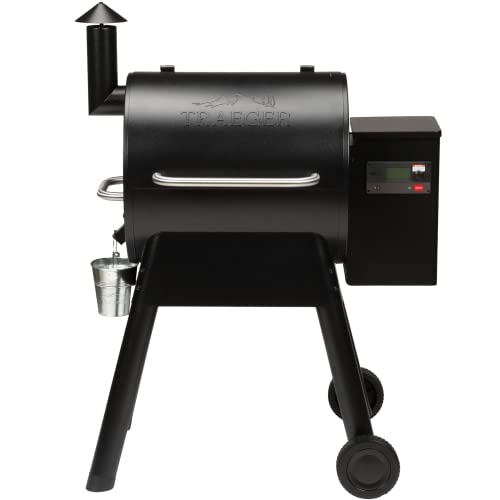
The construction is easy to see in the product photo. The cooking chamber is a horizontal, round barrel with a hinged lid. On the left the chimney with a cap rises upwards, the grease bucket hangs beneath it, and on the right sits a box-shaped pellet hopper with the controller mounted on it. Traeger describes the grill chamber as oval and justifies the barrel shape with air and smoke circulation.
You grill on two levels made of porcelain-coated steel. For the grates, the British page gives 572 sq in, and for the total cooking area 575 sq in, which converts to around 3,710 cm². For the Pro 575 and Pro 780 together, the manual states a range of 0.37 to 0.50 m², which fits both models. Amazon lists 3,960 cm²; where this higher value comes from cannot be derived from the Traeger documents, so we calculate with the 575 sq in. For capacity, Traeger writes: 24 burgers or 5 racks of ribs or 4 chickens.
You can remove the upper grate. According to the manual, you set the lower one to the searing position if needed; what that is good for is covered in the section on searing. According to Amazon, there is a hook on the outside of the grill from which an additional rack can hang.
According to Traeger UK, the pellet hopper holds 18 lbs, the manual speaks of just over 8.2 kg, and Amazon rounds down to 8 kg. The 9 kg that used to appear on this page is not found in any manufacturer source.
On weight, the sources are close: 124 lbs, around 56 kg, according to Traeger and 58 kg according to Amazon. Traeger publishes external dimensions neither on the product page nor in the manual. Amazon gives 135 cm height, 104 cm width and 69 cm depth, that is, the overall envelope across chimney, pellet hopper and bucket.
In the photo, the two wheels sit on the legs beneath the pellet hopper, and the other two legs stand on the ground without wheels. Traeger calls them all-terrain wheels. To move it, you lift the wheel-less side and push. According to the parts list, casters are reserved for the Pro 780.
Traeger allows 30 to 60 minutes for assembly. According to Amazon, the box contains a meat probe in addition to the two porcelain-enamelled grates.
In detail: auger, igniter rod, probe
A pellet grill works fundamentally like a wood-fired oven with a thermostat. An auger pushes pellets from the hopper into the fire pot, an igniter rod lights them at start-up, and a temperature sensor in the cooking chamber tells the controller whether fuel needs to follow. The higher the target temperature, the more often the auger runs. On the Pro 575, a heat baffle sits above the fire pot, shielding the flame from the grate and distributing the heat in the barrel. Above it, the grease drip tray catches drippings and directs them to the bucket.
The most important assembly rule follows from this layering. If the heat baffle is not seated correctly, according to the manual direct heat and flames from the fire pot can start a grease fire in the grill.
Control is via the D2 Controller. According to Traeger UK, the TurboTemp function is meant to shorten start-up and bring the temperature back faster after the lid is opened; no time in minutes is given. According to the manual, at the very first start it can take up to 7 minutes for the first pellets to reach the fire pot. Traeger states the temperature range as 165 to 500 °F, around 74 to 260 °C. The KEEP WARM setting holds 74 °C and, according to the manual, is explicitly intended only for keeping food warm, not for cooking.
The grill is designed for operation with the lid closed; with it open, cooking time increases considerably according to Traeger. The manual calls temperature fluctuation normal for any grill, and lists wind, air temperature, operation or lack of maintenance as causes.
Smoke and heat are linked. Traeger writes that less smoke is produced at higher temperatures, and places more smoke flavour between 165 and 225 °F, that is, around 74 to 107 °C. That matches combustion theory: at low output the wood smoulders more slowly and less completely, at high output it burns more cleanly. If you want a lot of smoke on the meat, plan long cooks at low temperature. How to go about it is covered in our guide Smoking on the grill.
The controller has a selector dial, a status display, the socket for the meat probe and the MENU and IGNITE buttons. The power switch is on the back of the grill. To switch off, you hold the dial for 3 seconds, and according to the manual you let this shutdown cycle run through completely after every cook.
Is the Pro 575 any good for hot searing?
To a limited extent. Traeger gives 350 to 500 °F, around 177 to 260 °C, as the range for effective searing and recommends the reverse sear method. The Pro 575 has no open-flame zone; even at maximum temperature the heat arrives indirectly via hot air and the grate.
With reverse sear, you first cook the meat at low temperature to just short of the target core temperature and then turn it up for the crust. A pellet grill suits this sequence because it handles the long first phase without refuelling. For grill marks, according to the manual, you set the lower grate to the searing position.
Two limits remain in our assessment. Porcelain-coated steel stores less heat than a thick cast-iron grate, so the marks come out correspondingly weaker. And hot air transfers heat far more slowly than radiation directly above embers.
If you often want to sear steaks hot, our catalogue has two pellet grills with more options for that: the Pit Boss Pro 850 with a slider that exposes the flame beneath the grate, and the Broil King Regal Pellet 500 with a higher grilling setting.
WiFIRE and meat probe: what the app can and cannot do
The Pro 575 connects to the Traeger app via WiFIRE. According to the British product page, you use it to monitor the cook, change the grill temperature and access over 1,600 recipes. Shutting down also works remotely, in the app via the gear icon and the item “Shut Down Grill”.
Lighting does not. The manual gives safety as the reason, and the Amazon text says the same: it is lit only at the grill itself. For planning, this means that if you want to put ribs on at six in the evening, you are standing in the garden at the start; a remote start from the office is not possible.
A meat probe is included. It plugs into the socket on the controller and sounds an alarm as soon as the set core temperature is reached; with the app, the message also arrives on your phone as a push notification. If it measures more than 104 °C during operation, the controller shows “Probe Fell Out”, because the probe is then probably no longer in the meat. If it is off, you set an offset of -8 to +8 °C in 1-degree steps; the manual describes the check in ice water. Which core temperature belongs to which cut is in our core temperature chart.
Traeger itself rates the timer soberly. It serves only as a reminder and has no influence on the grill programme, so when it runs out the grill neither shuts off nor turns down. In the settings menu you find speaker, contrast, probe calibration, clearing notifications and the choice between °F and °C.
What else is worth considering?
| Model | The difference | Price | Our rating | Choose this one if |
|---|---|---|---|---|
| Traeger Pro 575 (this one) | 575 sq in, indirect heat only, WiFIRE | approx. €749 | 8.9 | you mainly cook low and slow and want to monitor the grill via app |
| Traeger Pro 780 | according to Traeger the only difference: 780 sq in cooking area | approx. €1,049 | 8.9 | you regularly put several large cuts on at the same time |
| Pit Boss Pro 850 | Flame Broiler: slider exposes the flame beneath the grate | approx. €649 | 8.6 | you also want to grill directly as well as low and slow |
| Broil King Regal Pellet 500 | GRILL preset 315 °C instead of 260 °C upper limit | approx. €999 | 9.4 | you want higher temperatures and a rotisserie |
The prices are guide values from our price boxes and may have moved since. The rating is our editorial assessment from the data comparison; it was not measured on a device.
When the Pro 575 fits and when another one does
Start with group size. Traeger’s capacity examples describe a grill filled to the brim on both levels. Traeger attaches no number of people to this. For a shoulder and a few racks of ribs at the weekend, the area is enough in our assessment. If you more often want to cook two large cuts plus sides at the same time, you should look at the Traeger Pro 780; in our price boxes it costs around €300 more than the Pro 575, for the same technology with more area according to Traeger.
Then the spot. The grill may only go outdoors, on non-combustible ground and at a distance from anything that burns; the figures are in the safety section below. The manual does not address balconies specifically. With hours of smoke and the clearances from the manual, we would not set up a pellet grill on a typical rented balcony, and the house rules have the last word there anyway.
Power is mandatory. For buyers in the EU, the manual requires a suitable earthed socket; you do not remove the earthing contact, you do not modify the plug, and adapters or extension cables are expressly prohibited. The socket therefore has to be close to the spot. On a campsite without a power pillar, a pellet grill is the wrong choice.
Steak or low and slow? If you want both equally often, you are better off in our assessment with the Pit Boss Pro 850, which can grill directly with its flame slider and stands at approx. €649 in our price box, against the Pro 575 at Santos Grills at approx. €749. The Broil King Regal Pellet 500 reaches higher and has a rotisserie, but stands at approx. €999.
Two items are not included in the price in the budget: pellets and a cover. For the Pro series, Traeger recommends its own all-weather cover with logo, sold separately. If you smoke outdoors a lot, you should plan for it, because according to the manual no water may get into the pellet hopper when it rains.
And if you often have to move the grill, for example from the garage to the patio and back, you should take the weight seriously. With wheels on one side only, you lift part of the roughly 56 kg every time you move it.
Care and safety according to the manual
Before first use, and only then, you season the grill. First you fill the auger via MENU, AUGER and “Prime Auger” until the first pellets fall into the fire pot. Then you set 177 °C, press IGNITE, close the lid and let the grill heat for 20 minutes after reaching temperature. Then follow 232 °C for another 30 minutes and finally the shutdown cycle. The 230 °C for 45 minutes previously stated here are not in the manual as such.
On placement, Traeger writes: use the grill only outdoors, on non-combustible ground and at a safe distance from combustible materials. The minimum distance to combustible materials during operation is 45.7 cm. If the grill stands under combustible materials, at least 102 cm are required. Before assembly you should find out about local fire protection rules, because according to the manual one of the main causes of fires is failure to observe these clearances.
For lighting, you never use petrol, lamp oil, kerosene, lighter fluid or other flammable liquids, and such liquids also do not belong near the grill, whether in use or stored. You never top up pellets into the fire pot by hand; the manual warns of serious burns. Water does not belong in it either, as it would clog the auger. You never touch the igniter rod.
Even outdoors, burning produces carbon monoxide, which according to the manual disperses naturally in open air. Traeger lists the symptoms of poisoning: headache, dizziness, weakness, nausea, vomiting, fatigue and confusion. If you get cold- or flu-like symptoms while grilling, you should see a doctor.
In a grease fire, you switch the grill off and leave the lid closed, never open. If the fire is then still not out, according to the manual you sprinkle a little baking soda on the flames.
The maintenance intervals are specific. You remove ash from the interior and around the fire pot every 20 hours of operation, only when the grill has cooled down completely and the power is off; according to Traeger, an ash vacuum with a metal dust container is best. The ash goes into a metal container with a fitting lid, standing on a non-combustible surface. You check the grease drainage system at least twice a year and scrape the deposits out of the V-shaped grease drain with a sturdy, non-metallic tool; the manual recommends gloves for this. You brush the grates while they still hold residual heat; Traeger advises a long-handled brush.
You clean the outside with warm soapy water. The manual prohibits oven cleaner and abrasive or harsh cleaning agents for the outer surface. Every 90 days you apply a car wax, and only to a cold grill. Before any maintenance you disconnect the grill from the power. If the cable is damaged, according to the manual it is replaced by a special cable from the manufacturer or a specialist dealer. If the grill does not start as expected, our guide Pellet grill will not start goes through the usual causes.
Warranty, spare parts and what remains open
On the warranty, the sources contradict each other for German buyers. The British product page promises three years for material and workmanship defects from the original purchase. The German manual prints the same term but overrides it with “USA only”. It replaces defective parts, does not bear labour and freight costs, and may require proof of purchase. The warranty becomes void, among other things, in the case of deviations from the manual, incompatible parts or fuels, commercial use and lack of maintenance. Which terms apply in Germany, we would ask the retailer for in writing before buying.
According to the manual, you get spare parts via Traeger dealers or customer service. Have the model and serial number ready for this; both are on the label in the lid of the pellet hopper. For Europe, the British page gives the telephone number +44 208 620 1070 and a separate email address for European support.
After going through both manufacturer sources, these points remain open: external dimensions in centimetres, a heating output in kW (the 10.5 kW comes only from the Amazon text), mains voltage and plug type of the EU version, a control accuracy in degrees, the controller’s setting steps, a heat-up time in minutes, a pellet consumption per hour, the material of housing, lid and fire pot, the country of manufacture, the Wi-Fi frequency band and the price of the cover. The British page also states 95 W, 120 V and a 6 ft cable with a North American plug, and the manual in the North America section a 1.80 m cable; we do not adopt these values for the EU version. Amazon lists the item in the colour Bronze, while according to Traeger UK the model number TFB57GLEC belongs to the black version.