A cast iron skillet for cooktop, oven, grill and campfire
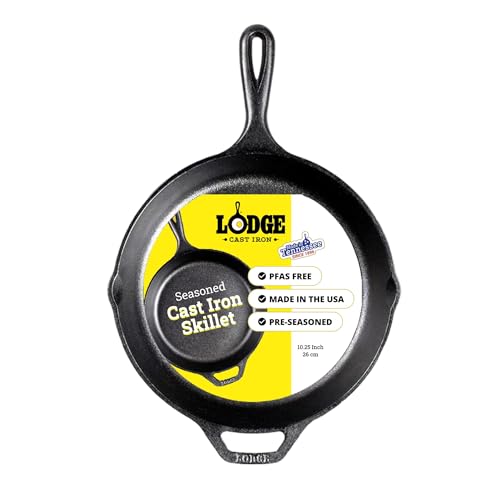
The L8SK3 is the 10.25 inch (Ø 26 cm) size in Lodge’s Classic series, which comes in nine sizes from 3.5 to 15 inches. It is made of cast iron, arrives seasoned at the factory and costs approx. €39.95 on Amazon (as of September 2026). What interests us most is the grill: on a gas grill, Lodge intends the skillet for ingredients that are hard to cook on the grate. In our grill accessories category, it sits alongside its ribbed sister, the L8GP3, and the Dutch ovens from the table further down.
Lodge states that it has been making cookware since 1896 and operates two foundries in South Pittsburg, Tennessee. The company introduced factory seasoning in 2002. The product page says “Made in the USA”.
This page is based on Lodge’s manufacturer pages: the product pages of the Classic Skillets and several sister models, the pages on cleaning, seasoning, troubleshooting, heat sources, warranty, company history and distribution, and a few blog articles, read in October 2026, plus the Amazon catalogue. Everything there is in English; translations and conversions to centimetres and kilograms are ours. We have not held the skillet or cooked anything in it.
Dimensions, handles and surface
For the L8SK3, Lodge gives 16.12 inches in length (approx. 40.9 cm, including handle), 10.68 inches in width (approx. 27.1 cm), 2.0 inches in height (approx. 5.1 cm) and 5.66 pounds in weight (approx. 2.57 kg). The Amazon catalogue lists 10 inches in width and 5.35 pounds (approx. 2.43 kg); we work with the Lodge figures, especially as the 5.1 cm height from the Amazon title matches them. The width is a good centimetre above the nominal diameter of 26 cm. In the product photo, the two pouring spouts protrude beyond the rim, which could explain the difference.
The skillet has a long handle, a helper handle opposite and one pouring spout on the left and one on the right; this is how Lodge describes it in the caption of its product photo. At the end of the handle, the photo shows an opening, presumably for hanging. According to Lodge, the cookware consists only of iron and the seasoning layer, so a handle cover is not part of it. A handle made of the same iron and attached to the body of the skillet conducts its heat onwards; on the grill we would therefore treat it as hot and keep gloves ready. What to look for in heat-resistant grill gloves is covered in our grill accessories essentials. In the photo, the handle and helper handle look like part of the cast body.
Lodge writes that the cooking surface is rough because it is formed in sand casting, and becomes smoother the longer you use and season the skillet. The skillet is also made without PFAS; according to Lodge, independent laboratories confirmed that the cast iron is free of PFAS and of hazardous amounts of lead and cadmium.
In detail: how cast iron handles heat
Cast iron conducts heat less well than aluminium or copper. What speaks for the skillet is its mass: 2.57 kg of iron absorbs a lot of heat and cools down less when cold food goes in. In return, heating up takes longer, and the skillet keeps giving off heat when you have long since turned the burner down. Amazon advertises heat retention and even heat distribution. Lodge writes more cautiously: larger cast iron on a smaller heat source creates hot spots, and uneven heat can warp the skillet or even make it crack.
On a gas grill, according to Lodge the skillet is meant for small or delicate ingredients that are hard to cook directly on the grate: fish, vegetables, pizza and smash burgers. If you want to grill vegetables without a skillet, the guide grilling vegetables shows how to keep them from falling through the grate. Preheat to medium-high heat, 5 to 10 minutes depending on the grill, and a closed lid can speed this up. According to Lodge, the middle and the back of the grill are usually the hottest and the edges weaker; you control this via the grill setting and the distance from the heat source.
On a charcoal grill, the oil needs a high smoke point; vegetable and rapeseed oil are named, otherwise it can burn and change the flavour. Medium-high heat is enough for most dishes; at very high temperatures, food can burn and stick. As a test, Lodge recommends water drops: if they dance on the skillet, the temperature is right; if they evaporate immediately or the oil smokes, it is too hot. No temperature figure can be read from this. To prevent sticking, 4 to 5 minutes of preheating before cooking helps; the most common causes are a skillet that is too hot or too little oil.
Do I need to season the skillet before first use?
No. Lodge seasons every skillet at the factory in South Pittsburg and writes that seasoning at home is not necessary. You can cook straight away.
On Lodge’s seasoning page, the layer consists of 100 % natural soybean oil; the product page and Amazon only mention vegetable oil. It is described there as highly refined and without detectable allergenic proteins. If you are allergic to soy, clarify this with the manufacturer before buying. With every cooking session in oil or fat, another layer is added; cooking itself is the easiest way to maintain it.
Because the skillets are seasoned hanging at the factory, a small spot or blister can appear on the rim or the helper handle. According to Lodge it is not rust, not dangerous, and it disappears with regular use.
What Lodge does not state
We found nothing on these points on the Lodge pages we read or in the Amazon catalogue:
- Capacity in litres and a number of servings
- Inner diameter of the cooking surface, diameter of the base and the point at which nominal diameter and width are measured
- Wall and base thickness of the cast iron
- A maximum temperature specifically for the L8SK3, including for the oven; Lodge only comments on cast iron in general
- A heat-up time to a target temperature
- Handle temperature and grip protection
- Measured values for heat distribution on the cooking surface
- An EU mark for food contact such as LFGB (the German food and feed code); Lodge only refers to laboratory checks
- Accessories in the box; Amazon lists one unit
- The year since which the L8SK3 has existed
- A German manual and a data sheet
What else is worth considering?
| Model | The difference | Price | Our rating | Choose this one if |
|---|---|---|---|---|
| Lodge L8SK3 skillet Ø 26 cm (this skillet) | flat cooking surface, open skillet with long handle, approx. 2.57 kg | approx. €39.95 | 8.8 | you want to prepare eggs or sauce dishes on a flat surface |
| Lodge L8GP3 grill pan | raised grill ridges, 6.13 pounds (approx. 2.78 kg) | approx. €49 | 8.7 | sear marks on meat, vegetables or halloumi matter more to you than a flat surface |
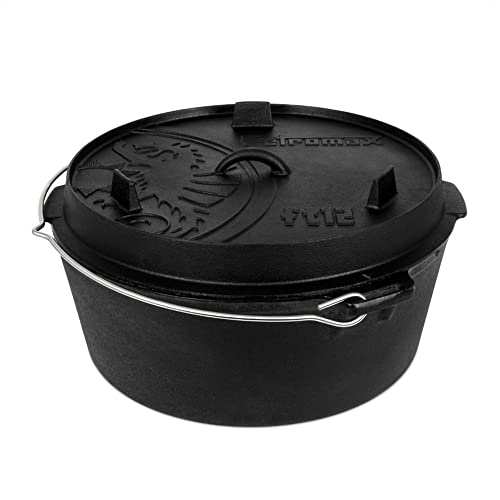
| BBQ-Toro Dutch Oven DO45P | closed pot with lid, 4.2 l total, approx. 5.8 kg | approx. €44.95 | 8.4 | you want to braise over charcoal or cook in a closed pot |
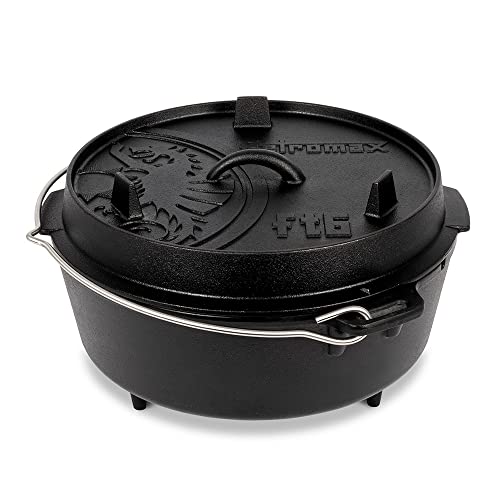
| Petromax fire pot ft6 | closed pot, 5.5 l in the pot, 9 kg, three feet | approx. €75 | 9.0 | you regularly braise or bake for several people and accept the weight |
The prices are guide values from our individual reviews. They are not reconciled to the same date for every row and are not current prices; the page for the L8GP3 gives a lower price in its short verdict than the €49 here. The rating is our editorial assessment, not a measurement result.
When this skillet, when another?
First, the cooking surface. According to Lodge, the L8GP3 has raised grill ridges with the same outer dimensions as the L8SK3 and weighs approx. 0.21 kg more; in our table it appears with the higher guide price. Ridges touch the food only with their crests, which we infer from the shape. We would pick the L8GP3 if sear marks on halloumi, vegetables or meat matter to you, and the L8SK3 for eggs and sauce dishes.
The second question is height. In the same size, Lodge offers the Deep Skillet L8DSK3 with a height of 3.06 inches (approx. 7.8 cm) instead of 2.0 inches; it weighs 6.39 pounds (approx. 2.90 kg) and is called “3.2 Quart” in the product name, which is approx. 3.0 l. For the L8SK3, neither Lodge nor Amazon gives a volume, and we do not calculate one from catalogue dimensions, because those are outer dimensions. If you often cook larger quantities of sauce dishes, take a look at the deeper skillet.
On the grill itself, space counts. How much of it is left under the lid depends on your grill; so first compare the distance between grate and lid with the 5.1 cm skillet height and check whether the lid still closes with the skillet and its handle (40.9 cm long).
Our assessment for braises and stews: a pot with a lid is the more suitable design than an open skillet. According to the table, the BBQ-Toro DO45P costs €5 more than the L8SK3, the Petromax ft6 around €35 more. In return, the BBQ-Toro weighs more than twice as much as the skillet and the Petromax three and a half times as much. Petromax gives 4 to 8 people for the ft6, expressly as a “can” figure. How much heat a Dutch oven needs is covered in our Dutch oven guide.
The skillet alone is not the whole sum: add hand protection for the handle, a brush or skillet scraper and cooking oil for re-oiling, and on Lodge’s care pages also the Rust Eraser.
Cleaning, rust and warranty
Lodge explains cleaning in three steps:
- Wash: with warm soapy water and a stiff brush or scouring pad.
- Dry: completely, with a paper towel or a lint-free cloth.
- Oil: apply a thin layer of oil and spread it over the whole surface with a paper towel.
According to Lodge, dish soap is fine, because today’s dish soap no longer strips the seasoning layer. This contradicts our Dutch oven guide, which washes without dish soap. For the Lodge skillet, what Lodge writes applies. It does not belong in the dishwasher, because that removes the seasoning layer and probably leads to rust. Soaking also promotes rust. Baked-on residue is loosened with a nylon brush or skillet scraper and warm water; for stubborn residue, let water simmer in the skillet for 3 to 5 minutes and scrape it off after it has cooled.
Rust can develop if cast iron sits in water, has been in the dishwasher, air-dries or is stored in a humid environment. If you store your grill accessories in a garden shed or garage, you come close to such an environment; we would oil the skillet thinly there before putting it away and check for rust after the winter.
Against rust, Lodge names three steps. First, scrub it off: with the Rust Eraser on a cold, dry skillet and then wash and dry it, or, without the Rust Eraser, with steel wool or a metal sponge in warm soapy water, then rinse and dry completely. Second, apply a very thin, even layer of cooking oil inside and out. With little rust, this may be enough. Third, with larger amounts of rust, re-season: preheat the oven to 450 to 500 °F (approx. 232 to 260 °C), place the skillet upside down on the top rack, bake for an hour and let it cool in the oven. According to Lodge, steel wool is fine only for removing rust, not for daily cleaning.
What the warranty covers
Lodge gives a limited lifetime warranty (“Made Right”), issued by Lodge Manufacturing Co. It applies against defects in material and workmanship at the time of purchase for the first individual purchaser or gift recipient. Whether it also applies to goods bought on Amazon.de is not settled on the pages we read; more on this in the FAQ. The condition is that you follow the use and care instructions that come with the product; we do not have them, and we rely on the manufacturer’s care pages. With normal household use, Lodge replaces cast iron that cracks or warps, and likewise after damage in the shipping carton. Quality defects include excessive grinding or chatter marks, holes in the casting, metallic protrusions and other casting flaws.
Not covered are:
- commercial use, accidents, dropping, incorrect handling, misuse, neglect, overheating and any use contrary to the enclosed instructions
- damage from melted objects or other external influences, as well as residues of abrasives or polishes on the surfaces
- minor cosmetic blemishes that come with sand casting and hand finishing, as long as they do not affect function
- rust, pitting, roughness, sticky seasoning, flaking and odours
Lodge expressly lists three things that void the warranty: cleaning in the dishwasher, soaking in water and use in the microwave.
If you are switching from a non-stick pan, the manufacturer supplies a sales argument: a typical non-stick pan can lose its coating after just three years, whereas Lodge cast iron lasts for generations. Lodge sells skillets, so the claim comes from a source with a vested interest. The warranty promises less than the advertising claim: it replaces cracks, warping and casting flaws, not rust and not flaking seasoning.